


Ten Indonesian migrant fishers working on a Taiwanese-flagged distant-water fishing vessel on Wednesday said they were collectively owed wages totaling US$80,850 for periods of employment ranging from 11 to 15 months.
The 10 Indonesians were crew members of the fishing vessel You Fu, which is based at a port in Pingtung County’s Liouciou Township (琉球).
Feri Rahardjo, one of the fishers, said at a news conference that he had not been paid for 15 months.
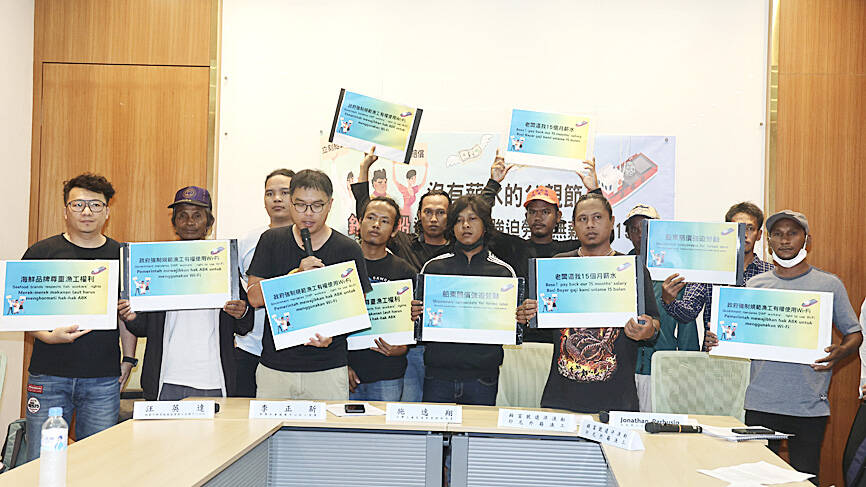
Photo: CNA
Due to the delayed paychecks, Rahardjo said his aunt died, because his family could not afford the medical treatment she required, adding that his house is also on the verge of being seized by the bank.
Another crew member, Masduki Priyono, said they lived in appalling conditions, with their beds infested by bedbugs that left their whole bodies itchy.
Food deliveries were late on two occasions during the past 15 months, Priyono said, adding that while waiting, they could only eat fish bait and instant noodles.
In addition, the shipowner often subjected them to verbal abuse and threatened them, he said.
The fishers said there was no Wi-Fi on the vessel, and Priyono only found out they had not been paid and that his wife and two children had not received any remittances upon their return to shore on July 15.
Just paying the owed wages would not be sufficient, Priyono said, expressing hope that the shipowner would receive adequate punishment.
“If they are punished for catching fish they are not supposed to catch, why are they not punished for subjecting migrant fishers to illegal treatment?” he asked.
In the past, incidents involving delayed salary payments to migrant fishers were handled according to the Act Governing Distant Water Fisheries (遠洋漁業條例), which decides the punishments for contraventions of contractual terms, such as suspension of fishing permits, Rerum Novarum Center migrant worker rights advocate Lee Cheng-hsin (李正新) said.
However, shipowners who owe crew members salaries are also liable under the Civil Code and should pay interest on top of the owed pay, because their families were forced to borrow money to survive, Lee said.
Rules should be introduced to enable judges to order offenders to pay crew members damages in addition to late salary payments, Lee added.
In response, Fisheries Agency’s Fisheries Manpower Division head Hsueh Po-yuan (薛博元) said the agency had ordered the shipowner to clear up all the pay owed to the fishers by today.
If the shipowner fails to meet the deadline, the agency would pay the fishers using the collateral from their manpower broker, Hsueh said.
Contacted for a comment, the shipowner, surnamed Huang (皇), on Tuesday said she had encountered financial difficulty, which resulted in the delayed pay.
Huang said she had come up with the money and that the fishers received their payments yesterday.
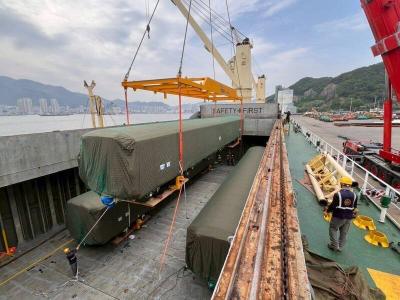
The first of 10 new high-capacity trains purchased from South Korea’s Hyundai Rotem arrived at the Port of Taipei yesterday to meet the demands of an expanding metro network, Taipei Rapid Transit Corp (TRTC) said yesterday. The train completed a three-day, 1,200km voyage from the Port of Masan in South Korea, the company said. Costing NT$590 million (US$18.79 million) each, the new six-carriage trains feature a redesigned interior based on "human-centric" transportation concepts, TRTC said. The design utilizes continuous longitudinal seating to widen the aisles and optimize passenger flow, while also upgrading passenger information displays and driving control systems for a more comfortable
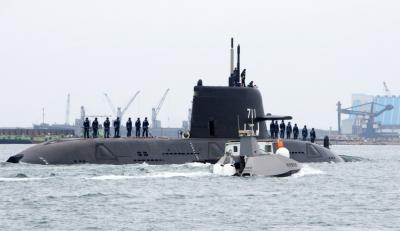
Taiwan's first indigenous defense submarine, the SS-711 Hai Kun (海鯤, or Narwhal), departed for its 13th sea trial at 7am today, marking its seventh submerged test, with delivery to the navy scheduled for July. The outing also marked its first sea deployment since President William Lai (賴清德) boarded the submarine for an inspection on March 19, drawing a crowd of military enthusiasts who gathered to show support. The submarine this morning departed port accompanied by CSBC Corp’s Endeavor Manta (奮進魔鬼魚號) uncrewed surface vessel and a navy M109 assault boat. Amid public interest in key milestones such as torpedo-launching operations and overnight submerged trials,
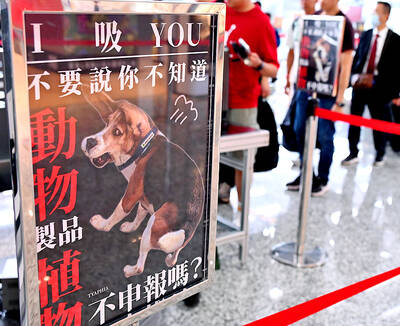
Quarantine awareness posters at Taiwan Taoyuan International Airport have gone viral for their use of wordplay. Issued by the airport branch of the Animal and Plant Health Inspection Agency, the posters feature sniffer dogs making a range of facial expressions, paired with advisory messages built around homophones. “We update the messages for holidays and campaign needs, periodically refreshing materials to attract people’s attention,” quarantine officials said. “The aim is to use the dogs’ appeal to draw focus to quarantine regulations.” A Japanese traveler visiting Taiwan has posted a photo on X of a poster showing a quarantine dog with a

Taiwan’s coffee community has launched a “one-person-one-e-mail” campaign, calling for people to send a protest-e-mail to the World Coffee Championships (WCC) urging it to redesignate Taiwanese competitors as from “Taiwan,” rather than “Chinese Taipei.” The call followed sudden action last week after the WCC changed all references to Taiwanese competitors from “Taiwan” to “Chinese Taipei,” including recent World Latte Art champion Bala (林紹興), who won the World Latte Art Championship in San Diego earlier this month. When Bala received the trophy, he was referred to as representing Taiwan, as well as in the announcement on the WCC’s Web site, until it


 RSS
RSS