

China’s expansion of laws targeting Taiwan is meant to provide justification of the use of force against the country, Mainland Affairs Council (MAC) Minister Chiu Chui-cheng (邱垂正) said on Tuesday.
Since the People’s Republic of China’s (PRC) “Anti-Secession” Law took effect in 2005, Beijing has launched a series of “legal wars” against Taiwan, including the June 21 announcement of a set of legal guidelines targeting advocates of Taiwanese independence, Chiu said.
“These activities have violated international laws and the cross-strait reality,” he said, adding that Chinese laws have no jurisdiction over Taiwanese.

Photo: Tien Yu-hua, Taipei Times
Beijing’s threats against so-called Taiwanese independence activists would not be supported by the international community and would not improve cross-strait relations, the minister added.
Chiu made the remarks during his address at a Taipei seminar on the “Anti-Secession” Law, which turns 20 next year.
China introduced the law during the administration of then-president Chen Shui-bian (陳水扁), after Chen undertook actions that Beijing viewed as provocative, such as declaring that there was one country on each side of the Taiwan Strait.
The “Anti-Secession” Law reiterated the core elements of Beijing’s Taiwan policy and its red lines, including outlining the circumstances under which Beijing would consider employing “non-peaceful means” to annex Taiwan.
The guidelines released in June allow courts in China to try “Taiwanese independence separatists” in absentia.
In addition, they permit the use of the death penalty against “die-hard” advocates of Taiwanese independence convicted of inciting secession who also cause “grave harm” to the state and the Chinese people, the China-run Xinhua news agency reported at the time.
During Tuesday’s seminar, Chen Yu-jie (陳玉潔), an assistant research professor at Academia Sinica’s Institutum Iurisprudentiae, said that China has weaponized international law to push for unification.
However, the “Anti-Secession” Law and the new guidelines serve only as “cognitive warfare,” as they contravene several international laws, said Chen Yu-jie, who specializes in international law and cross-strait relations.
For example, the law’s threat to use “non-peaceful” means to unify Taiwan contravenes Article 2, Paragraph 4 of the UN Charter, which stipulates that “all members shall refrain in their international relations from the threat or use of force against the territorial integrity or political independence of any state,” she said.
The threat to use violence against Taiwan also contravenes international human rights law, she added.
Julian Ku (古舉倫), a law professor at Hofstra University in Hempstead, New York, said that China’s new guidelines targeting Taiwanese independence activists could affect not only Taiwanese, but also “anyone who engages in what they [China] define as [support for] Taiwanese independence.”
People who Beijing deems to have contravened the guidelines could also face extradition to China depending on bilateral treaties, he said.
“I think what would be useful for the Taiwan government and other governments is to make clear that such application of Chinese law to Taiwanese people and other people outside of China is improper and illegal, and that countries will not abide by a request, as such request is illegal or inconsistent with the treaty,” he said.
The seminar, “The PRC’s Anti-Secession Lawfare and Its Implications,” was organized by the Washington-based Center for Strategic and International Studies and the Taipei-based Prospect Foundation.

The donation of offshore patrol vessel Kinmen to the Philippines includes provisions that protect Taiwanese fishers and facilitate security cooperation across the First Island Chain, officials said yesterday. The comment was made during the Cabinet’s comprehensive administrative report at the legislature after Chinese Nationalist Party (KMT) Legislator Hsu Yu-chen (許宇甄) expressed concerns about the decision to give a ship to a country whose coast guard had in 2013 fired on a Taiwanese trawler and killed its captain without provocation. The Cabinet should lay out the safeguards that have been established to prevent the Philippine government from using the Kinmen to harass, expel
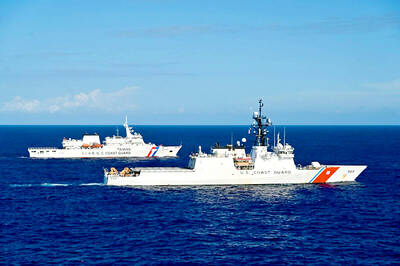
GROWING TIES: The CGA is planning a goodwill mission to the Philippines, in what would be the first time since 1975 a Taiwanese paramilitary vessel has visited the country The Coast Guard Administration (CGA) plans to significantly expand its participation in international security cooperative frameworks and its operational capabilities, a budget proposal for next year showed. The budget indicates a transformation of the CGA from a maritime law enforcement arm into a national defense and intelligence gathering entity capable of tackling larger regional security matters. The proposal showed that personnel from the coast guard’s Intelligence Division and Special Action Support Center are to participate in high-level national security talks with the US. As the CGA has dealt with China’s rising “gray zone” threats around Taiwan, it has become a valuable asset to
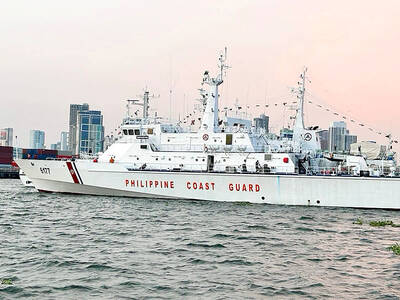
A patrol vessel donated by the Coast Guard Administration (CGA) to the Philippines was commissioned into the Philippine Coast Guard (PCG) on Friday, a Philippine non-governmental organization said. The CGA on Sept. 16 confirmed media reports that Taiwan had donated a retired 500-tonne patrol vessel to the Philippines. The Manila-based We Protect Our Seas (WPS) foundation, which served as an intermediary in the transfer, said that the vessel was formerly the CGA’s 500-tonne petrol vessel Kinmen (CG123). The WPS, in a statement issued on Friday, said the vessel, renamed as the BRP Sarangani, had been commissioned into the PCG the
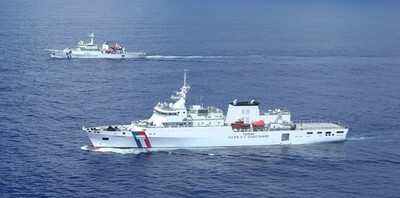
The Coast Guard Administration (CGA) today said that two of its patrol vessels have docked at Palau's Malakal Harbor as part of an expedition exercise and diplomatic visit, during which a senior official is expected to meet with the Palauan president. The two vessels, the 4,000-tonne-class Chiayi (嘉義) and the 1,000-tonne-class Penghu (澎湖), set sail for Palau from Taiwan last week and arrived at Malakal Harbor yesterday, the CGA's Fleet Branch said in a statement. The journey marked the second time the CGA has dispatched a "Friendship Fleet" to another country, after it sent its first-ever goodwill fleet, comprising the Hualien (花蓮)


 RSS
RSS