


Constitutional Court justices on Tuesday asked the legislature’s representatives to consider removing a clause in a bill passed earlier this year requiring the president to give a “state of the nation” address to the Legislative Yuan, especially as there was no penalty for noncompliance.
Justice Jan Sheng-lin (詹森林) asked whether it was possible for the opposition in the legislature to achieve “reconciliation” with the ruling party over the “state of the nation” requirement without involving the court.
The legislature’s representatives, who were all from the opposition Chinese Nationalist Party (KMT) and Taiwan People’s Party (TPP), responded that the legislation was meant to normalize the process of the president delivering a state of the nation address at the legislature and answering questions from lawmakers.
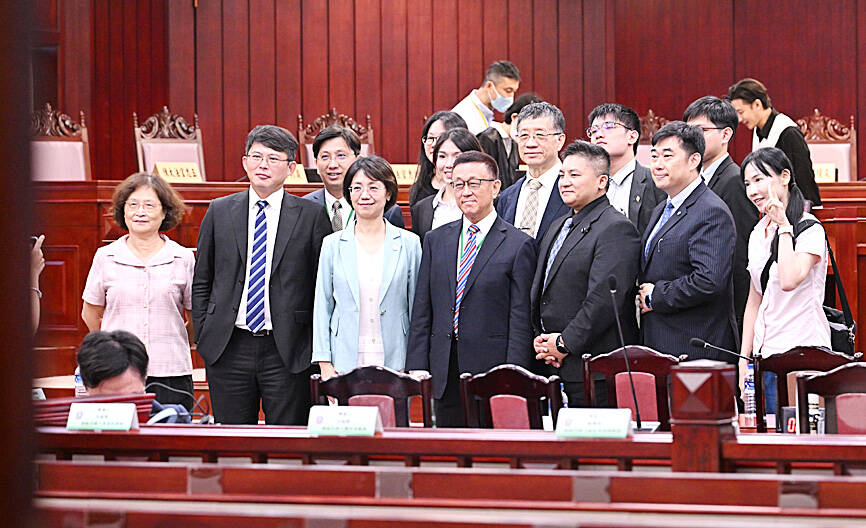
Photo: Liu Hsin-de, Taipei Times
The Presidential Office and the Democratic Progressive Party (DPP) caucus have said the amendment made the president’s presence at the legislature compulsory, which is unconstitutional because the president is not accountable to legislators.
Before being amended, the Act Governing the Legislative Yuan’s Power (立法院職權行使法) stated that the legislature “could” listen to an address from the president.
The DPP said that under the revisions, the president’s presence would be compulsory.
TPP caucus whip Huang Kuo-chang (黃國昌) previously told the court that there is nothing the legislature could do if the president chose not to deliver an address, which means the legislation is just advisory, Jan said.
“The two sides should be able to resolve this without involving the court,” he said.
Justice Tsai Tsai-chen (蔡彩貞) also questioned the point of the amendments if there was no penalty for noncompliance.
Although Huang said there was no penalty if the president refuses to comply, there could be political consequences as it might reflect poorly on the president to the public.
The legislation is an “internal regulation” for the legislature, “so we have regulations regarding inviting the president to attend in the future,” KMT Legislator Weng Hsiao-ling (翁曉玲) said.
“We wish to set up a mechanism to normalize” the president addressing the legislature, she said.
However, Yeh Ching-yuan (葉慶元), the lawyer for the legislature’s representatives, said that the president was “obligated” to deliver the address.
The legislature’s right to hear a state of the nation address from the president is stated in Article 4-3 of the Additional Articles of the Constitution, Yeh said.
While the country has a semi-parliamentary system, “the president [rather than the premier] has now become the de facto executive head of the government,” he said.
President William Lai (賴清德) recently set up three committees related to major national policies that report to the Presidential Office — the National Climate Change Response Committee, the Whole-of-Society Defense Resilience Committee and the Healthy Taiwan Promotion Committee, he said.
That move aims to influence the direction of the Executive Yuan, “so why should [the legislature] not be allowed to ask him to explain his decisions?” Yeh said.
The address requirement is one of the controversial amendments to expand the legislature’s powers of investigation that are being debated in the Constitutional Court.
The amendments to the Act Governing the Legislative Yuan’s Power and the Criminal Code were pushed through by the KMT and TPP at the end of May.
The oral arguments, which lasted until 5pm on Tuesday and was presided over by 15 justices, involved expert witnesses, some of whom said the legislative process in passing the amendments was so flawed that they should be declared void.
Under the Constitutional Court Procedure Act (憲法訴訟法), the approval of at least eight justices is required for any of the amendments to be annulled.
The court should render a ruling within three months after the conclusion of oral arguments, but the deadline can be pushed back

Taiwan has received more than US$70 million in royalties as of the end of last year from developing the F-16V jet as countries worldwide purchase or upgrade to this popular model, government and military officials said on Saturday. Taiwan funded the development of the F-16V jet and ended up the sole investor as other countries withdrew from the program. Now the F-16V is increasingly popular and countries must pay Taiwan a percentage in royalties when they purchase new F-16V aircraft or upgrade older F-16 models. The next five years are expected to be the peak for these royalties, with Taiwan potentially earning
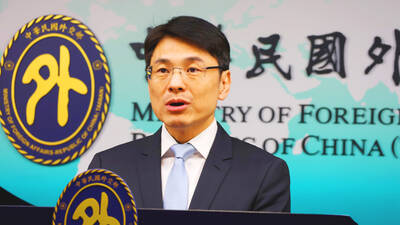
STAY IN YOUR LANE: As the US and Israel attack Iran, the ministry has warned China not to overstep by including Taiwanese citizens in its evacuation orders The Ministry of Foreign Affairs (MOFA) yesterday rebuked a statement by China’s embassy in Israel that it would evacuate Taiwanese holders of Chinese travel documents from Israel amid the latter’s escalating conflict with Iran. Tensions have risen across the Middle East in the wake of US and Israeli airstrikes on Iran beginning Saturday. China subsequently issued an evacuation notice for its citizens. In a news release, the Chinese embassy in Israel said holders of “Taiwan compatriot permits (台胞證)” issued to Taiwanese nationals by Chinese authorities for travel to China — could register for evacuation to Egypt. In Taipei, the ministry yesterday said Taiwan
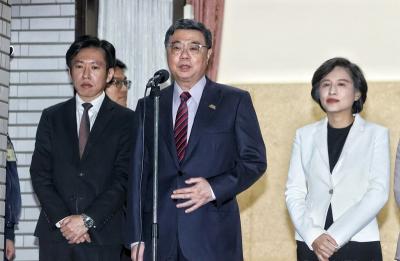
Taiwan is awaiting official notification from the US regarding the status of the Agreement on Reciprocal Trade (ART) after the US Supreme Court ruled US President Donald Trump's global tariffs unconstitutional. Speaking to reporters before a legislative hearing today, Premier Cho Jung-tai (卓榮泰) said that Taiwan's negotiation team remains focused on ensuring that the bilateral trade deal remains intact despite the legal challenge to Trump's tariff policy. "The US has pledged to notify its trade partners once the subsequent administrative and legal processes are finalized, and that certainly includes Taiwan," Cho said when asked about opposition parties’ doubts that the ART was
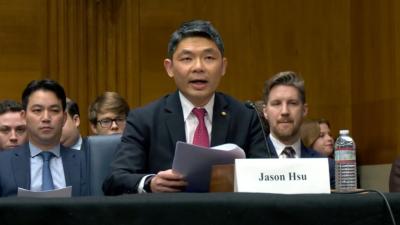
If China chose to invade Taiwan tomorrow, it would only have to sever three undersea fiber-optic cable clusters to cause a data blackout, Jason Hsu (許毓仁), a senior fellow at the Hudson Institute and former Chinese Nationalist Party (KMT) legislator, told a US security panel yesterday. In a Taiwan contingency, cable disruption would be one of the earliest preinvasion actions and the signal that escalation had begun, he said, adding that Taiwan’s current cable repair capabilities are insufficient. The US-China Economic and Security Review Commission (USCC) yesterday held a hearing on US-China Competition Under the Sea, with Hsu speaking on


 RSS
RSS