


Students from 10 European countries who had concluded an integrated circuit (IC) design summer training program in Taiwan said that it left them impressed and looking to the future.
The program, organized by the Taiwan Semiconductor Research Institute (TSRI), selected European students with IC design knowledge to come to Taiwan for a month of training in four areas — analog circuit design, microelectromechanical chip design, silicon photonic chip design and digital circuit design.
“It [Taiwan] is the biggest and most advanced semiconductor industry in the world, and I think it is better to ... study in Taiwan than in the US,” Czech student Josef Nagy said during the program’s closing ceremony on Friday last week.

Photo: CNA
The biggest draws were Taiwan’s advanced technology and its focus on research and development, he said.
“We learned how to calculate, measure and simulate the parameters of the components, and how to design the circuit. I think it confirmed my belief that it is what I want to do for living, like analog IC design,” Nagy said.
Another participant, Emanuele Platania from Italy, said his curiosity about how Taiwan was able to develop a strong semiconductor industry and interest in companies such as Taiwan Semiconductor Manufacturing Co that led him to apply for the summer training program.
After completing the program, Platania said he wrote to professors at National Taiwan University, expressing his desire to pursue a doctorate in IC design in Taiwan.
Romanian student Alexandru Kiraly praised the program and said it would help him in his field of research.
“I actually do not have a background in electronics. I study computer science, and I was really surprised by how well the course was organized,” he said.
“I learned so much from this that I can transplant it back into my field of research,” Kiraly said about cybersecurity and artificial intelligence.
After the training program, some participants are to intern in semiconductor centers or companies such as Synopsys International Ltd and Chroma ATE Inc in Taiwan, the TSRI said.
At the program’s closing ceremony, students received certificates as proof of their training.
The program included lectures, practical projects and corporate internship opportunities for students, TSRI director-general Hou Tuo-hung (侯拓宏) said at the event.
It invited 79 students from 10 European countries to learn about Taiwan’s most advanced semiconductor technology, deepening bilateral partnerships between the countries, with the support of the National Science and Technology Council’s Chip-based Industrial Innovation Program and the Ministry of Foreign Affairs’ Taiwan-Europe program, Hou said.
Countries such as the Czech Republic, Italy, Ukraine, Slovakia, Belarus, Bulgaria and Spain participated in the program.
The Czech Representative to Taiwan David Steinke was also in attendance.
Taiwan has achieved an incredible global position after 40 years of hard work, Steinke said.
“I’m very, very happy to be here today to see that Taiwan is willing to share some of its knowledge and some of its expertise with its foreign partners,” he said.
Italian Economic, Trade and Cultural Promotion Office representative Marco Lombardi also attended the ceremony.
“Italy is paying a lot of attention [to semiconductors] and is very happy that there are a number of my fellow nationals here representing Italy and improving their knowledge,” Lombardi said.
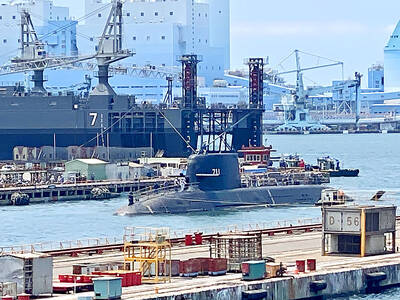
AGING: While Japan has 22 submarines, Taiwan only operates four, two of which were commissioned by the US in 1945 and 1946, and transferred to Taiwan in 1973 Taiwan would need at least 12 submarines to reach modern fleet capabilities, CSBC Corp, Taiwan chairman Chen Cheng-hung (陳政宏) said in an interview broadcast on Friday, citing a US assessment. CSBC is testing the nation’s first indigenous defense submarine, the Hai Kun (海鯤, Narwhal), which is scheduled to be delivered to the navy next month or in July. The Hai Kun has completed torpedo-firing tests and is scheduled to undergo overnight sea trials, Chen said on an SET TV military affairs program. Taiwan would require at least 12 submarines to establish a modern submarine force after assessing the nation’s operational environment and defense

Yangmingshan National Park authorities yesterday urged visitors to respect public spaces and obey the law after a couple was caught on a camera livestream having sex at the park’s Qingtiangang (擎天崗) earlier in the day. The Shilin Police Precinct in Taipei said it has identified a suspect and his vehicle registration number, and would summon him for questioning. The case would be handled in accordance with public indecency charges, it added. The couple entered the park at about 11pm on Thursday and began fooling around by 1am yesterday, the police said, adding that the two were unaware of the park’s all-day live
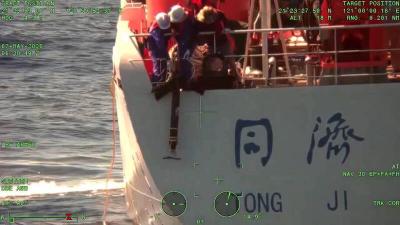
The coast guard today said that it had disrupted "illegal" operations by a Chinese research ship in waters close to the nation and driven it away, part of what Taipei sees a provocative pattern of China's stepped up maritime activities. The coast guard said that it on Thursday last week detected the Chinese ship Tongji (同濟號), which was commissioned only last year, 29 nautical miles (54km) southeast of the southern tip of Taiwan, although just outside restricted waters. The ship was observed lowering ropes into the water, suspected to be the deployment of scientific instruments for "illegal" survey operations, and the coast

A former soldier and an active-duty army officer were yesterday indicted for allegedly selling classified military training materials to a Chinese intelligence operative for a total of NT$79,440. The Taipei District Prosecutors’ Office indicted Chen Tai-yin (陳泰尹) and Lee Chun-ta (李俊達) for contravening the National Security Act (國家安全法) and the Anti-Corruption Act (貪污治罪條例). Chen left the military in September 2013 after serving alongside then-staff sergeant Lee, now an army lieutenant, at the 21st Artillery Command of the army’s Sixth Corps from 2011 to 2013, according to the indictment. Chen met a Chinese intelligence operative identified as “Wang” (王) through a friend in November


 RSS
RSS