


Suicides last year were the leading cause of death in the Taiwanese armed forces for the second consecutive year, showing inadequate mental health care standards in the military, the National Audit Office said.
The military over the past five years reported 158 suicides, including 97 deaths and 61 attempted suicides, the office said in the annual report for last year.
Suicide has been the top cause of death in the armed forces since 2022, overtaking traffic accidents, it said.
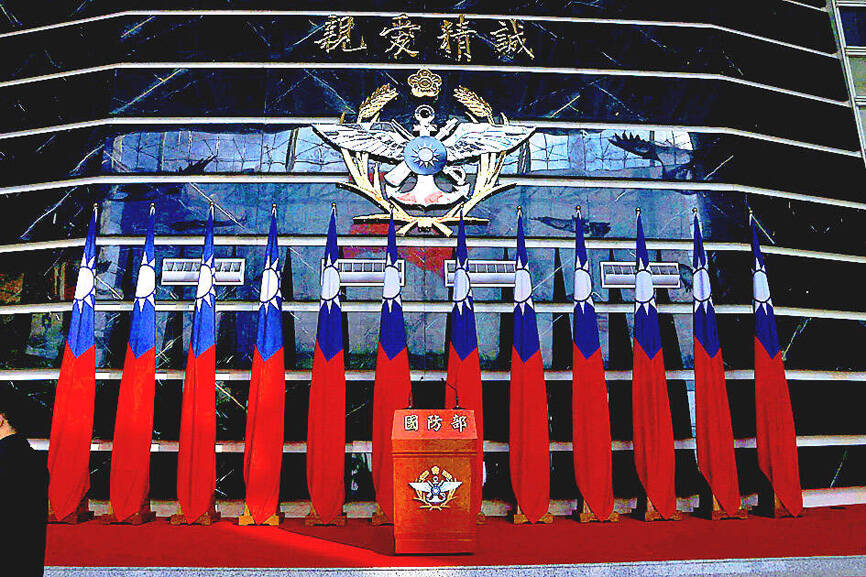
Photo: Ann Wang, Reuters
The number of suicides has also increased significantly, with the military reporting 17 incidents from January to April, five more than in the same period last year, the office said.
Economic hardship is believed to have been the cause of 40 of the suicides in the past five years, making it the leading cause of self-harm in the armed forces, it said.
For female military personnel, most of the suicides were due to mental illnesses and difficulties in adapting to life in the armed forces, it added.
The military’s three-tiered mental health program failed to spot 130 of those who were at risk of self-harm, a figure that is equivalent to an 82 percent failure rate, the office said.
Military mental health counselors on the program’s lower tiers flagged about 18 percent of the cases as potential suicide risks, but concluded that nothing was amiss, the office added.
Of the military mental health counselors, only 62 percent held a certificate or degree in a mental health field, it said, adding that the program was understaffed, with large swathes of the military not having the right counselor-soldier ratio of 1 to 500.
For example, only one counselor was available for every 810 service members assigned to the Ministry of National Defense, the office said.
Since service members could not be referred to civilian care without approval from the three tiers of the military mental health system, the latter were sometimes more of a hindrance, rather than a help, it said.
The office urged the military to increase the number of mental health professionals in its program and reduce the red tape blocking access to civilian medical resources.
In response to the office’s findings, the ministry said it would organize a group to assess the effectiveness of the military mental health program.
The group would include civilian mental health experts and Ministry of Health and Welfare officials, the office said.

Considering that most countries issue more than five denominations of banknotes, the central bank has decided to redesign all five denominations, the bank said as it prepares for the first major overhaul of the banknotes in more than 24 years. Central bank Governor Yang Chin-lung (楊金龍) is expected to report to the Legislative Yuan today on the bank’s operations and the redesign’s progress. The bank in a report sent to the legislature ahead of today’s meeting said it had commissioned a survey on the public’s preferences. Survey results showed that NT$100 and NT$1,000 banknotes are the most commonly used, while NT$200 and NT$2,000

The Centers for Disease Control (CDC) yesterday reported the first case of a new COVID-19 subvariant — BA.3.2 — in a 10-year-old Singaporean girl who had a fever upon arrival in Taiwan and tested positive for the disease. The girl left Taiwan on March 20 and the case did not have a direct impact on the local community, it said. The WHO added the BA.3.2 strain to its list of Variants Under Monitoring in December last year, but this was the first imported case of the COVID-19 variant in Taiwan, CDC Deputy Director-General Lin Ming-cheng (林明誠) said. The girl arrived in Taiwan on

South Korea is planning to revise its controversial electronic arrival card, a step Taiwanese officials said prompted them to hold off on planned retaliatory measures, a South Korean media report said yesterday. A Yonhap News Agency report said that the South Korean Ministry of Foreign Affairs is planning to remove the “previous departure place” and “next destination” fields from its e-arrival card system. The plan, reached after interagency consultations, is under review and aims to simplify entry procedures and align the electronic form with the paper version, a South Korean ministry official said. The fields — which appeared only on the electronic form

The Ministry of Foreign Affairs (MOFA) is suspending retaliation measures against South Korea that were set to take effect tomorrow, after Seoul said it is updating its e-arrival system, MOFA said today. The measures were to be a new round of retaliation after Taiwan on March 1 changed South Korea's designation on government-issued alien resident certificates held by South Korean nationals to "South Korea” from the "Republic of Korea," the country’s official name. The move came after months of protests to Seoul over its listing of Taiwan as "China (Taiwan)" in dropdown menus on its new online immigration entry system. MOFA last week


 RSS
RSS