


Taiwan should amend the law to ensure Indonesian live-in care workers’ right to have days off work is protected, Indonesia’s representative to Taiwan said.
Indonesia hopes Taiwan would soon finalize a draft domestic workers protection act stipulating that live-in workers “shall have at least one day off every seven days,” Iqbal Shoffan Shofwan, head of the Indonesian Economic and Trade Office to Taipei told the Central News Agency.
The bill also includes provisions on the termination of work contracts, rest time, leave, special leave, insurance and filing complaints, Shofwan said.
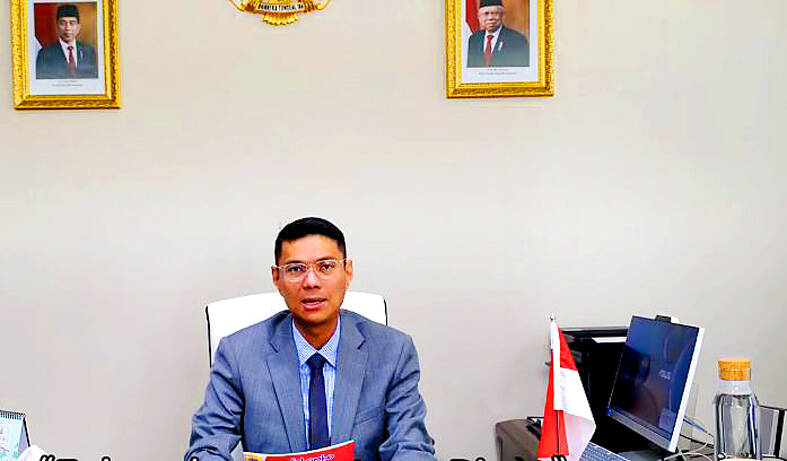
Photo: screen grab from National Museum of Taiwan Literature’s Facebook page
The council of labor affairs, which is now the Ministry of Labor, first drafted the bill in 2011. In 2013 it was sent for review to the Cabinet, which in 2016 returned it to the ministry.
The ministry has cited difficulties in implementing the bill, including that as live-in care workers mainly work in homes, their work hours and rest time are difficult to define.
It has no plans to draft a bill to introduce new leave regulations for live-in care workers, it said.
Domestic caregivers in Taiwan are subject to a different labor law than workers in other sectors and are therefore not eligible for the “one fixed day off, one flexible rest day” rule requiring employers to give workers at least one day off every seven days.
As such, many migrant care workers in Taiwan only get one day off each month, and some do not get days off at all.
There are more than 280,000 Indonesian migrant workers in Taiwan, of whom about 180,000 are live-in care workers, ministry data showed.
Labor rights groups have proposed domestic caregiver protection rules, which have remained a focus of campaigns to improve labor standards for migrant care workers.
While some Indonesian live-in care workers want one day off per week, others would rather not follow the “one day off per seven days” rule because of the overtime they can earn, Shofwan said.
Taiwan last year implemented an expanded respite service that allows live-in care workers to take up to 52 days off a year, but that program is at the employer’s expense, the ministry said.
Regarding the minimum monthly wage for migrant care workers, Shofwan said that the Indonesian government realizes there is a “significant gap” in welfare between care workers and industrial workers, despite the two groups both having heavy workloads.
The minimum monthly wage for domestic care workers is NT$20,000, much lower than the basic wage of NT$27,470 stipulated by the Labor Standards Act (勞動基準法).
Taiwan’s classification of intermediate-skilled foreign workers in the Long-term Retention of Skilled Foreign Workers Program raises the minimum monthly wage of live-in caregivers to NT$24,000, Shofwan said.
Under the program, employers of migrant workers who have worked in Taiwan for at least six years and meet qualification guidelines can apply for them to be designated as intermediate-skilled foreign workers.

Considering that most countries issue more than five denominations of banknotes, the central bank has decided to redesign all five denominations, the bank said as it prepares for the first major overhaul of the banknotes in more than 24 years. Central bank Governor Yang Chin-lung (楊金龍) is expected to report to the Legislative Yuan today on the bank’s operations and the redesign’s progress. The bank in a report sent to the legislature ahead of today’s meeting said it had commissioned a survey on the public’s preferences. Survey results showed that NT$100 and NT$1,000 banknotes are the most commonly used, while NT$200 and NT$2,000

The Centers for Disease Control (CDC) yesterday reported the first case of a new COVID-19 subvariant — BA.3.2 — in a 10-year-old Singaporean girl who had a fever upon arrival in Taiwan and tested positive for the disease. The girl left Taiwan on March 20 and the case did not have a direct impact on the local community, it said. The WHO added the BA.3.2 strain to its list of Variants Under Monitoring in December last year, but this was the first imported case of the COVID-19 variant in Taiwan, CDC Deputy Director-General Lin Ming-cheng (林明誠) said. The girl arrived in Taiwan on

South Korea is planning to revise its controversial electronic arrival card, a step Taiwanese officials said prompted them to hold off on planned retaliatory measures, a South Korean media report said yesterday. A Yonhap News Agency report said that the South Korean Ministry of Foreign Affairs is planning to remove the “previous departure place” and “next destination” fields from its e-arrival card system. The plan, reached after interagency consultations, is under review and aims to simplify entry procedures and align the electronic form with the paper version, a South Korean ministry official said. The fields — which appeared only on the electronic form

The Ministry of Foreign Affairs (MOFA) is suspending retaliation measures against South Korea that were set to take effect tomorrow, after Seoul said it is updating its e-arrival system, MOFA said today. The measures were to be a new round of retaliation after Taiwan on March 1 changed South Korea's designation on government-issued alien resident certificates held by South Korean nationals to "South Korea” from the "Republic of Korea," the country’s official name. The move came after months of protests to Seoul over its listing of Taiwan as "China (Taiwan)" in dropdown menus on its new online immigration entry system. MOFA last week


 RSS
RSS