


A National Taiwan University Hospital (NTUH) research team has become the first to develop a noninvasive urinary biomarker to monitor those recovering from thyroid cancer and potentially predict the risk of recurrence, the hospital said yesterday.
NTUH Department of Internal Medicine deputy director Wang Chih-yuan (王治元), who led the research team, said thyroid cancer is among the 10 most common cancers in Taiwan and the most common in the endocrine system, with about 5,000 new cases diagnosed each year.
About 80 percent of all thyroid cancer cases are papillary thyroid carcinoma, which tends to grow slowly and has a relatively good prognosis if treated appropriately, while other types of thyroid cancer include follicular carcinoma, medullary carcinoma and anaplastic carcinoma, Wang said.
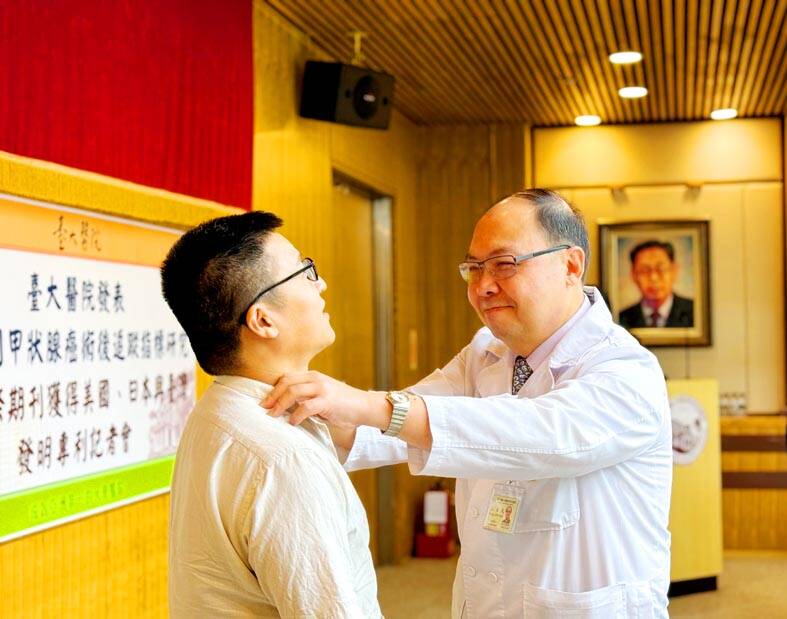
Photo: CNA
As people with papillary thyroid cancer have relatively high survival rates of 20 to 30 years after treatment, developing an effective lifelong follow-up biomarker for early detection of a recurrence is important, he said.
Many people undergo a thyroidectomy to remove a portion or the entire thyroid gland, which is combined with radioactive iodine therapy, but the recurrence rate after surgery is 10 to 28 percent, he said.
In common clinical practice, follow-up treatment involves periodically measuring a person’s thyroglobulin levels in their blood to detect any remaining cancer cells and monitor for recurrence, Wang said.
However, the thyroglobulin antibody can interfere with the blood test result, and a recombinant human thyrotropin stimulation might be needed to increase the test’s sensitivity, but that is costly — about NT$40,000 per test, he said.
In the past several years, Wang’s research team analyzed urinary exosomal proteins, and found that the urinary exosomal thyroglobulin could be used as a biological marker to substitute serum thyroglobulin, as it is more sensitive and accurate, and is not affected by the thyroglobulin antibody.
Exosomes are nanovesicles secreted into extracellular environments, including plasma, saliva, urine and other body fluids, and can carry nucleic acids, proteins and lipids that are unique to the origin cell, the team’s paper said.
Studies have indicated that exosomes hold promise in the diagnosis of thyroid diseases, it said.
The research team collected urine samples from people diagnosed with papillary thyroid carcinoma and follicular carcinoma, from pre-surgery, post-surgery, and at three and six months after their surgery for analysis, Wang said.
They found a significant correlation between urinary exosomal thyroglobulin concentration and tumor size and the anatomic stage of the person’s cancer, he said.
The findings suggest that urinary exosomal thyroglobulin could be useful for predicting the risk of thyroid cancer recurrence, he said.
A urine test is noninvasive and could potentially detect cancer recurrence three to five years earlier than through a thyroglobulin blood test, he added.
“Our study not only provides thyroid cancer patients a more sensitive post-surgery tracking method, it can also hopefully reduce their financial burden and mental stress,” Wang said.
The team’s latest finding was published in May in the International Journal of Nanomedicine.
The biomarker the team developed has received patent approval in Japan, the US and Taiwan, the hospital said.

Taiwan has received more than US$70 million in royalties as of the end of last year from developing the F-16V jet as countries worldwide purchase or upgrade to this popular model, government and military officials said on Saturday. Taiwan funded the development of the F-16V jet and ended up the sole investor as other countries withdrew from the program. Now the F-16V is increasingly popular and countries must pay Taiwan a percentage in royalties when they purchase new F-16V aircraft or upgrade older F-16 models. The next five years are expected to be the peak for these royalties, with Taiwan potentially earning
STAY IN YOUR LANE: As the US and Israel attack Iran, the ministry has warned China not to overstep by including Taiwanese citizens in its evacuation orders The Ministry of Foreign Affairs (MOFA) yesterday rebuked a statement by China’s embassy in Israel that it would evacuate Taiwanese holders of Chinese travel documents from Israel amid the latter’s escalating conflict with Iran. Tensions have risen across the Middle East in the wake of US and Israeli airstrikes on Iran beginning Saturday. China subsequently issued an evacuation notice for its citizens. In a news release, the Chinese embassy in Israel said holders of “Taiwan compatriot permits (台胞證)” issued to Taiwanese nationals by Chinese authorities for travel to China — could register for evacuation to Egypt. In Taipei, the ministry yesterday said Taiwan
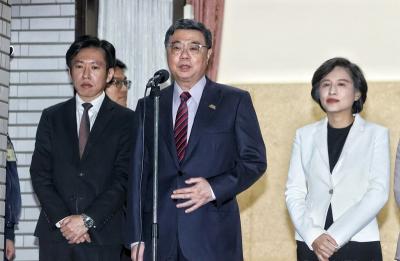
Taiwan is awaiting official notification from the US regarding the status of the Agreement on Reciprocal Trade (ART) after the US Supreme Court ruled US President Donald Trump's global tariffs unconstitutional. Speaking to reporters before a legislative hearing today, Premier Cho Jung-tai (卓榮泰) said that Taiwan's negotiation team remains focused on ensuring that the bilateral trade deal remains intact despite the legal challenge to Trump's tariff policy. "The US has pledged to notify its trade partners once the subsequent administrative and legal processes are finalized, and that certainly includes Taiwan," Cho said when asked about opposition parties’ doubts that the ART was
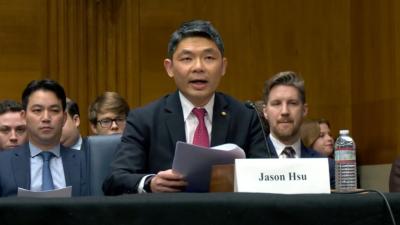
If China chose to invade Taiwan tomorrow, it would only have to sever three undersea fiber-optic cable clusters to cause a data blackout, Jason Hsu (許毓仁), a senior fellow at the Hudson Institute and former Chinese Nationalist Party (KMT) legislator, told a US security panel yesterday. In a Taiwan contingency, cable disruption would be one of the earliest preinvasion actions and the signal that escalation had begun, he said, adding that Taiwan’s current cable repair capabilities are insufficient. The US-China Economic and Security Review Commission (USCC) yesterday held a hearing on US-China Competition Under the Sea, with Hsu speaking on


 RSS
RSS