


The Taipei District Court’s ruling against Hsinchu Mayor Anne Kao (高虹安) was regrettable and highlighted the lack of proportionality in the justice system’s meting out of punishments for similar crimes, the Taiwan People’s Party (TPP) said yesterday.
Kao was found guilty of contravening the Anti-Corruption Act (貪污治罪條例) and sentenced to seven years and four months in prison for corruption that involved misuse of public funds.
She was also deprived of her civil rights for four years and suspended from her post as mayor. Article 78 of the Local Government Act (地方制度法) stipulates that a mayor of a special municipality found guilty of contravening the Anti-Corruption Act is to be suspended from office.
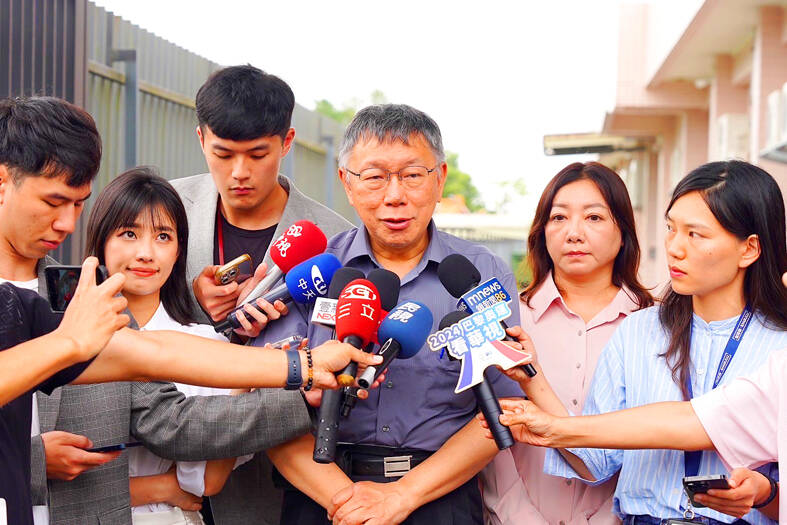
Photo courtesy of the Taiwan People’s Party
Formerly an aide to business tycoon Terry Gou (郭台銘), Kao joined the TPP and served as a legislator at-large from 2020 to 2022 before running for Hsinchu mayor. She withdrew her party membership after the ruling was announced.
The presiding judge had chosen to recognize the validity of claims that Kao’s legislative assistants had inflated their monthly overtime, but did not recognize the validity of Kao’s claims that she had paid out-of-pocket many official business expenses with the sum exceeding the NT$116,514 (US$3,549) the court said she had embezzled, the TPP said in a statement.
Democratic Progressive Party (DPP) New Taipei City Councilor Chou Ya-ling (周雅玲) and her sister Chou Wen-ying (周雯瑛), who were indicted on similar charges involving the payrolls of legislative assistants and accused of embezzling NT$13.88 million, were sentenced to eight months and six months in prison respectively, suspended for three years, the TPP said.
Citing another case, the TPP said that former DPP legislator Chen Lai Su-mei (陳賴素美) was accused of embezzling NT$7.85 million in assistants’ funds, and was sentenced to two years in prison, suspended for five years, on the grounds that “she had used most of the funds in service of the people and the disadvantaged, which is different from other cases wherein embezzlement served to benefit the self.”
Placed side by side, the ruling against Kao shows “the standards that the Taiwanese judiciary has on the principle of proportionality and the severity of sentences are highly disparate,” the TPP said.
The TPP added that Huang Hui-wen (黃惠玟), the former head of administrative affairs of Kao’s legislative office, had testified that she had only followed the same accounting methods that former DPP legislator Lee Chun-yi (李俊俋) used, but the court had made no progress on a separate investigation into the case since August last year.
The judiciary should not have double standards and should investigate the other case to uphold the integrity of the law, the TPP said.
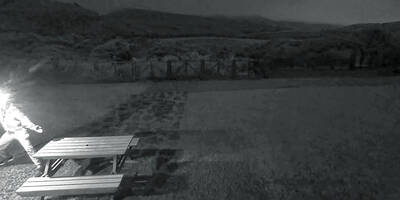
Yangmingshan National Park authorities yesterday urged visitors to respect public spaces and obey the law after a couple was caught on a camera livestream having sex at the park’s Qingtiangang (擎天崗) earlier in the day. The Shilin Police Precinct in Taipei said it has identified a suspect and his vehicle registration number, and would summon him for questioning. The case would be handled in accordance with public indecency charges, it added. The couple entered the park at about 11pm on Thursday and began fooling around by 1am yesterday, the police said, adding that the two were unaware of the park’s all-day live
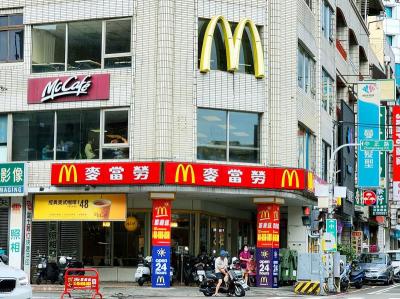
Fast food chain McDonald's is to raise prices by up to NT$5 on some products at its restaurants across Taiwan, starting on Wednesday next week, the company announced today. The prices of all extra value meals and sharing boxes are to increase by NT$5, while breakfast combos and creamy corn soup would go up by NT$3, the company said in a statement. The price of the main items of those meals, if ordered individually, would remain the same. Meanwhile, the price of a medium-sized lemon iced tea and hot cappuccino would rise by NT$3, extra dipping sauces for chicken nuggets would go up
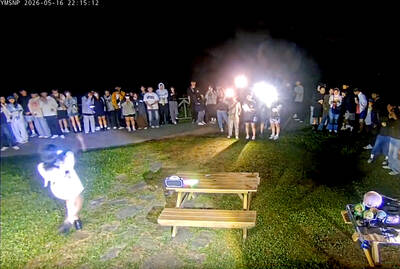
Yangmingshan National Park’s Qingtiangang (擎天崗) nature area has gone viral after a park livestream camera observed a couple in the throes of intimate congress, which was broadcast live on YouTube, drawing large late-night crowds and sparking a backlash over noise, bright lights and disruption to wildlife habitat. The area’s livestream footage appeared to show a couple engaging in sexual activity on a picnic table in the park on Friday last week, with the uncensored footage streamed publicly online. The footage quickly spread across social media, prompting a tide of visitors to travel to the site to “check in” and recreate the

Minister of Digital Affairs Lin Yi-ching (林宜敬) yesterday cited regulatory issues and national security concerns as an expert said that Taiwan is among the few Asian regions without Starlink. Lin made the remarks on Facebook after funP Innovation Group chief executive officer Nathan Chiu (邱繼弘) on Friday said Taiwan and four other countries in Asia — China, North Korea, Afghanistan and Syria — have no access to Starlink. Starlink has become available in 166 countries worldwide, including Ukraine, Malaysia, the Philippines and Vietnam, in the six years since it became commercial, he said. While China and North Korea block Starlink, Syria is not


 RSS
RSS