


The Russia-Ukraine war is a warning to democracies that they should not have unrealistic expectations about authoritarian nations, a visiting German parliament member said in Taipei on Tuesday.
German Bundestag’s Parliamentary Oversight Panel deputy head and member of the Foreign Affairs Committee Roderich Kiesewetter on Tuesday met with Minister of Foreign Affairs Lin Chia-lung (林佳龍), where they discussed issues such as countering the global expansion of authoritarian rule, ties between Taiwan and Europe, and technical collaboration between Germany and Taiwan on semiconductors.
Kiesewetter stressed the importance of building coalitions and cooperation among democratic partners and emphasized mutual trust as being the key to such cooperation.

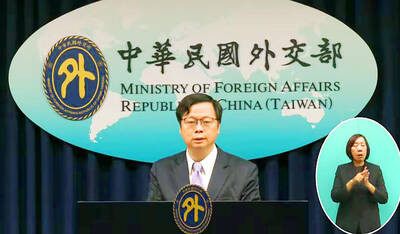
Photo courtesy of the Ministry of Foreign Affairs
Lin expressed his gratitude to Kiesewetter for his support for Taiwan, saying that Germany and other like-minded nations should work together to address the major challenges faced by the world.
While China has engaged in hybrid warfare in the Indo-Pacific region as well as in the rest of the world, the international community must understand that cross-strait peace and stability are the key to regional security and the stability of the global supply chain, he said.
Taiwan and Germany have close academic and business collaborations, and these are set to strengthen as Taiwan Semiconductor Manufacturing Co is to invest in new plants in Dresden, Lin said.
Kiesewetter endorsed the significance of Taiwan’s investment in Germany’s semiconductor industry in facilitating the bilateral exchange of talent and technology, as well as enhancing the global democratic supply chain.
Meanwhile, Vice Minister of Foreign Affairs Remus Chen (陳立國) in a luncheon with Kiesewetter on Monday thanked the German Bundestag for approving a friendly resolution on the cross-strait issue, which called on the German government to highlight the importance of cross-strait peace and stability.
Chen said he expects Kiesewetter to exert his influence and continue to build up the community of Taiwan supporters in Germany and strengthen bilateral ties.
Kiesewetter also appealed to democratic partners to collectively deter China from invading Taiwan by force, saying that bilateral official visits would be welcomed to deepen cooperation between Taiwan and Germany in different fields.
The Ministry of Foreign Affairs on Wednesday in a news release said it expects Taiwan and Germany to deepen their bilateral relationship based on existing collaboration and collectively defend peace in the Indo-Pacific region and around the world.

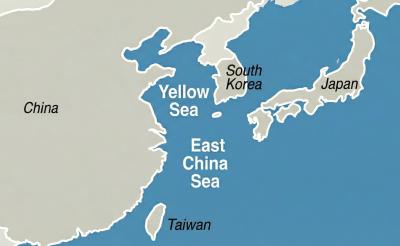
China has reserved offshore airspace in the Yellow Sea and East China Sea from March 27 to May 6, issuing alerts usually used to warn of military exercises, although no such exercises have been announced, the Wall Street Journal (WSJ) reported yesterday. Reserving such a large area for 40 days without explanation is an “unusual step,” as military exercises normally only last a few days, the paper said. These alerts, known as Notice to Air Missions (Notams), “are intended to inform pilots and aviation authorities of temporary airspace hazards or restrictions,” the article said. The airspace reserved in the alert is
NAMING SPAT: The foreign ministry called on Denmark to propose an acceptable solution to the erroneous nationality used for Taiwanese on residence permits Taiwan has revoked some privileges for Danish diplomatic staff over a Danish permit that lists “Taiwan” as “China,” Eric Huang (黃鈞耀), head of the Ministry of Foreign Affairs’ Department of European Affairs, told a news conference in Taipei yesterday. Reporters asked Huang whether the Danish government had responded to the ministry’s request that it correct the nationality on Danish residence permits of Taiwanese, which has been listed as “China” since 2024. Taiwan’s representative office in Denmark continues to communicate with the Danish government, and the ministry has revoked some privileges previously granted to Danish representatives in Taiwan and would continue to review

More than 6,000 Taiwanese students have participated in exchange programs in China over the past two years, despite the Mainland Affairs Council’s (MAC) “orange light” travel advisory, government records showed. The MAC’s publicly available registry showed that Taiwanese college and university students who went on exchange programs across the Strait numbered 3,592 and 2,966 people respectively. The National Immigration Agency data revealed that 2,296 and 2,551 Chinese students visited Taiwan for study in the same two years. A review of the Web sites of publicly-run universities and colleges showed that Taiwanese higher education institutions continued to recruit students for Chinese educational programs without

China has reserved offshore airspace over the Yellow Sea and East China Sea from March 27 to May 6, issuing alerts that are usually used to warn of military exercises, although no such exercises have been announced, the Wall Street Journal (WSJ) reported on Sunday. Reserving such a large area for 40 days without explanation is an “unusual step,” as military exercises normally only last a few days, the paper said. The alerts, known as notice to air missions (NOTAMs), “are intended to inform pilots and aviation authorities of temporary airspace hazards or restrictions,” the article said. The airspace reserved in the alert


 RSS
RSS