


Taiwan has not approved any electronic-cigarette products, the Health Promotion Administration (HPA) said, adding that users of heated tobacco products and vapes are subject to fines.
The agency’s latest warning came after the Chinese Nationalist Party (KMT) caucus early this month published security footage allegedly showing Democratic Progressive Party Legislator Chuang Ruei-hsiung (莊瑞雄) using a heated tobacco product in the legislature’s corridors.
Novel tobacco and nicotine products cannot be used or distributed without government approval, HPA Director-General Wu Chao-chun (吳昭軍) said, citing the latest amendments to the Tobacco Hazards Prevention Act (菸害防制法).
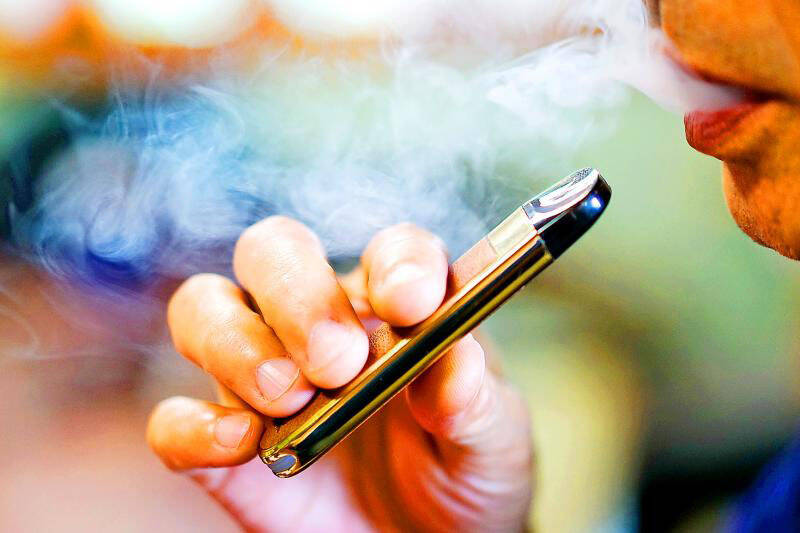
Photo: Lin Ching-lun, Taipei Times
The manufacture, import, sale, supply, display or advertisement of unauthorized novel tobacco products is punishable by a maximum fine of NT$5 million (US$152,263), while users may be fined NT$10,000, the act says.
The agency has received applications for authorization to use heated tobacco products from 12 commercial entities since the amendments went into effect in March last year, Wu said.
It has rejected the applications of eight companies, while two of the remaining four have been asked thrice to furnish additional information to complete the evaluation, he said.
The agency has tasked a panel of toxicology, public health and addiction experts to assess requests for authorized use of specific heated tobacco products, HPA Tobacco Control Division head Lo Su-ying (羅素英) said.
FAIR EVALUATION
The panel has so far convened 30 meetings and all applicants can expect a fair assessment if they provide all the requisite information, she said.
The evaluation process is unavoidably time-consuming as the agency’s main responsibility is to protect the health of children and the public and it has to enforce rigorous standards before accepting manufacturers’ claims, she said.
As a result, some companies were asked to provide additional data, which usually takes one to three months, she said.
Restrictions on the marketing and sales of novel tobacco products, tobacco tax collection and other regulatory matters would be duly considered after the evaluation of all applications is complete, Lo said.
Regional health authorities have been ordered to look into incidents of alleged heated tobacco use by politicians and celebrities as they arise, she said.

FUKUOKA SITUATION: Japanese media reported that the pathogen is expected to be identified by the summer, while the CDC downplayed the idea that it was hMPV A “mysterious cold-like illness” reported in Japan’s Fukuoka Prefecture does not seem to be a new disease, but Japanese authorities have been asked about the situation, the Centers for Disease Control (CDC) said yesterday. The Fukuoka Prefectural Medical Association on Wednesday told a news conference that a “mystery cold” that has become a hot topic on social media is “highly likely to be caused by some kind of viral infection,” Japan’s KBC News reported. “Many people are experiencing symptoms starting with a sore throat, followed by a runny nose, phlegm and a severe cough,” KBC News reported, citing association officials. Health authorities are

Nvidia Corp CEO Jensen Huang (黃仁勳) arrived in Taiwan yesterday ahead of upcoming AI and technology events, saying he plans to meet with clients and Taiwan Semiconductor Manufacturing Co Chairman C.C. Wei (魏哲家) during his visit. After landing at Taipei Songshan Airport, Huang posed for photos with fans and handed out Yakult drinks to reporters and supporters waiting at the scene, saying he has “a lot to do” during the trip. Asked about reports that Nvidia’s planned headquarters site in Taipei’s Beitou Shilin Technology Park could break ground on May 27, Huang said that if the company holds an event, he would

Carrefour Taiwan is to begin using a new name from the start of July, but it cannot divulge the name until then, the chairman of the supermarket chain's parent company said today. President Chain Store Co chairman Lo Chih-hsien (羅智先) was asked by reporters after a shareholders' meeting to confirm whether the company has settled on a new name for the supermarket brand. In March, the government-registered name of two Carrefour Taiwan branches was quietly changed to "Le Chia Kang" (樂家康) in Chinese, raising speculation that has been selected as the name. Lo said that because of local regulations and contractual obligations, the
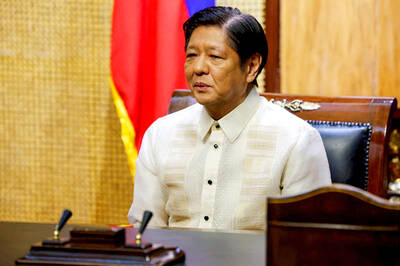
The Philippines would likely be involved in any conflict over Taiwan due to its proximity to the democracy claimed by China, President Ferdinand Marcos Jr said, reiterating a stance that risks angering Beijing. “In the Philippines, we do not have a choice because Taiwan is so close to the Philippines and we have almost 200,000 Filipino nationals living and working in Taiwan,” Marcos said in an interview with Japanese media in Manila on Monday. The Philippine leader’s comments come ahead of a state visit to Japan next week, where he is to meet with Japanese Prime Minister Sanae Takaichi to discuss security


 RSS
RSS