


Many people have begun working at home since the COVID-19 pandemic, but without preventive measures, sitting for long periods can increase the risk of developing hemorrhoids, a colorectal surgeon said.
A man in his early 20s sought medical treatment at Taipei Medical University Hospital after finding blood in the toilet following bowel movements accompanied by pain for three to four months.
Wang Weu (王偉), a colorectal surgeon at the hospital, diagnosed him with hemorrhoids.
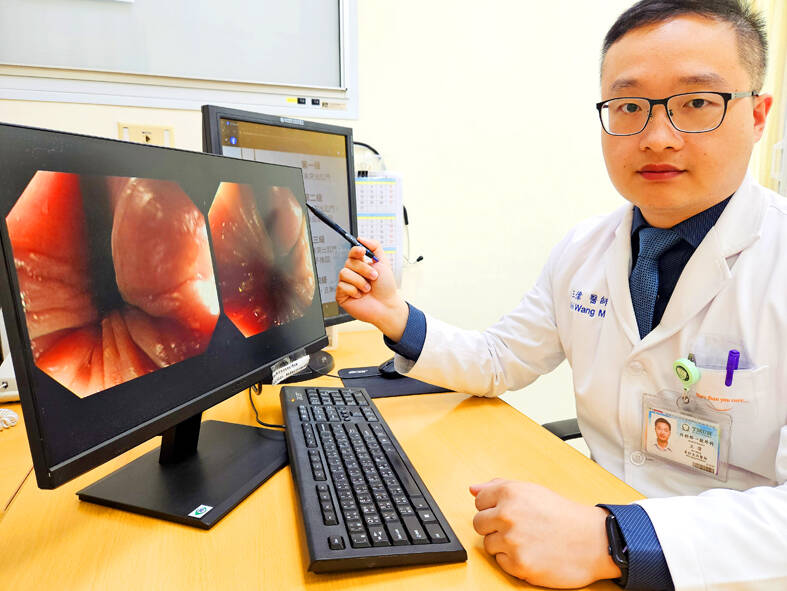
Photo courtesy of Taipei Medical University Hospital
The man, a designer who began working at home since the pandemic, reported sitting at work for more than 10 hours, rarely standing up or leaving his seat, which helped his hemorrhoids to progress rapidly, the hospital said in a news release issued yesterday.
He received a hemorrhoidectomy as treatment, it added.
Hemorrhoids can develop from increased pressure in the lower rectum, causing decreased blood flow and swollen veins in and around the anus and rectum, Wang was quoted as saying in the news release.
“The main causes of hemorrhoids include prolonged sitting or standing, insufficient water intake, insufficient consumption of fruit and vegetables, straining during bowel movements, lack of exercise, being overweight and pregnancy” he said.
SYMPTOMS
Common symptoms include pain or itchiness around the anus, a lump around the anus, and bright red blood in the stool after a bowel movement, he said.
There are four grades of hemorrhoids, Wang said.
The first are internal hemorrhoids that do not extend out of the anus, the second is a hemorrhoid that bulges from the anus during bowel movements, but retracts inside afterward, he said.
The third grade is a hemorrhoid that bulges from the anus during bowel movements and must be pushed back manually, and the fourth is a hemorrhoid that protrudes from the anus all the time, he said.
The designer often sits and work for long hours at a desk at home, only moving to the sofa after work, Wang said, adding that the man used to commute to work, attend meetings and go out for lunch with coworkers, preventing him from sitting for long periods.
To prevent hemorrhoids or alleviate pain from them, avoid sitting or standing in the same position for long periods, as it can easily increase rectal pressure, and try to get up from a seat to move once every hour, Wang said.
WHAT TO DO
“Do not sit on a toilet for too long and avoid using the phone on the toilet. Only go when you really have to,” he said.
“Also, drink at least 1.5 to 2 liters of water every day, and eat enough fruits, vegetables and whole grains that have dietary fiber to help increase intestinal motility and prevent constipation,” he added.
To relieve the acute symptoms of pain, swelling or bleeding from hemorrhoids, sit in a warm bath for 10 minutes several times a day, he said.
However, if the symptoms do not improve and affect a person’s quality of life, they should seek medical attention for a suitable treatment based on their condition, including oral or topical medicine, rubber band ligation, hemorrhoid energy treatment, laser hemorrhoidoplasty or a hemorrhoidectomy, he said.

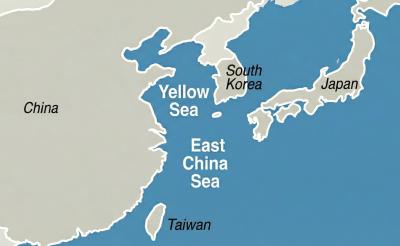
China has reserved offshore airspace in the Yellow Sea and East China Sea from March 27 to May 6, issuing alerts usually used to warn of military exercises, although no such exercises have been announced, the Wall Street Journal (WSJ) reported yesterday. Reserving such a large area for 40 days without explanation is an “unusual step,” as military exercises normally only last a few days, the paper said. These alerts, known as Notice to Air Missions (Notams), “are intended to inform pilots and aviation authorities of temporary airspace hazards or restrictions,” the article said. The airspace reserved in the alert is

NAMING SPAT: The foreign ministry called on Denmark to propose an acceptable solution to the erroneous nationality used for Taiwanese on residence permits Taiwan has revoked some privileges for Danish diplomatic staff over a Danish permit that lists “Taiwan” as “China,” Eric Huang (黃鈞耀), head of the Ministry of Foreign Affairs’ Department of European Affairs, told a news conference in Taipei yesterday. Reporters asked Huang whether the Danish government had responded to the ministry’s request that it correct the nationality on Danish residence permits of Taiwanese, which has been listed as “China” since 2024. Taiwan’s representative office in Denmark continues to communicate with the Danish government, and the ministry has revoked some privileges previously granted to Danish representatives in Taiwan and would continue to review
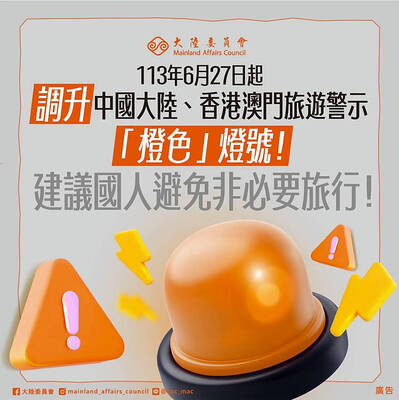
More than 6,000 Taiwanese students have participated in exchange programs in China over the past two years, despite the Mainland Affairs Council’s (MAC) “orange light” travel advisory, government records showed. The MAC’s publicly available registry showed that Taiwanese college and university students who went on exchange programs across the Strait numbered 3,592 and 2,966 people respectively. The National Immigration Agency data revealed that 2,296 and 2,551 Chinese students visited Taiwan for study in the same two years. A review of the Web sites of publicly-run universities and colleges showed that Taiwanese higher education institutions continued to recruit students for Chinese educational programs without

China has reserved offshore airspace over the Yellow Sea and East China Sea from March 27 to May 6, issuing alerts that are usually used to warn of military exercises, although no such exercises have been announced, the Wall Street Journal (WSJ) reported on Sunday. Reserving such a large area for 40 days without explanation is an “unusual step,” as military exercises normally only last a few days, the paper said. The alerts, known as notice to air missions (NOTAMs), “are intended to inform pilots and aviation authorities of temporary airspace hazards or restrictions,” the article said. The airspace reserved in the alert


 RSS
RSS