


President William Lai (賴清德) yesterday made his first inspection of the annual Han Kuang exercises as the nation’s commander-in-chief.
Arriving at Hualien Air Base on a presidential aircraft at about 10:30am, Lai, who was inaugurated in May, changed from a suit into an army uniform before beginning his inspection.
Accompanied by Minister of National Defense Wellington Koo (顧立雄) and senior military officials, Lai stopped at an area of the base where a group of medics were simulating treating patients in a field hospital.
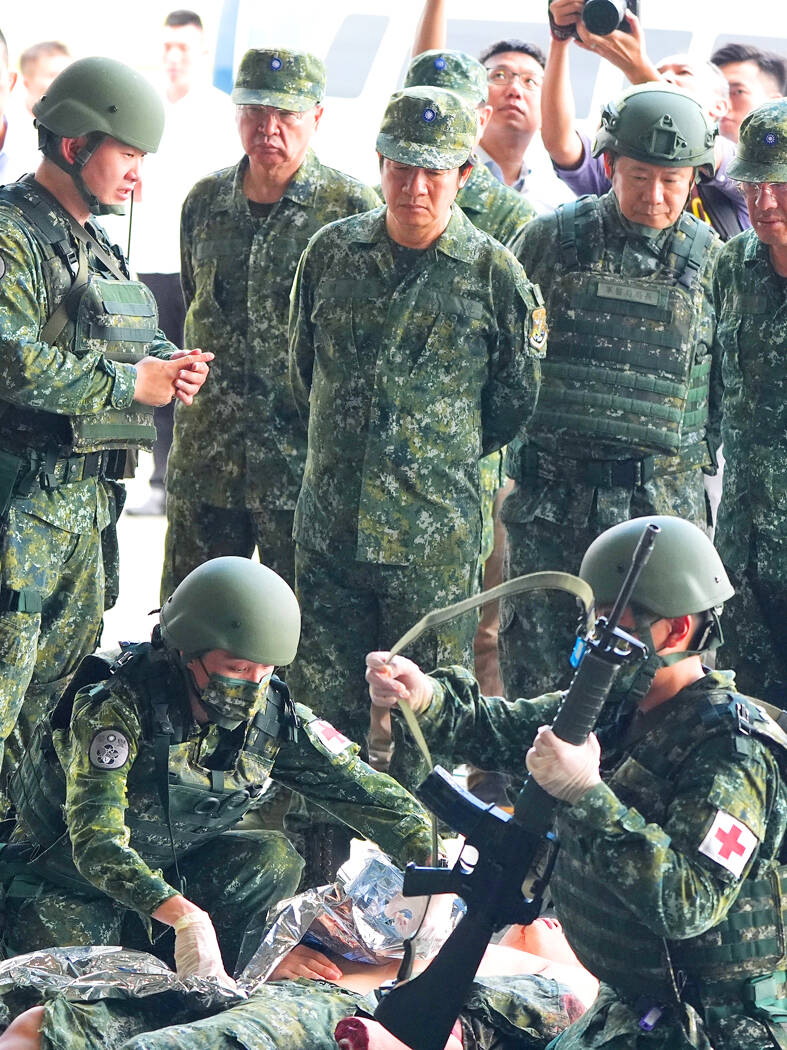
Photo: CNA
The drill observed by the president, a former physician, was meant to test medics’ familiarity with so-called “Tactical Combat Casualty Care,” a set of guidelines for trauma life support in prehospital combat medicine published by the US Defense Health Agency.
Lai then handed out red envelopes to participating troops before leaving without making a public address.
“All brothers and sisters in the military are important combat forces in safeguarding national security,” Lai said in Hualien, according to a statement released by the Presidential Office.
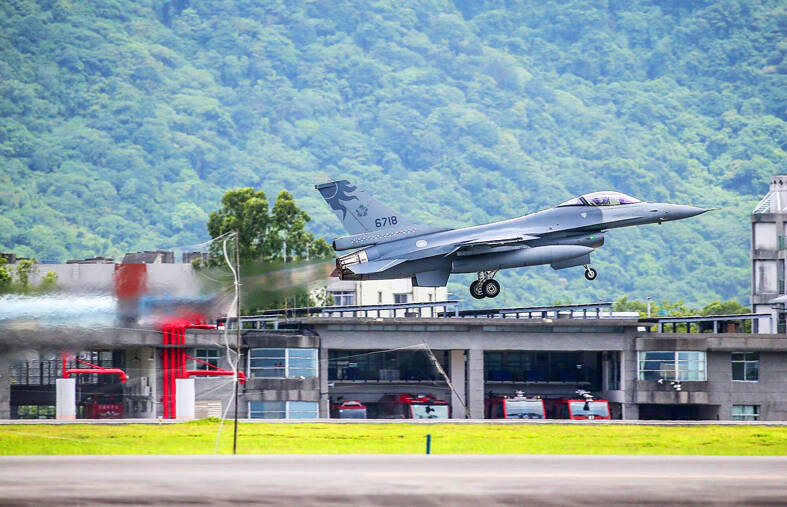
Photo: Cheng I-hwa, Bloomberg
“I hope that we can continue to improve our combat capabilities, not only to reassure the public, but also to let the world see our determination to protect the nation,” he said.
Lai, a staunch defender of Taiwan’s democracy, is regarded as a “dangerous separatist” by China. Three days after he was sworn into office, China launched war games simulating an encirclement of Taiwan as a “punishment” for his inauguration speech, which Beijing said was a “confession of Taiwanese independence.”
Earlier yesterday, troops from the Hualien Air Base-based 5th Tactical Mixed Wing conducted a round of exercises simulating turning the base’s taxiway into an emergency runway within 30 minutes.
The drill simulated a scenario where enemy missiles had rendered the base’s main runway unusable.
Troops used a bird dispersal vehicle and a separate vehicle to detect foreign objects near the runway to ensure arriving aircraft would not be damaged by bird strikes or foreign objects.
They also installed signs along the emergency runway at 1,000 feet (305m) intervals to show pilots the distance remaining to the end of the runway.
An arresting gear system was used to bring jets landing on the temporary runway to a halt.
Land-based arresting gear systems are usually used for landing aircraft on short or temporary runways, and for emergencies involving brake failure or steering problems, or when sections of a runway are out of commission.
However, due to the incoming Typhoon Gaemi, the military canceled a round of fighter jet emergency landing and refueling drills on the emergency runway yesterday.
Military spokesman Sun Li-fang (孫立方) told reporters that the ongoing live-fire component of the Han Kuang series of exercises had been adjusted for safety reasons.
“The impact from the typhoon at present on the east coast is rather obvious,” Sun said. “So we will adjust some of the air and naval elements given the situation.”
Sun did not disclose if more scheduled drills would be canceled due to the typhoon.
The 40th edition of the annual event officially began at 6am on Monday after the Ministry of National Defense’s Joint Operations Command Center announced the beginning of the five-day around-the-clock drills.
The annual Han Kuang exercises, which have served as Taiwan’s major war games since 1984, consist of live-fire drills and computerized war games, and seek to test Taiwan’s combat readiness in the face of a possible Chinese invasion.
This year’s tabletop exercises were staged in April.

Considering that most countries issue more than five denominations of banknotes, the central bank has decided to redesign all five denominations, the bank said as it prepares for the first major overhaul of the banknotes in more than 24 years. Central bank Governor Yang Chin-lung (楊金龍) is expected to report to the Legislative Yuan today on the bank’s operations and the redesign’s progress. The bank in a report sent to the legislature ahead of today’s meeting said it had commissioned a survey on the public’s preferences. Survey results showed that NT$100 and NT$1,000 banknotes are the most commonly used, while NT$200 and NT$2,000

The Centers for Disease Control (CDC) yesterday reported the first case of a new COVID-19 subvariant — BA.3.2 — in a 10-year-old Singaporean girl who had a fever upon arrival in Taiwan and tested positive for the disease. The girl left Taiwan on March 20 and the case did not have a direct impact on the local community, it said. The WHO added the BA.3.2 strain to its list of Variants Under Monitoring in December last year, but this was the first imported case of the COVID-19 variant in Taiwan, CDC Deputy Director-General Lin Ming-cheng (林明誠) said. The girl arrived in Taiwan on

South Korea is planning to revise its controversial electronic arrival card, a step Taiwanese officials said prompted them to hold off on planned retaliatory measures, a South Korean media report said yesterday. A Yonhap News Agency report said that the South Korean Ministry of Foreign Affairs is planning to remove the “previous departure place” and “next destination” fields from its e-arrival card system. The plan, reached after interagency consultations, is under review and aims to simplify entry procedures and align the electronic form with the paper version, a South Korean ministry official said. The fields — which appeared only on the electronic form

The Ministry of Foreign Affairs (MOFA) is suspending retaliation measures against South Korea that were set to take effect tomorrow, after Seoul said it is updating its e-arrival system, MOFA said today. The measures were to be a new round of retaliation after Taiwan on March 1 changed South Korea's designation on government-issued alien resident certificates held by South Korean nationals to "South Korea” from the "Republic of Korea," the country’s official name. The move came after months of protests to Seoul over its listing of Taiwan as "China (Taiwan)" in dropdown menus on its new online immigration entry system. MOFA last week


 RSS
RSS