


Minister of Agriculture Chen Junne-jih (陳駿季) yesterday urged the Legislative Yuan not to approve a hike in government purchase prices for grains, saying that past experiences show it drives down market rates, ultimately harming farmers.
Cross-party negotiations on the issue took place yesterday.
The Chinese Nationalist Party (KMT) proposed raising government purchase prices by NT$8 per kilogram, while the Taiwan People’s Party proposed a hike of NT$5 per kilogram.
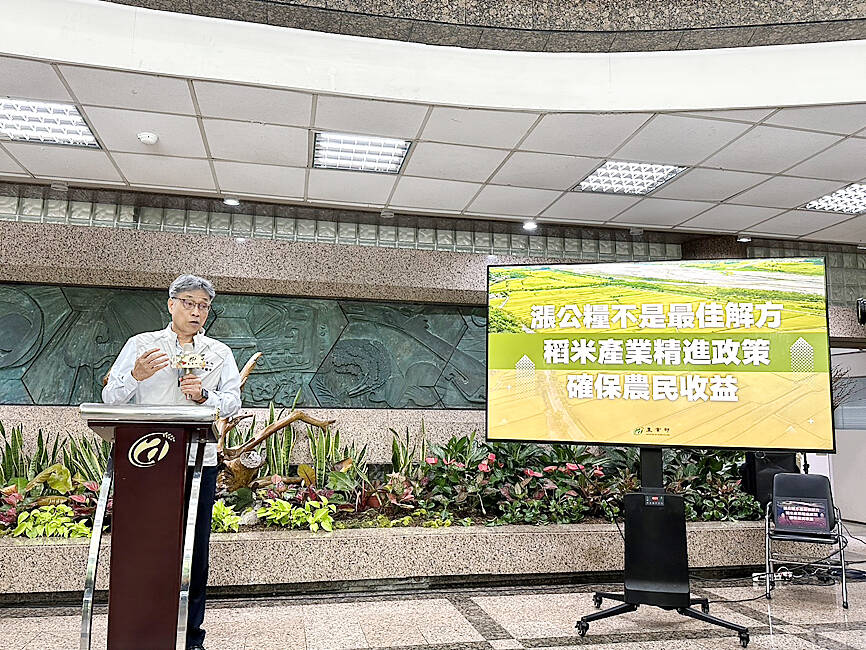
Photo: Yang Yuan-ting, Taipei Times
Chen urged lawmakers to block the proposal, saying it would harm farmers’ interests and could create a “butterfly effect” that could damage the nation’s food security by upsetting the general production and sales structure.
The proposal to hike the base price for the government purchase of rice would increase the government’s annual budget by NT$11.3 billion (US$347.6 million), whereas the ministry’s policy is estimated at NT$2 billion, he said.
While the policy would seemingly increase farmers’ income by NT$48,000 per hectare, Chen said a precedent set in 2011, when the government hiked the government buy-in price by NT$3, caused an explosion in rice planting, but also the lowest rice price in years.
If the Legislative Yuan approves the proposal, it could give foreign rice products the opening they need to establish a foothold in the Taiwanese market, Chen added.
As of last year, agriculture communities were selling rice at NT$26 to NT$29 per kilo, which has already exceeded the base government buy-in price of NT$26, he said.
The Ministry of Agriculture’s policy promoting farming cooperatives to increase farmers’ income has received support from more than 80 percent of farmers’ associations in regions where the policy was implemented, Chen said.
The policy encourages farmers who had to turn in grains to the government to join agricultural cooperatives and provide better grains, with the ministry offering NT$10,000 per extra hectare grown, he said.
The ministry expects that fields under agriculture cooperatives would reach about 10,000 hectares within three years, and the number of excellent-grade crops grown would increase to 60 percent within that time, he said.
The second part of the policy encourages farmers in certain areas to switch to planting grains, which would reduce the overproduction of rice and increase Taiwan’s self-reliance on grain production.
The ministry is offering NT$20,000 in subsidies per hectare if farmers whose fields border the high-speed railway are willing to plant grains in the first planting, while cooperatives are willing to provide an additional NT$5,000 on top of the government’s subsidies.
Chen said that the policy hopes to increase the price of dry grains by NT$3 per kilogram within three years.

Considering that most countries issue more than five denominations of banknotes, the central bank has decided to redesign all five denominations, the bank said as it prepares for the first major overhaul of the banknotes in more than 24 years. Central bank Governor Yang Chin-lung (楊金龍) is expected to report to the Legislative Yuan today on the bank’s operations and the redesign’s progress. The bank in a report sent to the legislature ahead of today’s meeting said it had commissioned a survey on the public’s preferences. Survey results showed that NT$100 and NT$1,000 banknotes are the most commonly used, while NT$200 and NT$2,000

The Centers for Disease Control (CDC) yesterday reported the first case of a new COVID-19 subvariant — BA.3.2 — in a 10-year-old Singaporean girl who had a fever upon arrival in Taiwan and tested positive for the disease. The girl left Taiwan on March 20 and the case did not have a direct impact on the local community, it said. The WHO added the BA.3.2 strain to its list of Variants Under Monitoring in December last year, but this was the first imported case of the COVID-19 variant in Taiwan, CDC Deputy Director-General Lin Ming-cheng (林明誠) said. The girl arrived in Taiwan on

South Korea is planning to revise its controversial electronic arrival card, a step Taiwanese officials said prompted them to hold off on planned retaliatory measures, a South Korean media report said yesterday. A Yonhap News Agency report said that the South Korean Ministry of Foreign Affairs is planning to remove the “previous departure place” and “next destination” fields from its e-arrival card system. The plan, reached after interagency consultations, is under review and aims to simplify entry procedures and align the electronic form with the paper version, a South Korean ministry official said. The fields — which appeared only on the electronic form

The Ministry of Foreign Affairs (MOFA) is suspending retaliation measures against South Korea that were set to take effect tomorrow, after Seoul said it is updating its e-arrival system, MOFA said today. The measures were to be a new round of retaliation after Taiwan on March 1 changed South Korea's designation on government-issued alien resident certificates held by South Korean nationals to "South Korea” from the "Republic of Korea," the country’s official name. The move came after months of protests to Seoul over its listing of Taiwan as "China (Taiwan)" in dropdown menus on its new online immigration entry system. MOFA last week


 RSS
RSS