


The Constitutional Court is to hear oral arguments next month on the constitutionality of a package of controversial amendments passed by the legislature at the end of May that opposition lawmakers said would strengthen lawmakers’ ability to scrutinize the executive branch.
The oral arguments are scheduled to be held in Taipei on Aug. 6, the Judicial Yuan, which oversees the Constitutional Court, said in a news release on Thursday.
Relevant parties are to present their views on whether the amendments, which came into effect on Wednesday last week, contravene the Constitution and whether the deliberation that led up to their passage in the Legislative Yuan constituted “palpable” and “sufficient” defects.
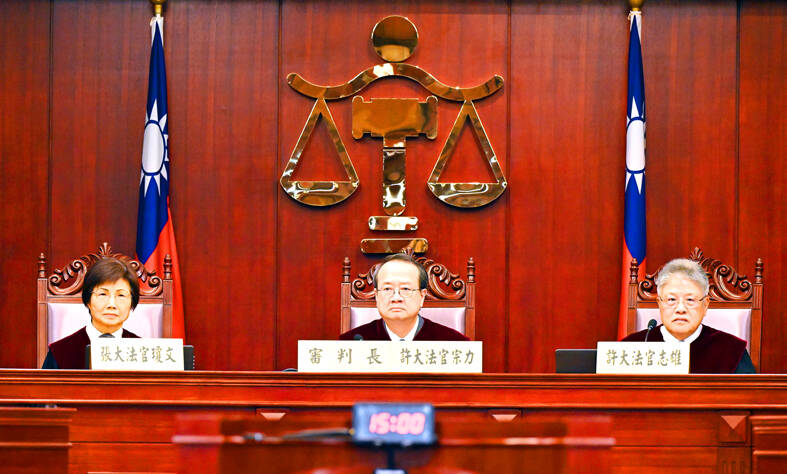
Photo: Liao Chen-huei, Taipei Times
Respective cases were brought to the court over the past week by the Democratic Progressive Party (DPP) caucus, the Executive Yuan, President William Lai (賴清德) and the Control Yuan, as part of a DPP-led effort to overturn amendments they said are unconstitutional.
The changes to the Act Governing the Legislative Yuan’s Power (立法院職權行使法) and the Criminal Code were passed by Chinese Nationalist Party (KMT) and Taiwan People’s Party lawmakers, who hold a combined majority in the legislature, on May 28.
The updated laws grant the Legislative Yuan new investigative powers, including the power to hold hearings. Public officials would be fined or imprisoned if they refuse to attend hearings or provide information when asked to do so by legislators, or if they present false information.
People or entities in the private sector might also face penalties if they are deemed uncooperative.
The amendments also include provisions that could compel the president to give an annual state of the nation address and field questions from legislators.
Thursday’s announcement came two days after the Judicial Yuan said the Constitutional Court planned to hold a preparatory hearing for an injunction requested by the DPP petitioners seeking to halt enforcement of the new amendments.
Tens of thousands of protesters gathered outside the Legislative Yuan in the days leading up to the passing of the amendments on May 28, with an estimated 100,000 demonstrators on May 24.

NATIONAL SECURITY: Authorities are working to confirm the identities of the military personnel involved and investigating possible illegal conduct and regulatory violations Authorities are probing possible national security implications after Kinmen police and immigration officers on Sunday found a Chinese woman allegedly posing as a tourist while engaging in prostitution involving more than 10 military personnel. The woman, surnamed Chen (陳), has since been deported, authorities said, adding that investigators are still working to confirm the identities of those implicated, as the records only listed code names and aliases. The case stemmed from a report received by the Kinmen District Prosecutors’ Office on Friday last week from the Jinhu Precinct of the Kinmen County Police Bureau. On Sunday, police, along with the National Immigration

GLOBALGIVING: ‘ Caving to external pressure is not acceptable for an organization that has cultivated justice reform and human rights for 30 years,’ one NGO said A slew of non-government organizations (NGOs) have withdrawn from the GlobalGiving fundraising platform after it announced it would use “Chinese Taipei” instead of “Taiwan” from next month. The Taiwan Good Rice Association wrote on Facebook on Friday that it was informed on April 28 via a teleconference call of the change, which was made because the platform wanted to operate in China. Taiwan Good Rice is to terminate all cooperative relationships with GlobalGiving in response to the platform’s “unilateral and non-negotiable” decision to remove references to Taiwan, the NGO said. “Taiwan is in the official name of Taiwan Good Rice Association and the

HEAVY WEATHER: Typhoon Jangmi is due to crash straight into the Ryukyus as airlines look to shift flights to larger aircraft or cancel flights to Okinawa entirely Taiwan’s international air carriers announced flight adjustments over the weekend as Typhoon Jangmi is forecast to hit the Ryukyu Islands today and tomorrow. The Central Weather Administration (CWA) upgraded Jangmi from a tropical storm to a typhoon at 8am yesterday, with the eye located 580km south of Naha city. It was moving north at 19kph. Today, China Airlines’ CI-120, CI-121, CI-122 and CI-123 flights between Taoyuan and Naha, Okinawa, have been canceled as well as CI-132 and CI-133 between Kaohsiung and Naha. EVA Air’s BR-112, BR-113, BR-186 and BR-185 flights between Taoyuan and Naha are also canceled. Low-cost carrier Tigerair Taiwan canceled IT-230,

Chinese Nationalist Party (KMT) Chairwoman Cheng Li-wun (鄭麗文) yesterday briefed her party’s Central Standing Committee regarding her scheduled visit to the US between Monday next week and June 16, saying that her purpose would be to persuade the US that the Republic of China (ROC) Constitution was a “one China” constitution that would foster stable and peaceful cross-strait relations. The ROC Constitution is the most important defense for all Taiwanese citizens, as it upholds our democracy and has contributed to our robust economy, which aligns with international and US interests, she said. “We would not be troublemakers and drag the US under,”


 RSS
RSS