


New ways of thinking should be applied to the management of roads and highways in Hualien County, as its mountain slopes could remain unstable for the next seven to eight years, an official from the Directorate-General of Highways said after a rockfall damaged railway tracks near Heren Tunnel in the county’s Sioulin Township (秀林) yesterday.
Rockfalls and landslides have affected Suhua Highway and the North-link rail line more often than normal since a large earthquake in Hualien County on April 3.
The earthquake, which measured 7.2 on the Richter scale, struck 15km south of Hualien City and was the strongest temblor in Taiwan since 1999.
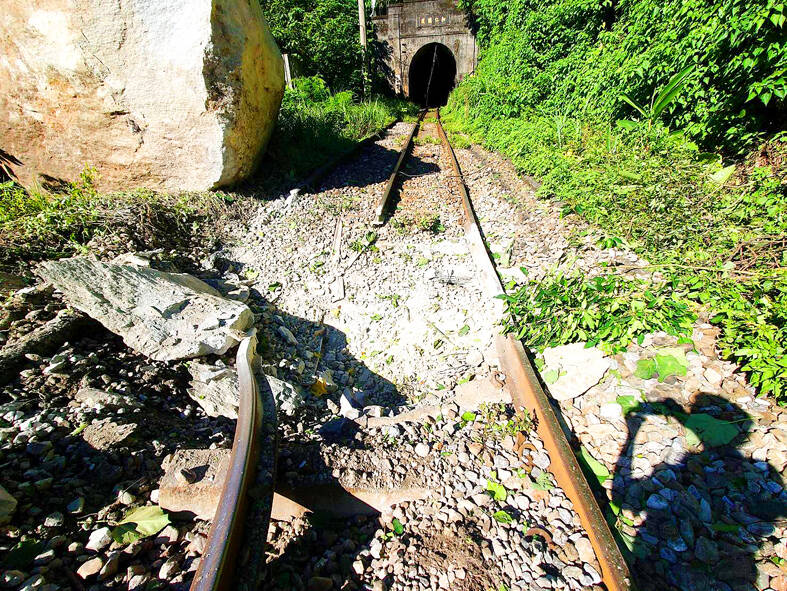
Photo courtesy of Taiwan Railway Corp
A rock weighing an estimated 150 tonnes yesterday destroyed tracks near the tunnel. Heavy rain caused a landslide on Monday that buried part of the Suhua Highway between Heren (和仁) and Chongde (崇德).
The east railway line between the two communities has been temporarily closed, with trains running in both directions on the west line, Taiwan Railway Corp said.
There were multiple rockfalls and landslides last month, including a slide that led to the derailment of a New Tze-chiang Limited Express near the Cingshuei River (清水溪) on June 21.
April’s earthquake affected areas up to an altitude of 1,000m and resulted in unprecedented damage to the Suhua Highway and the Central Cross-lsland Highway, with much of the region’s vegetation ruined by slope collapses and falling rocks, Directorate-General of Highways official Lin Wen-hsiung (林文雄) said.
“Due to the damage, 10mm of rainfall could cause a rockfall, when it used to take 50mm to 60mm,” Lin said.
For example, only 1mm of rainfall led to the June 21 derailment, he said, adding that rockfalls are occurring almost every day on slopes along the Central Cross-lsland Highway, which passes through Taroko Gorge.
The slopes and roads in mountainous areas would “remain unstable for the following seven to eight years, or even 20 years” based on Japan’s experience after the Great Hanshin-Awaji Earthquake on Jan. 17, 1995, so “we should abandon outdated ideas and consider newly developed situations to manage roads and highways,” Lin said.
People will have to be prepared for land collapses for years to come, although senior officials say the rockfall situation might stabilize after typhoons clear unstable material, he said.
In addition to slope maintenance, rockfall barriers and fences should be added and more rock sheds, or open-cut tunnels, should be built on the roads that pass through Taroko Gorge, Lin said, adding that most of the engineering projects have already been outsourced to contractors.

NATIONAL SECURITY: Authorities are working to confirm the identities of the military personnel involved and investigating possible illegal conduct and regulatory violations Authorities are probing possible national security implications after Kinmen police and immigration officers on Sunday found a Chinese woman allegedly posing as a tourist while engaging in prostitution involving more than 10 military personnel. The woman, surnamed Chen (陳), has since been deported, authorities said, adding that investigators are still working to confirm the identities of those implicated, as the records only listed code names and aliases. The case stemmed from a report received by the Kinmen District Prosecutors’ Office on Friday last week from the Jinhu Precinct of the Kinmen County Police Bureau. On Sunday, police, along with the National Immigration

GLOBALGIVING: ‘ Caving to external pressure is not acceptable for an organization that has cultivated justice reform and human rights for 30 years,’ one NGO said A slew of non-government organizations (NGOs) have withdrawn from the GlobalGiving fundraising platform after it announced it would use “Chinese Taipei” instead of “Taiwan” from next month. The Taiwan Good Rice Association wrote on Facebook on Friday that it was informed on April 28 via a teleconference call of the change, which was made because the platform wanted to operate in China. Taiwan Good Rice is to terminate all cooperative relationships with GlobalGiving in response to the platform’s “unilateral and non-negotiable” decision to remove references to Taiwan, the NGO said. “Taiwan is in the official name of Taiwan Good Rice Association and the

HEAVY WEATHER: Typhoon Jangmi is due to crash straight into the Ryukyus as airlines look to shift flights to larger aircraft or cancel flights to Okinawa entirely Taiwan’s international air carriers announced flight adjustments over the weekend as Typhoon Jangmi is forecast to hit the Ryukyu Islands today and tomorrow. The Central Weather Administration (CWA) upgraded Jangmi from a tropical storm to a typhoon at 8am yesterday, with the eye located 580km south of Naha city. It was moving north at 19kph. Today, China Airlines’ CI-120, CI-121, CI-122 and CI-123 flights between Taoyuan and Naha, Okinawa, have been canceled as well as CI-132 and CI-133 between Kaohsiung and Naha. EVA Air’s BR-112, BR-113, BR-186 and BR-185 flights between Taoyuan and Naha are also canceled. Low-cost carrier Tigerair Taiwan canceled IT-230,

Chinese Nationalist Party (KMT) Chairwoman Cheng Li-wun (鄭麗文) yesterday briefed her party’s Central Standing Committee regarding her scheduled visit to the US between Monday next week and June 16, saying that her purpose would be to persuade the US that the Republic of China (ROC) Constitution was a “one China” constitution that would foster stable and peaceful cross-strait relations. The ROC Constitution is the most important defense for all Taiwanese citizens, as it upholds our democracy and has contributed to our robust economy, which aligns with international and US interests, she said. “We would not be troublemakers and drag the US under,”


 RSS
RSS