


Convenience store chain Taiwan FamilyMart Co and non-governmental organization One-Forty on Tuesday introduced multilingual signs to direct people from four Southeast Asian countries to the services they most commonly use as part of a “migrant-friendly services” initiative.
The signs, written in Indonesian, Filipino, Vietnamese and Thai, have been put up at counters in more than 4,200 FamilyMart stores across Taiwan to help people with tasks such as sending remittances back home, and sending and receiving packages.
Those services, in addition to purchasing food, are the three most commonly used by migrant workers, a survey conducted by FamilyMart and One-Forty among workers from Indonesia, Philippines, Thailand and Vietnam in January found.
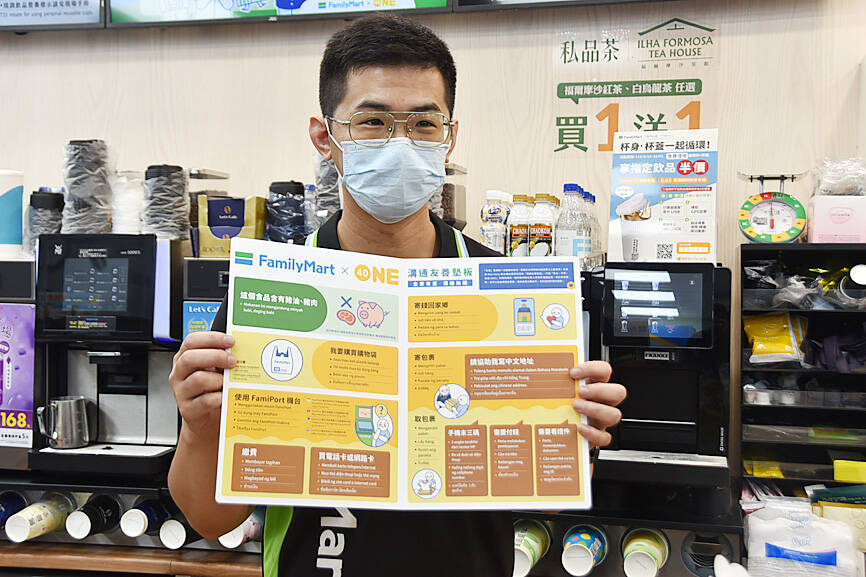
Photo: Wu Po-hsuan, Taipei Times
One-Forty is dedicated to helping migrant workers adapt to life in Taiwan and teaching them how to start their own businesses when they return home.
Migrant workers visit convenience stores once every two days on average, but nearly 60 percent said they wished there were “tools” to help them solve communication problems, said the survey, which garnered 2,600 valid responses.
Some respondents said they wished there was clearer labeling on food products containing pork or lard.
As a result, FamilyMart said it has created an Indonesian-language sign with an illustration so that Muslim customers do not accidentally purchase such products.
The franchise expects to increase its number of stores with a Southeast Asian imported products area to 500 nationwide and the number of branches with Halal deli sections to about 1,000 from 600 by the end of this year, FamilyMart Corporate Communications Department manager Vita Wu (吳采樺) said.
FamilyMart branch supervisor Chen Jou-en (陳柔恩) said clerks would now be able to cater to the needs of migrants much more promptly thanks to the multilingual signs.
For example, it often takes a lot of time just for foreigners to tell clerks that they need to send a package or pick up transportation tickets, Chen said.
Thirty-five years after Taiwan began recruiting migrant workers, they now form an important part of the nation’s workforce, supporting local industries and providing care to households, Taiwan FamilyMart president Hsueh Tung-tu (薛東都) said.
Hsueh said that convenience stores have become a “third living space” for them, after their workplaces and homes, and he hopes FamilyMart will become Taiwan’s most migrant-friendly convenience store franchise.
Under the initiative, users of FamilyMart’s app can make donations to One-Forty, which would be used to make videos teaching migrant caregivers how to take care of people with dementia.

REASONS FOR TRAVEL: An assistant professor said that proposed amendments to penalize drivers if they used drugs overseas would not deter people from traveling People who operate a motor vehicle under the influence of marijuana would have their driver’s license revoked, even if they used the substance while overseas, the Ministry of Transportation and Communications said yesterday, citing proposed amendments to the Road Traffic Management and Penalty Act (道路交通管理處罰條例). The amendments would also authorize the government to revoke the licenses of people determined to have used Category 1 or Category 2 narcotics, even if they were not operating a vehicle while under the influence of drugs, as well as ban them from taking the license test for three years, the ministry said. People aged 18 or

UPGRADE: The Kang Ding-class frigate is replacing its Chaparall missiles with Tien Chien II and Hua Yang VLS, which would provide it with long-range, 360° air defense Taiwan plans to produce 1,200 to 1,376 Hai Chien II missiles (海劍二, Sea Sword II) — also known as TC-2N — to serve as the standard air defense system of the navy’s surface combatant fleet, a source said yesterday. Last week, the Hai Chien II, the naval version of the Tien Kung II missile (天劍二, Sky Sword II), completed a live-fire test in waters off the National Chungshan Institute of Science and Technology’s Jiupeng facility (九鵬) in Pingtung County’s Manjhou Township (滿州). The MIM72 Chaparral and other dated air defense missiles that currently arm Taiwanese ships have inadequate range to combat Chinese

GLOBALGIVING: ‘ Caving to external pressure is not acceptable for an organization that has cultivated justice reform and human rights for 30 years,’ one NGO said A slew of non-government organizations (NGOs) have withdrawn from the GlobalGiving fundraising platform after it announced it would use “Chinese Taipei” instead of “Taiwan” from next month. The Taiwan Good Rice Association wrote on Facebook on Friday that it was informed on April 28 via a teleconference call of the change, which was made because the platform wanted to operate in China. Taiwan Good Rice is to terminate all cooperative relationships with GlobalGiving in response to the platform’s “unilateral and non-negotiable” decision to remove references to Taiwan, the NGO said. “Taiwan is in the official name of Taiwan Good Rice Association and the

HEAVY WEATHER: Typhoon Jangmi is due to crash straight into the Ryukyus as airlines look to shift flights to larger aircraft or cancel flights to Okinawa entirely Taiwan’s international air carriers announced flight adjustments over the weekend as Typhoon Jangmi is forecast to hit the Ryukyu Islands today and tomorrow. The Central Weather Administration (CWA) upgraded Jangmi from a tropical storm to a typhoon at 8am yesterday, with the eye located 580km south of Naha city. It was moving north at 19kph. Today, China Airlines’ CI-120, CI-121, CI-122 and CI-123 flights between Taoyuan and Naha, Okinawa, have been canceled as well as CI-132 and CI-133 between Kaohsiung and Naha. EVA Air’s BR-112, BR-113, BR-186 and BR-185 flights between Taoyuan and Naha are also canceled. Low-cost carrier Tigerair Taiwan canceled IT-230,


 RSS
RSS