


It has been three years since Apple Daily, a pro-democracy newspaper and one of the largest Chinese-language media outlets in Hong Kong, was forced to close. Following police raids on its newsroom and the freezing of its assets, the paper published 1 million copies of its final print edition on June 24, 2021.
Jimmy Lai (黎智英), the newspaper founder, alongside three Apple Daily subsidiaries, is still standing trial, accused of “conspiring to collude with foreign forces” and “conspiring to publish seditious material.”
The 76-year-old was first arrested under the Beijing-imposed National Security Law in August 2020 and has been imprisoned since Dec. 31 that year.
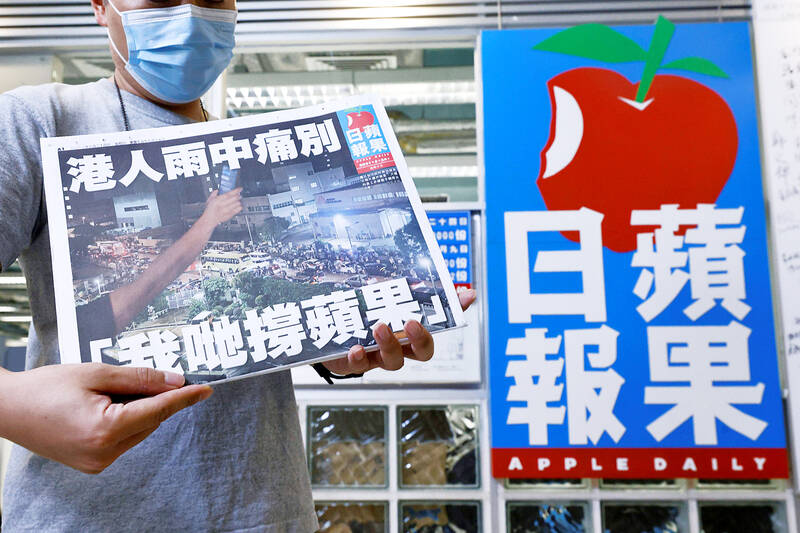
Photo: REUTERS
On the third anniversary of the newspaper’s shutdown, three of the former employees reflected on their time at Apple Daily and their lives since they were forced to leave their beloved home.
Shirley Leung (梁嘉麗) joined Apple Daily in 2018 as a journalist and covered various topics, including feature articles about protesters during the Anti-Extradition Law Amendment Bill Movement. These protests lasted from June 2019 until Beijing’s Hong Kong National Security Law took effect on June 30, 2020.
Recalling those days working at the only pro-democracy newspaper in Hong Kong, she said she cherished the press freedom that now no longer exists in Hong Kong.
“When you see your colleagues or superiors get arrested and serve prison sentences because they stood firm in their positions, defended press freedom and were committed to journalism, you feel a great sense of pride,” Leung said. “They are truly respectable, and I am very proud to have worked with them.”
Leung, who founded Photon Media in April last year in Taiwan that focuses on Hong Kong news, said Taiwan is a suitable base for her operation because it upholds press freedom.
Leung said she was motivated to establish her own outlet because her experience at Apple Daily had made her “braver.”
On the last day of the newspaper’s operation, Leung remembered how Chan Pui-man (陳沛敏), the former associate publisher of Apple Daily on bail at that time, said: “We should just focus on making today’s final edition of the newspaper the best it can be — let’s do good journalism.”
While Leung rebuilds her journalistic career in Taiwan, Joshua (a pseudonym due to safety concerns) moved to Canada.
With previous job duties including filming live video and editing documentaries, the former producer at Apple Daily said working in the field often meant navigating numerous “inconveniences.”
“Some media outlets were allowed to film in certain places, but if they [people managing the venue] knew you were from Apple Daily, they wouldn’t let you film,” he said, citing examples such as covering court cases or events inside government premises.
Despite the difficulties, Joshua said his problem-solving abilities improved significantly during his several years working for Apple Daily due to frequent dealings with the authorities.
This “training,” along with the grueling work patterns has been useful in adapting to life in the Land of Maple Syrup, where he mostly works in the catering and service industry.
Joshua said it might be tough for him to resume video journalism in the country, because the Chinese-language news organizations in Canada are “old school” and “rigid,” which makes him nostalgic for the vibrant work environment he once had in Apple Daily.
The UK is also a popular destination for Hong Kong immigrants, including former Apple Daily video editor Andrew (a pseudonym due to safety concerns), who has been in the UK for about three years.
He resigned a few months before Apple Daily’s closure, as he had already foreseen that the Hong Kong government would target the company.
At that time, Andrew, in his late 20s, decided to prioritize moving to the UK, which had just eased immigration policies for Hong Kongers through the introduction of the British National (Overseas) visa.
Andrew said he did not seek out media jobs upon arrival in the UK, because he knew his English proficiency was not high enough.
Now working in the catering industry, he admitted he missed the fast-paced environment of news media.
“I honed my skills there [at Apple Daily], and now it’s like I’ve put them aside ... There’s a sense of powerlessness,” he said.
That said, he added he still has a passion for it and continues to work on his English skills in hopes of returning to a newsroom one day.

The Ministry of Finance this afternoon announced the winning numbers for the March-April uniform invoice lottery. The winning number for the NT$10 million (US$318,060) special prize is 19531471, and the winning number for the NT$2 million grand prize is 85941329. Three numbers were drawn for the NT$200,000 first prize: 07225810, 20231230 and 83518781. Those with receipts matching the last seven digits of any of the first-prize numbers will win the NT$40,000 second prize, while those matching the last six digits will win the NT$10,000 third prize. Those whose receipts match the last five digits of the first-prize numbers can claim the NT$4,000 fourth prize,

SIX SUBSIDIES: The monthly allowance for older farmers is to increase to NT$10,000, and NT$5,000 is to be given to homemakers under the national pension system, Lai said The government is to implement major welfare policies for disadvantaged groups, including raising the monthly allowance for older farmers to NT$10,000 and providing homemakers with NT$5,000 per month, President William Lai (賴清德) said yesterday. Lai made the remarks during a visit to Wangling Temple in Chiayi County, saying that the planned increases were being introduced amid economic growth and an increase in tax revenue. Touting a policy, in which the government plans to provide a monthly allowance of NT$5,000 for every child under the age of 18 in a bid to address Taiwan’s low birthrate, Lai said that if received for the
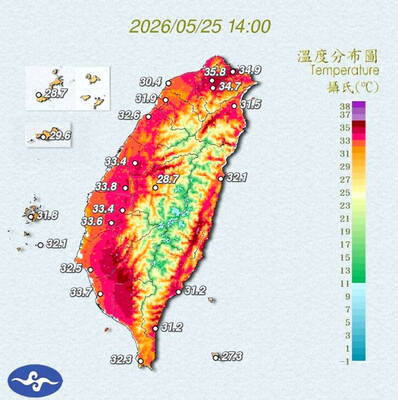
STAY COOL: The HPA recommended that people stay hydrated, use air-conditioning or fans while indoors, wear loose-fitting clothes and walk in the shade while outdoors Employers must implement measures such as installing cooling equipment, and providing drinking water and rest breaks for outdoor workers starting from Monday next week, the Taipei Department of Labor said on Sunday. Employers who fail to comply could face fines of NT$30,000 to NT$300,000 under the Occupational Safety and Health Act (職業安全衛生法), the department said. Businesses in Taipei employing fewer than 100 workers, as well as registered self-employed workers with labor insurance coverage, could receive on-site assessments and guidance from occupational safety consultants to help them apply for central government subsidies to implement or improve heat-protection measures, it said. Under the Ministry of

ISOLATION: The outposts would serve as support and backup bases, forcing US forces to either face China head-on or reroute, increasing travel time and operational costs China’s outposts in the South China Sea could be used to delay and constrain foreign forces during a conflict in the Taiwan Strait, giving Beijing a critical window to carry out amphibious landing and blockade operations, a report said. The Chinese Communist Party’s (CCP) forward operating bases on islands and reclaimed features in the South China Sea could delay foreign forces long enough for the Chinese People’s Liberation Army (PLA) to secure a key 48-to-72-hour window in the Taiwan Strait, a report commissioned by the Mainland Affairs Council found. The report, conducted by the Institute for National Defense and Security Research, examined


 RSS
RSS