


The US and allied navies plan to sink a 40,000-tonne ship at the latest Rim of the Pacific (RIMPAC) exercise to simulate defeating a Chinese amphibious assault on Taiwan.
This year’s RIMPAC — the 29th iteration of the world’s largest naval exercise — involves the US, 28 partners, more than 25,000 personnel, 40 warships, three submarines and more than 150 aircraft operating in and around Hawaii from yesterday to Aug. 1, the US Navy said in a press release.
The major components of the event include multidomain warfare exercises in multiship surface engagements, anti-submarine warfare and multi-axis defense of a carrier strike group against live forces, it said.
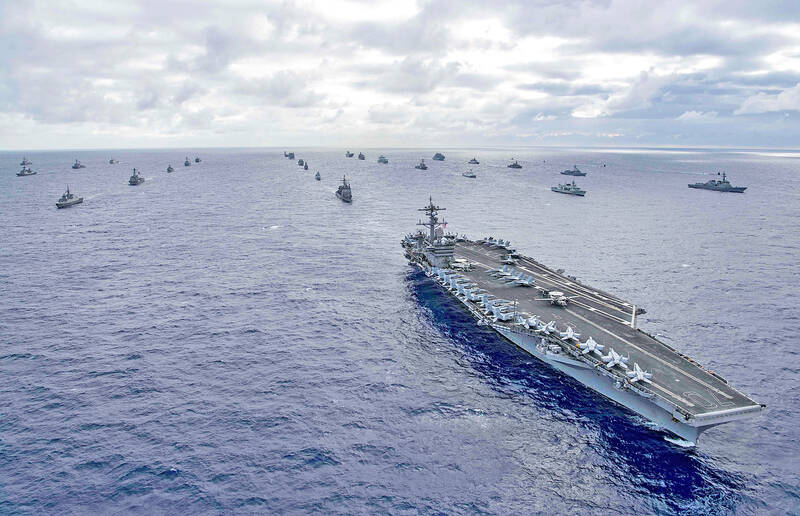
Photo: AFP / US Navy / Dylan M. Kinee
The capstone event of the drills is the sink exercise, which is to utilize different classes of ships throughout the years, the War Zone said in a report on June 10.
This year’s target, the USS Tarawa, an amphibious assault ship, was the lead warship of its class and was designed to transport marines and support them with its complement of strike aircraft, the outlet said.
Although another Tarawa-class vessel was destroyed for target practice before, the ship’s impending demise is still important, as few opportunities exist for navies to test their weapons against a large and heavily protected target, it said.
“It [has] been a very long time since the navy used an amphibious assault ship of any kind for the RIMPAC [sink exercise], but [it] is the largest ship of any kind to be used in more than a decade,” the report said.
“Amphibious assault ships are high-value assets ... designed to be well-protected right down to their core structures and otherwise resilient to damage thanks to redundant features,” it said, adding that the USS Tarawa was more modern than the Iwo Jima-class types sunk in past drills.
The planned destruction of the USS Tarawa in the war games coincided with the Chinese People’s Liberation Army Navy’s efforts to expand its amphibious assault ship fleets, which would be “top target for US forces,” it said.
The ongoing RIMPAC exercise is meant to send China “a strong message,” analyst Richard Fisher Jr told Voice of America Cantonese.
The destruction of the USS Tarawa, the equivalent in size to China’s largest landing helicopter docks, would show the Chinese that the US Navy is capable of sinking their ships, he was cited as saying.

Yangmingshan National Park authorities yesterday urged visitors to respect public spaces and obey the law after a couple was caught on a camera livestream having sex at the park’s Qingtiangang (擎天崗) earlier in the day. The Shilin Police Precinct in Taipei said it has identified a suspect and his vehicle registration number, and would summon him for questioning. The case would be handled in accordance with public indecency charges, it added. The couple entered the park at about 11pm on Thursday and began fooling around by 1am yesterday, the police said, adding that the two were unaware of the park’s all-day live

A former soldier and an active-duty army officer were yesterday indicted for allegedly selling classified military training materials to a Chinese intelligence operative for a total of NT$79,440. The Taipei District Prosecutors’ Office indicted Chen Tai-yin (陳泰尹) and Lee Chun-ta (李俊達) for contravening the National Security Act (國家安全法) and the Anti-Corruption Act (貪污治罪條例). Chen left the military in September 2013 after serving alongside then-staff sergeant Lee, now an army lieutenant, at the 21st Artillery Command of the army’s Sixth Corps from 2011 to 2013, according to the indictment. Chen met a Chinese intelligence operative identified as “Wang” (王) through a friend in November

Minister of Digital Affairs Lin Yi-ching (林宜敬) yesterday cited regulatory issues and national security concerns as an expert said that Taiwan is among the few Asian regions without Starlink. Lin made the remarks on Facebook after funP Innovation Group chief executive officer Nathan Chiu (邱繼弘) on Friday said Taiwan and four other countries in Asia — China, North Korea, Afghanistan and Syria — have no access to Starlink. Starlink has become available in 166 countries worldwide, including Ukraine, Malaysia, the Philippines and Vietnam, in the six years since it became commercial, he said. While China and North Korea block Starlink, Syria is not
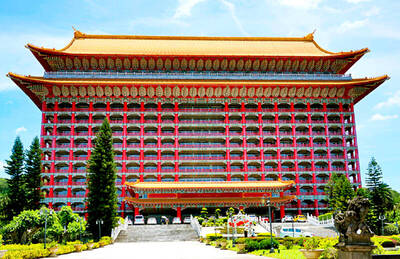
The Grand Hotel Taipei has rejected media reports claiming that the hotel had prevented CBS from broadcasting coverage of the Beijing summit between U.S. President Donald Trump and Chinese President Xi Jinping (習近平) on its premises. Media reports alleging that the hotel owner, dissatisfied with CBS’s coverage, prohibited the network from broadcasting political content on the hotel premises, are not true, the hotel said in a statement issued last night. The reports were “inconsistent with how the hotel actually handled the matter,” it said. The hotel said it received a refund request from a


 RSS
RSS