


Lacking a legislative majority, President William Lai (賴清德) is facing a tough fight to nominate the next Taiwan Foundation for Democracy chief executive, stymieing the leadership succession at the main organization handling the nation’s unofficial global outreach programs.
Then-president Chen Shui-bian (陳水扁) of the Democratic Progressive Party (DPP) in 2003 established the foundation as a subordinate body under the Ministry of Foreign Affairs, passing the measure through a fractious opposition-led Legislative Yuan.
Chen decided to appoint then-legislative speaker Wang Jin-pyng (王金平) of the Chinese Nationalist Party (KMT) as foundation chairman, a compromise that secured the opposition’s support for a DPP chief executive officer, then-vice minister of foreign affairs Michael Kau (高英茂).
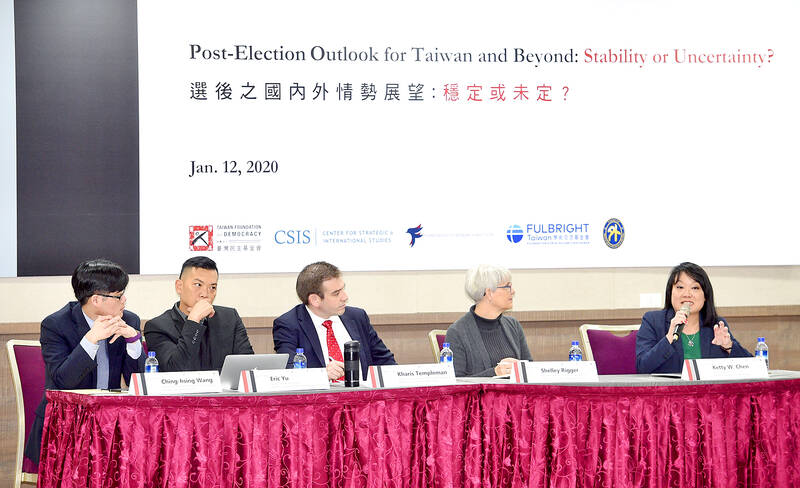
Photo: Lo Pei-de, Taipei Times
In an act that recognized the president’s prerogative over diplomacy, Wang later lent his support to Kau’s successor, Lin Wen-cheng (林文程), an academic tapped by the Chen administration to head the foundation.
Today’s impasse over choosing the foundation’s next chief executive could have been avoided if KMT Legislative Speaker Han Kuo-yu (韓國瑜) had respected the precedents set by Chen and Wang.
The seeds of the deadlock were laid when Han insisted on his prerogative to nominate the chief executive officer, contradicting a previous agreement between the government and the opposition that the board members should elect the chief executive.
Han was within his rights to tap a candidate without consultation, but doing so inevitably invited a logjam because the foundation board — not its chairman — has the power to approve the appointment of the chief executive.
The DPP appointed nine of the board’s 15 members, with the KMT and Taiwan People’s Party appointees accounting for the remaining six, giving the ruling party a decisive majority.
After nominating National Chengchi University diplomatic studies professor Lu Yeh-chung (盧業中) — who was unlikely to pass muster anyway — Han then abstained from the weekly board meeting, preventing a vote from being held.
Han might have been lobbied by his circle of advisers into throwing his support behind Lu not to appoint him as chief executive, but to sabotage the foundation, sources familiar with the matter said.
China has long deemed the foundation a thorn in its side, as demonstrated by its inclusion in Beijing’s list of sanctioned people and entities announced in 2022 following then-US House of Representatives speaker Nancy Pelosi’s visit to Taiwan.
However, Han’s intransigence is not likely to affect the outcome in the long term. With the KMT’s relative weakness on the board, the party’s attempt to muscle a candidate past DPP objections is almost certain to fail.
The foundation’s charter also authorizes its deputy executive officer, Liao Dachi (廖達琪) — a DPP appointee — to head the foundation in the absence of a chief executive officer, a responsibility she has already assumed.
That means the DPP can ignore Han’s objections indefinitely without jeopardizing the foundation’s operations.
Additional reporting by Lin Hsin-han
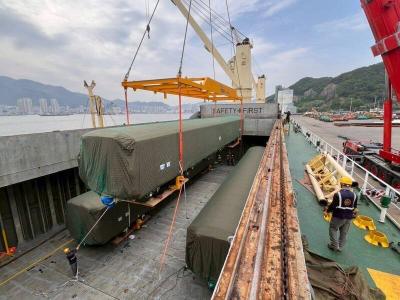
The first of 10 new high-capacity trains purchased from South Korea’s Hyundai Rotem arrived at the Port of Taipei yesterday to meet the demands of an expanding metro network, Taipei Rapid Transit Corp (TRTC) said yesterday. The train completed a three-day, 1,200km voyage from the Port of Masan in South Korea, the company said. Costing NT$590 million (US$18.79 million) each, the new six-carriage trains feature a redesigned interior based on "human-centric" transportation concepts, TRTC said. The design utilizes continuous longitudinal seating to widen the aisles and optimize passenger flow, while also upgrading passenger information displays and driving control systems for a more comfortable
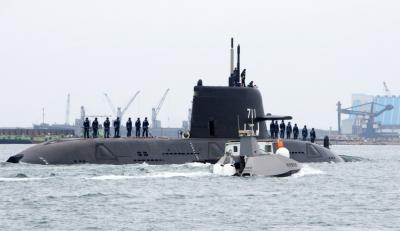
Taiwan's first indigenous defense submarine, the SS-711 Hai Kun (海鯤, or Narwhal), departed for its 13th sea trial at 7am today, marking its seventh submerged test, with delivery to the navy scheduled for July. The outing also marked its first sea deployment since President William Lai (賴清德) boarded the submarine for an inspection on March 19, drawing a crowd of military enthusiasts who gathered to show support. The submarine this morning departed port accompanied by CSBC Corp’s Endeavor Manta (奮進魔鬼魚號) uncrewed surface vessel and a navy M109 assault boat. Amid public interest in key milestones such as torpedo-launching operations and overnight submerged trials,
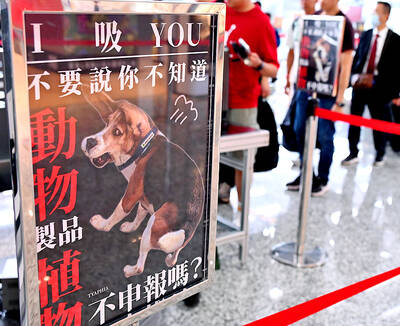
Quarantine awareness posters at Taiwan Taoyuan International Airport have gone viral for their use of wordplay. Issued by the airport branch of the Animal and Plant Health Inspection Agency, the posters feature sniffer dogs making a range of facial expressions, paired with advisory messages built around homophones. “We update the messages for holidays and campaign needs, periodically refreshing materials to attract people’s attention,” quarantine officials said. “The aim is to use the dogs’ appeal to draw focus to quarantine regulations.” A Japanese traveler visiting Taiwan has posted a photo on X of a poster showing a quarantine dog with a

Taiwan’s coffee community has launched a “one-person-one-e-mail” campaign, calling for people to send a protest-e-mail to the World Coffee Championships (WCC) urging it to redesignate Taiwanese competitors as from “Taiwan,” rather than “Chinese Taipei.” The call followed sudden action last week after the WCC changed all references to Taiwanese competitors from “Taiwan” to “Chinese Taipei,” including recent World Latte Art champion Bala (林紹興), who won the World Latte Art Championship in San Diego earlier this month. When Bala received the trophy, he was referred to as representing Taiwan, as well as in the announcement on the WCC’s Web site, until it


 RSS
RSS