


A broadcaster is being investigated for reportedly taking direction for one of its political programs from a Xinhua news agency correspondent, the National Communications Commission (NCC) said yesterday.
On Monday, the Liberty Times (sister paper of the Taipei Times) reported that a political program was taking instruction from a Xinhua correspondent, citing a journalist speaking on condition of anonymity.
China’s Taiwan Affairs Office earlier this year reached out to Taiwanese news channels requesting involvement in the production of talk shows in exchange for commercial interests in China, the source said.
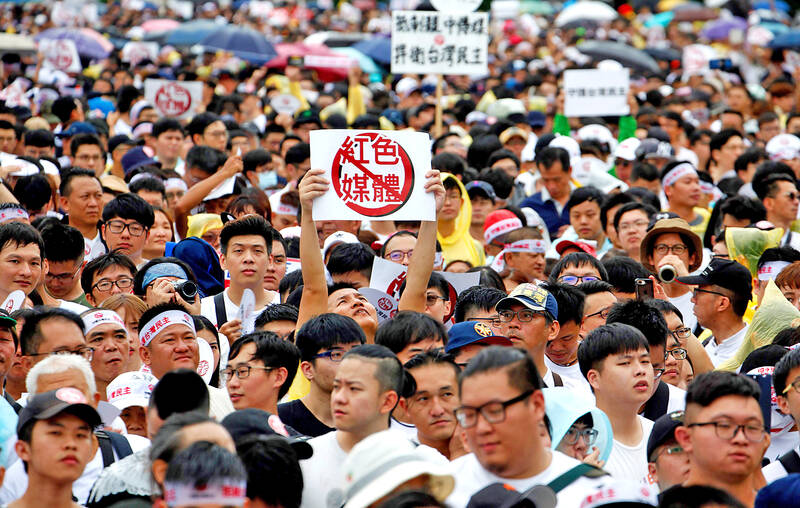
Photo: Hsu Tsun-hsu, AFP
Under the deal, Xinhua’s special correspondent in Taiwan would be involved in setting the topics, scripting dialogue and supervising filming, he said.
All but one channel rejected the offer, the source said, adding that it aired a series of shows praising former president Ma Ying-jeou’s (馬英九) cross-strait policy at Beijing’s behest during Ma’s most recent trip to China.
The show’s production team was not told about the identity or purpose of the Chinese woman, who started attending meetings until her topic selection and meddling in the delivery of lines prompted questions, the source said.
Team members who inquired into the matter learned from the channel’s senior staff that the Chinese woman was Xinhua reporter Zhao Bo (趙博), the source said.
“The saying among team members was that ratings do not matter when the fatherland is ordering the dishes,” he said.
Zhao’s replacement as special Taiwan correspondent was related to a leak about her work at the channel, the source said.
Speaking to the Taipei Times yesterday, NCC Vice Chairman and spokesman Wong Po-tsung (翁柏宗) said that the agency was aware of the report.
“We are still ascertaining details of the situation,” Wong said, without identifying the news channel.
The correspondent might have engaged in actions that were incongruent with the purpose they stated when applying for a permit to be stationed in Taiwan, Wong said, adding that the Ministry of Culture would determine whether the person had contravened Article 33-1 of the Act Governing Relations Between the People of the Taiwan Area and the Mainland Area (兩岸人民關係條例).
The NCC, on the other hand, would determine whether the channel contravened articles 22 and 27 of the Satellite Broadcasting Act (衛星廣播電視法), he said.
“News media ... should operate independently and professionally. That is the reason each newsroom is required to stipulate a journalistic code of ethics,” Wong said. “We have officially notified the Satellite Television Broadcasting Association and other broadcasting media associations that they need to beware and rectify the situation, and remind their members to abide by the code of ethics.”
Channels that fail to verify facts, are unfair in their reporting or disrupt public order face a fine of NT$400,000 to NT$2 million (US$12,329 to US$61,647). They could also be ordered to suspend broadcasting or have their license revoked, the broadcasting act says.
Mainland Affairs Council Minister Chiu Chui-cheng (邱垂正) told lawmakers in a question-and-answer session that Zhao had been recalled to China and that a multi-agency investigation would be launched.
The government did not deliberately allow Zhao’s departure from Taiwan to avoid an embarrassing scandal, Chiu said.
Premier Cho Jung-tai (卓榮泰) said on the sidelines of a legislative session that the government is not aware of the channel’s internal affairs, but authorities would probe the allegations.
“This incident shows the importance of the NCC and I hope the Legislative Yuan will approve the nomination of its members soon,” Cho said.
Additional reporting by Lin Hsin-han and Huang Ching-hsuan

NATIONAL SECURITY: Authorities are working to confirm the identities of the military personnel involved and investigating possible illegal conduct and regulatory violations Authorities are probing possible national security implications after Kinmen police and immigration officers on Sunday found a Chinese woman allegedly posing as a tourist while engaging in prostitution involving more than 10 military personnel. The woman, surnamed Chen (陳), has since been deported, authorities said, adding that investigators are still working to confirm the identities of those implicated, as the records only listed code names and aliases. The case stemmed from a report received by the Kinmen District Prosecutors’ Office on Friday last week from the Jinhu Precinct of the Kinmen County Police Bureau. On Sunday, police, along with the National Immigration

GLOBALGIVING: ‘ Caving to external pressure is not acceptable for an organization that has cultivated justice reform and human rights for 30 years,’ one NGO said A slew of non-government organizations (NGOs) have withdrawn from the GlobalGiving fundraising platform after it announced it would use “Chinese Taipei” instead of “Taiwan” from next month. The Taiwan Good Rice Association wrote on Facebook on Friday that it was informed on April 28 via a teleconference call of the change, which was made because the platform wanted to operate in China. Taiwan Good Rice is to terminate all cooperative relationships with GlobalGiving in response to the platform’s “unilateral and non-negotiable” decision to remove references to Taiwan, the NGO said. “Taiwan is in the official name of Taiwan Good Rice Association and the

HEAVY WEATHER: Typhoon Jangmi is due to crash straight into the Ryukyus as airlines look to shift flights to larger aircraft or cancel flights to Okinawa entirely Taiwan’s international air carriers announced flight adjustments over the weekend as Typhoon Jangmi is forecast to hit the Ryukyu Islands today and tomorrow. The Central Weather Administration (CWA) upgraded Jangmi from a tropical storm to a typhoon at 8am yesterday, with the eye located 580km south of Naha city. It was moving north at 19kph. Today, China Airlines’ CI-120, CI-121, CI-122 and CI-123 flights between Taoyuan and Naha, Okinawa, have been canceled as well as CI-132 and CI-133 between Kaohsiung and Naha. EVA Air’s BR-112, BR-113, BR-186 and BR-185 flights between Taoyuan and Naha are also canceled. Low-cost carrier Tigerair Taiwan canceled IT-230,
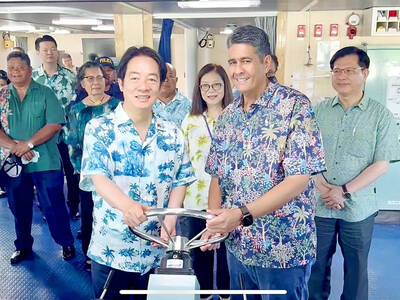
MULTIPRONGED APPROACH: China has sought to pressure Palau across a number of fronts, but the island nation has staunchly resisted overtures to ditch Taiwan Palau has been firm in backing Taiwan despite Chinese pressure that uses tourism economics, cyberattacks and criminal infiltration as tools to threaten the Pacific ally into renouncing its recognition of Taiwan as a sovereign state. The Presidential Office yesterday announced that Vice President Hsiao Bi-khim (蕭美琴) would visit Palau from Saturday to Wednesday next week at the invitation of Palauan President Surangel Whipps Jr. Whipps in April said in an interview that China had outspokenly asked Palau to “denounce Taiwan.” “And we have said: ‘We have no enemies, but nobody tells us who our friends are,’” he said. Whipps has told reporters multiple times


 RSS
RSS