


Scooter traffic incidents have a higher fatality rate when elderly people are involved, a study showed.
Taiwan is to become a super-aged society next year, and as elderly people are becoming a higher proportion of road users, traffic safety education is becoming more important, researchers a in the Department of Public Health at National Cheng Kung University (NCKU) in Tainan said.
Although there is a lower proportion of elderly people involved in traffic incidents, data showed that they have a higher death rate, NCKU Professor of Public Health Lee Chung-yi (李中一) said.
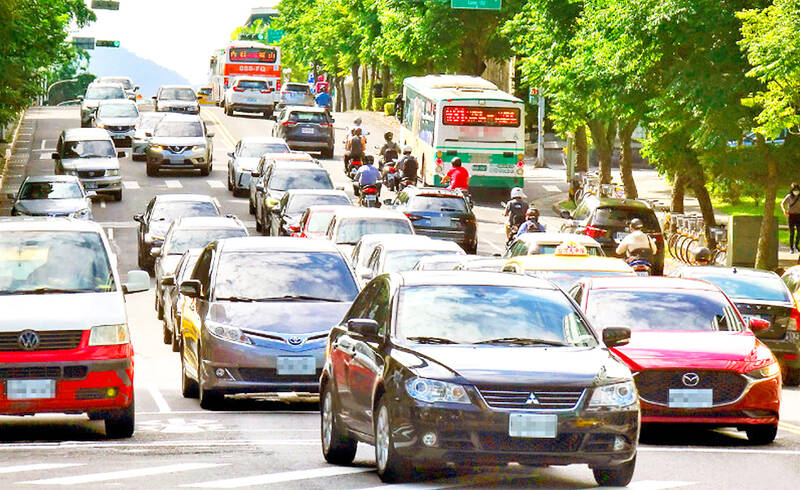
Photo: Taipei Times file
Data compiled by the research team showed that about 28,000 people aged 65 or older were injured in traffic incidents in 2011.
The number climbed to 73,000 last year, three times the amount in 2011, he said.
People aged 65 or older accounted for 13.6 percent of two-wheeled vehicle road accidents last year, but were 38.3 percent of the fatality rate, Lee said.
“Although elderly people are less likely to be in traffic incidents, when they are, it is more likely to be fatal. The government has regulations in place requiring people aged 75 and older to have a medical examination every three years when they renew their driver’s license,” he said.
The regulation requires that examinations be conducted at a hospital or a medical center, to check for dementia, cognitive decline and visual ability, and other tests to verify the person’s ability to drive a scooter.
“Although the regulation has been in place for many years, we still have no data on whether it has been effective in reducing traffic incidents among elderly people,” Lee said.
More resources are needed to help people who require mobility assistance, such as those recovering from stroke, spinal cord injuries and other major illnesses, NCKU Department of Occupational Therapy researcher Chen Yu-ting (陳郁婷) said.
“Although people recovering from these injuries — which affects elderly people in particular — have decreased mobility, they still need to go out to places to live their lives, and they often use vehicles,” Chen said.
The study found that 84 percent of elderly people in Tainan rely on a scooter as their main mode of transportation, and 80 percent of use a scooter three days or more in a week.
Chen said that 6 percent of the monitored subjects had a known decline in cognitive skills, 8 percent had balance problems, 24 percent had vision conditions leading to attention lapses and were unable to control or reduce their vehicle speed in time, and 24 percent admitted to not having a scooter license, or it was already expired.
The research team said that Taiwan must face up to issues associated with having a super-aged society, recommending that the government create education programs to train elderly people about road safety.
They said their research findings showed that through education, elderly people had a better comprehension of road safety, and greater awareness about potentially dangerous conditions and preventative measured required to keep safe on the road.

Considering that most countries issue more than five denominations of banknotes, the central bank has decided to redesign all five denominations, the bank said as it prepares for the first major overhaul of the banknotes in more than 24 years. Central bank Governor Yang Chin-lung (楊金龍) is expected to report to the Legislative Yuan today on the bank’s operations and the redesign’s progress. The bank in a report sent to the legislature ahead of today’s meeting said it had commissioned a survey on the public’s preferences. Survey results showed that NT$100 and NT$1,000 banknotes are the most commonly used, while NT$200 and NT$2,000

The Centers for Disease Control (CDC) yesterday reported the first case of a new COVID-19 subvariant — BA.3.2 — in a 10-year-old Singaporean girl who had a fever upon arrival in Taiwan and tested positive for the disease. The girl left Taiwan on March 20 and the case did not have a direct impact on the local community, it said. The WHO added the BA.3.2 strain to its list of Variants Under Monitoring in December last year, but this was the first imported case of the COVID-19 variant in Taiwan, CDC Deputy Director-General Lin Ming-cheng (林明誠) said. The girl arrived in Taiwan on

South Korea is planning to revise its controversial electronic arrival card, a step Taiwanese officials said prompted them to hold off on planned retaliatory measures, a South Korean media report said yesterday. A Yonhap News Agency report said that the South Korean Ministry of Foreign Affairs is planning to remove the “previous departure place” and “next destination” fields from its e-arrival card system. The plan, reached after interagency consultations, is under review and aims to simplify entry procedures and align the electronic form with the paper version, a South Korean ministry official said. The fields — which appeared only on the electronic form

The Ministry of Foreign Affairs (MOFA) is suspending retaliation measures against South Korea that were set to take effect tomorrow, after Seoul said it is updating its e-arrival system, MOFA said today. The measures were to be a new round of retaliation after Taiwan on March 1 changed South Korea's designation on government-issued alien resident certificates held by South Korean nationals to "South Korea” from the "Republic of Korea," the country’s official name. The move came after months of protests to Seoul over its listing of Taiwan as "China (Taiwan)" in dropdown menus on its new online immigration entry system. MOFA last week


 RSS
RSS