


The Legislative Yuan should convene and vote again on amendments to the Act Governing the Legislative Yuan’s Power (立法院職權行使法), as the Executive Yuan has found the amendments challenging to enact, Premier Cho Jung-tai (卓榮泰) said yesterday at the legislature in Taipei.
The Legislative Yuan is to review and decide whether to accept the Cabinet’s motion tomorrow.
The original review of the amendments contravened democratic principles, and the result could not be considered “law” due to the lack of proper discussion at any stage in the process, while unnecessary restrictions prevented those with opposing views from fully expressing their opinions, Cho said.
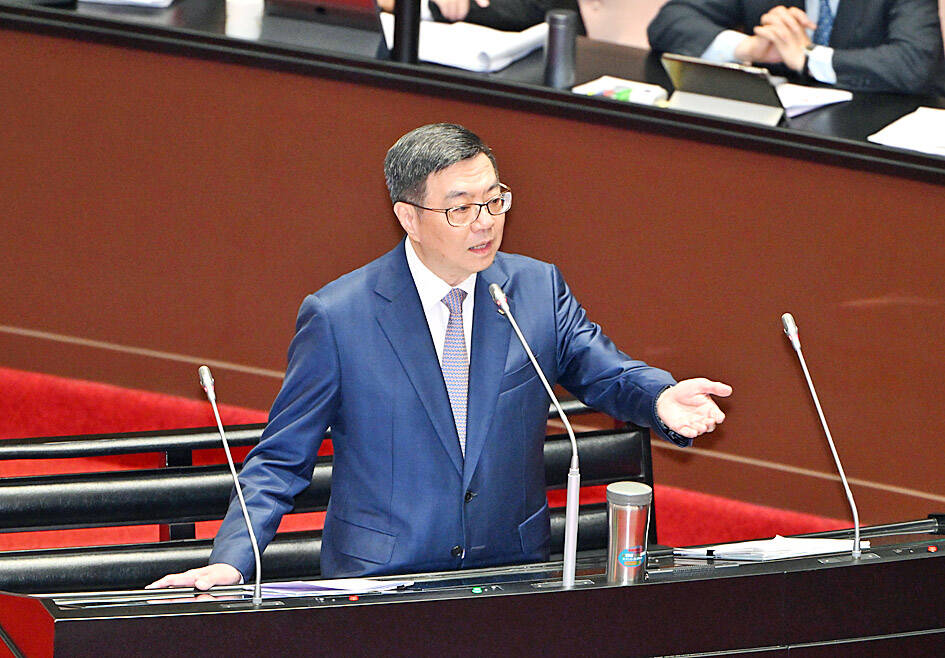
Photo: Tien Yu-hua, Taipei Times
Normalizing the president giving a state of the nation address at the legislature and answering lawmakers’ questions is unconstitutional, he said.
The National Assembly, which chose the president before direct elections in 1996, had no power to interrupt the president when they gave a state of the nation address, and the legislature, which inherited most of the National Assembly’s powers after it was frozen in 2005, should not retain powers exceeding those of its predecessor, Cho said.
The powers of inquiry, investigation and summoning witnesses for testimony in the amendments challenge the separation of powers and infringe on the people’s basic rights, he said.
The power of inquiry is given to investigate whether the government is at fault, and is under the jurisdiction of the Control Yuan and the judiciary, while no laws mandate the public’s cooperation with a government institution to fulfill its duties, Cho said.
It is not guaranteed that the legislature’s investigations would benefit the public more than they would infringe on people’s rights, he said.
The amendments touch on the powers of personnel ratification, but fail to set a time frame for deliberation, and overly long ratifications could prevent individuals from assuming office and affect government operations, Cho said.
The acts that would be defined as being “in contempt of the legislature” needed to be clarified, and if left as is, the amendments would only cause political strife to spill over into the judiciary, he said.
Cho said he was not against legislative reform, but such reforms should remain under the framework separating the five branches of the central government.
KMT Legislator Lo Chih-chiang (羅智強) said that of the 680 people accused of breaching the Social Order Maintenance Act (社會秩序維護法) from 2016 to January 2020, 500 were found to be innocent and victims of government abuse of power.
Failure to amend the Act Governing the Legislative Yuan’s Power is why no member of the public has been asked to stand before the legislature to assist in investigations into government abuse of power, Lo said.
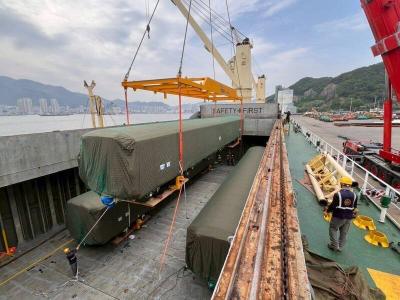
The first of 10 new high-capacity trains purchased from South Korea’s Hyundai Rotem arrived at the Port of Taipei yesterday to meet the demands of an expanding metro network, Taipei Rapid Transit Corp (TRTC) said yesterday. The train completed a three-day, 1,200km voyage from the Port of Masan in South Korea, the company said. Costing NT$590 million (US$18.79 million) each, the new six-carriage trains feature a redesigned interior based on "human-centric" transportation concepts, TRTC said. The design utilizes continuous longitudinal seating to widen the aisles and optimize passenger flow, while also upgrading passenger information displays and driving control systems for a more comfortable
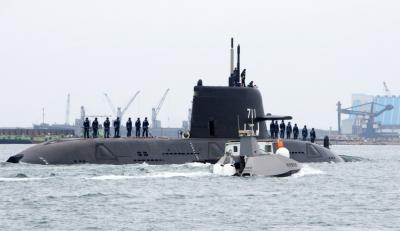
Taiwan's first indigenous defense submarine, the SS-711 Hai Kun (海鯤, or Narwhal), departed for its 13th sea trial at 7am today, marking its seventh submerged test, with delivery to the navy scheduled for July. The outing also marked its first sea deployment since President William Lai (賴清德) boarded the submarine for an inspection on March 19, drawing a crowd of military enthusiasts who gathered to show support. The submarine this morning departed port accompanied by CSBC Corp’s Endeavor Manta (奮進魔鬼魚號) uncrewed surface vessel and a navy M109 assault boat. Amid public interest in key milestones such as torpedo-launching operations and overnight submerged trials,
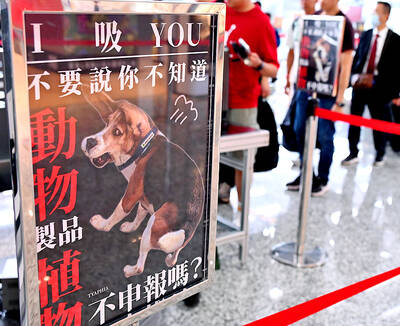
Quarantine awareness posters at Taiwan Taoyuan International Airport have gone viral for their use of wordplay. Issued by the airport branch of the Animal and Plant Health Inspection Agency, the posters feature sniffer dogs making a range of facial expressions, paired with advisory messages built around homophones. “We update the messages for holidays and campaign needs, periodically refreshing materials to attract people’s attention,” quarantine officials said. “The aim is to use the dogs’ appeal to draw focus to quarantine regulations.” A Japanese traveler visiting Taiwan has posted a photo on X of a poster showing a quarantine dog with a

Taiwan’s coffee community has launched a “one-person-one-e-mail” campaign, calling for people to send a protest-e-mail to the World Coffee Championships (WCC) urging it to redesignate Taiwanese competitors as from “Taiwan,” rather than “Chinese Taipei.” The call followed sudden action last week after the WCC changed all references to Taiwanese competitors from “Taiwan” to “Chinese Taipei,” including recent World Latte Art champion Bala (林紹興), who won the World Latte Art Championship in San Diego earlier this month. When Bala received the trophy, he was referred to as representing Taiwan, as well as in the announcement on the WCC’s Web site, until it


 RSS
RSS