


Three scientists were awarded this year’s Tang Prize in Biopharmaceutical Science for discovering the Glucagon-like peptide-1 (7-37) (GLP-1 (7-37)) which stimulates insulin secretion and can be used in medication combating diabetes and obesity, the Tang Prize Selection Committee announced in Taipei yesterday.
The three laureates — Joel Habener, Svetlana Mojsov and Jens Juul Holst — were presented the award for “the discovery of GLP-1 (7-37) as having an insulinotropic factor and the development of GLP-1 (7-37)-based anti-diabetic and anti-obesity drugs,” said Chang Wen-chang (張文昌), chair of the Tang Prize Selection Committee for Biopharmaceutical Science and an academic at Academia Sinica.
The laureates’ discoveries laid the foundation for the further development of GLP-1 (7-37), a 31-amino acid peptide, by other scientists. The result has been the development of blockbuster drugs that have benefited hundreds of millions of users and have great prospects, said Academia Sinica’s Kung Hsing-jien (龔行健), who introduced the laureates’ major contributions.
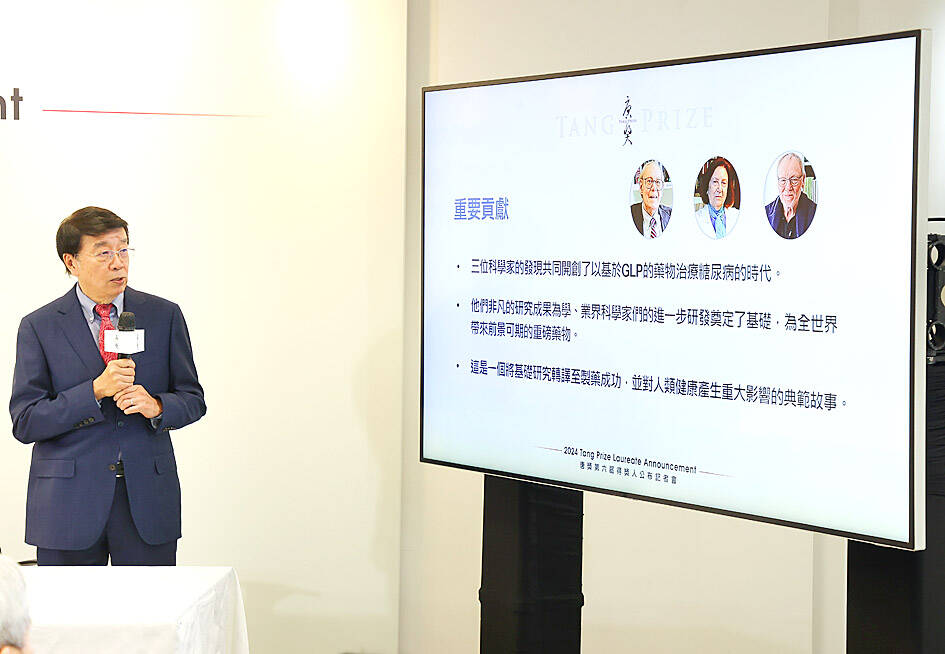
Photo: CNA
Their work surrounding GLP-1 (7-37) is also “an exemplary story of translating basic research into pharmaceutical success with major impacts on human health,” Kung said, adding that there are more than 500 million people with diabetes and about 1 billion obese individuals in the world.
Type 2 diabetes, which makes up about 90 percent of the world’s cases, occurs because pancreas beta cells do not secrete enough insulin, a peptide hormone that lowers blood glucose levels. The body also cannot respond to insulin properly, which causes high blood sugar and leads to severe complications.
On the other hand, obesity raises the risk of various diseases and is regarded as one of the most important global public health issues.
The work toward discovering that GLP-1 (7-37) has an insulinotropic factor — meaning it stimulates insulin secretion — dates back to the early 1980s. Habener, a physician at the Massachusetts General Hospital (MGH) and an emeritus professor of medicine at Harvard Medical School, then published the results of cloning the preproglucagon gene from anglerfish.
Specializing in endocrinology and metabolism, Habener found that preproglucagon, a precursor protein, contains glucagon — a peptide hormone that raises blood glucose levels — along with another glucagon-related peptide (GRP).
Subsequent cloning of the preproglucagon gene from rats showed that it contained glucagon and two additional peptides designated GLP-1 and GLP-2, and that the GRP from anglerfish is a form of GLP-1.
Habener then collaborated with Mojsov, the head of a peptide synthesis facility at MGH who identified GLP-1 (7-37) as the active form of intestinal GLP-1. Together they showed that GLP-1 (7-37) induces insulin release from the pancreas, as opposed to the entire GLP-1 (1-37) — the whole peptide.
The discovery was critical in identifying the long-sought-after incretin — a type of hormone released from the gut after eating, which stimulates insulin secretion from the pancreas in response to food intake — and led to GLP-1 (7-37) being used in diabetes medication, an award citation released by the Tang Prize Foundation said.
Mojsov made significant contributions to GLP-1 (7-37), through synthesizing — chemically creating — the peptide in the mid-80s, it said, adding that she also developed several important experimental approaches to detect the GLPs in the intestine.
She later collaborated again with Haberner and further demonstrated through human subject research that GLP-1 (7-37) stimulates insulin production, paving the way for its use in clinical settings.
Independently, Holst at the University of Copenhagen also isolated and identified GLP-1 (1-37), and subsequently the GLP-1 (7-36) amide — another truncated form of GLP-1 that is equally potent as GLP-1 (7-37) — as an active incretin in the mid-to-late 1980s.
He was also lauded by the foundation for characterizing the biology and physiology of GLP-1 (7-37), demonstrating its therapeutic potential and contributing to the development of anti-diabetic drugs.
The findings of Habener, Mojsov and Holst collectively led to an era of GLP-based drugs being used to treat diabetes from 2005 and obesity from 2014. More people have started using these medications over the past few years.
During clinical trials, it was observed that patients receiving GLP-based drugs experienced weight loss. Further studies revealed that GLP-1 receptors in the human brain could suppress appetite and treat obesity.
Holst also reported that GLP-1 (7-37) reduces stomach acid and slows gastric emptying, the foundation said.
After years of pharmaceutical development, there are at least 13 GLP-1 receptor agonist drugs — medications that mimic the actions of incretin and activate the GLP-1 receptor — approved by the US Food and Drug Administration for treating diabetes, obesity or both, the foundation added.


UPGRADE: The Kang Ding-class frigate is replacing its Chaparall missiles with Tien Chien II and Hua Yang VLS, which would provide it with long-range, 360° air defense Taiwan plans to produce 1,200 to 1,376 Hai Chien II missiles (海劍二, Sea Sword II) — also known as TC-2N — to serve as the standard air defense system of the navy’s surface combatant fleet, a source said yesterday. Last week, the Hai Chien II, the naval version of the Tien Kung II missile (天劍二, Sky Sword II), completed a live-fire test in waters off the National Chungshan Institute of Science and Technology’s Jiupeng facility (九鵬) in Pingtung County’s Manjhou Township (滿州). The MIM72 Chaparral and other dated air defense missiles that currently arm Taiwanese ships have inadequate range to combat Chinese

REASONS FOR TRAVEL: An assistant professor said that proposed amendments to penalize drivers if they used drugs overseas would not deter people from traveling People who operate a motor vehicle under the influence of marijuana would have their driver’s license revoked, even if they used the substance while overseas, the Ministry of Transportation and Communications said yesterday, citing proposed amendments to the Road Traffic Management and Penalty Act (道路交通管理處罰條例). The amendments would also authorize the government to revoke the licenses of people determined to have used Category 1 or Category 2 narcotics, even if they were not operating a vehicle while under the influence of drugs, as well as ban them from taking the license test for three years, the ministry said. People aged 18 or

Johanne Liou (劉喬安), a Taiwanese woman who shot to unwanted fame during the Sunflower movement protests in 2014, returned to Taiwan last night after being deported from the US. She is to stand trial in Taiwan for charges involving embezzlement, fraud and drug crimes. The Criminal Investigation Bureau (CIB) said it took her into custody at Taiwan Taoyuan International Airport and would first question her before transferring her to the New Taipei District Prosecutors’ Office. She was arrested upon disembarking a flight from San Francisco that landed shortly before 7pm. Liou absconded to the US in 2019 after jumping bail

Shih Hsin University President Chen Ching-he (陳清河) yesterday issued a public apology for comments made in his commencement speech last week, stating that he has asked the school to suspend his duties and halt his wages for two months as a show of contrition. At the commencement ceremony on May 30, Chen said, “If you don’t manage your time well, or your own emotions, or your health, then I am telling every one of you — put a quick end to ‘you,’ because the world has no need for ‘you.’” The comments have sparked significant controversy online, and Chen through an open


 RSS
RSS