


The US would intervene militarily if China attacked Taiwan, retired Japanese lieutenant general Hirotaka Yamashita said.
Yamashita made the remarks in an interview with the Liberty Times (the Taipei Times’ sister newspaper) on Friday.
He is in Taiwan to promote his book on Taiwan Strait security.
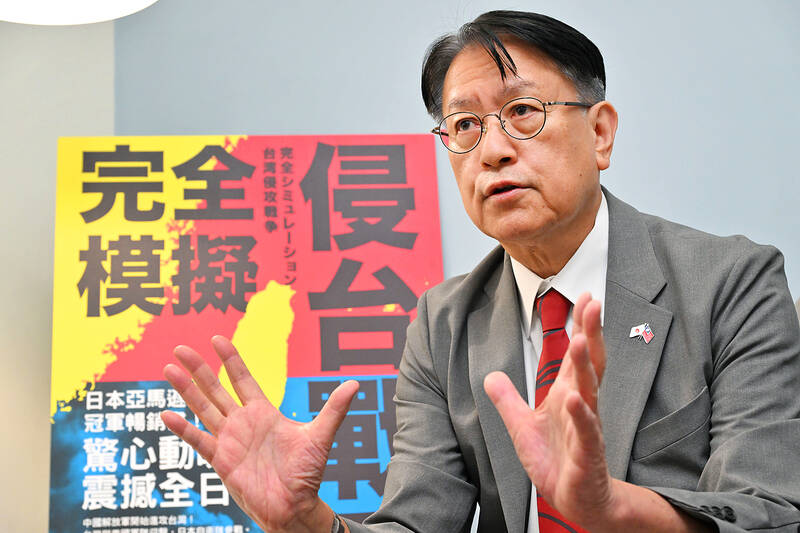
Photo: Tien Yu-hua, Taipei Times
Yamashita said he wrote Total Simulation of a Taiwan Invasion to warn and inform the Japanese public on the impact a conflict in the Taiwan Strait would have on Japan.
Most Japanese have heard the phrase “A Taiwan contingency is a Japan contingency,” without understanding what that means for their nation, he said.
As Russian President Vladimir Putin’s invasion of Ukraine under the pretext of demilitarization and fighting “Nazis” showed, Beijing would have no shortage of excuses if it wished to start a war against Taiwan, Yamashita said.
However, a US intervention is highly likely, as US President Joe Biden has stated multiple times that he would send troops to defend Taiwan, Yamashita said.
The loss of Taiwanese and US lives in a Chinese attack would force Washington’s hand, Yamashita added.
The US could defend Taiwan by deploying sea, air, electronic and cyberspace warfare capabilities, he said.
To invade Taiwan, the Chinese People’s Liberation Army (PLA) must deploy a massive number of troops across the Taiwan Strait, exposing vulnerable troop transport ships to smaller asymmetric weapons systems, he said.
The loss of one large transport ship could result in more than 1,000 casualties, losses Beijing increasingly could not afford amid its low birthrate and aging population, Yamashita said.
The PLA can no longer count on “out-bleeding” its opponents, and high casualties from an attempt to take over Taiwan could become politically unaffordable to China’s leadership, he said.
Taiwan’s decision to reinstate one year of military conscription is well-advised, as asymmetric warfare offers the nation its best chance at victory, he said.
Increasing the number of ground troops works well with the US’ strategy of holding the line with uncrewed aerial vehicles and robot ships to buy time to mount a response, Yamashita said.
Taiwan is a valued friend to Japan and many politicians in Tokyo share former Japanese prime minister Shinzo Abe’s concern for the security of Taiwan, he said.
The visit to Taipei by a multi-party delegation of Japanese lawmakers to attend President William Lai’s (賴清德) inauguration last month demonstrated the breadth of support Taiwan enjoys among Japanese, he said.
Despite the constraints of Japan’s pacifist constitution, Taipei and Tokyo can collaborate on many security matters, such as making better arrangements for the safety of Japanese citizens in Taiwan during a military conflict, he said.

Considering that most countries issue more than five denominations of banknotes, the central bank has decided to redesign all five denominations, the bank said as it prepares for the first major overhaul of the banknotes in more than 24 years. Central bank Governor Yang Chin-lung (楊金龍) is expected to report to the Legislative Yuan today on the bank’s operations and the redesign’s progress. The bank in a report sent to the legislature ahead of today’s meeting said it had commissioned a survey on the public’s preferences. Survey results showed that NT$100 and NT$1,000 banknotes are the most commonly used, while NT$200 and NT$2,000

The Centers for Disease Control (CDC) yesterday reported the first case of a new COVID-19 subvariant — BA.3.2 — in a 10-year-old Singaporean girl who had a fever upon arrival in Taiwan and tested positive for the disease. The girl left Taiwan on March 20 and the case did not have a direct impact on the local community, it said. The WHO added the BA.3.2 strain to its list of Variants Under Monitoring in December last year, but this was the first imported case of the COVID-19 variant in Taiwan, CDC Deputy Director-General Lin Ming-cheng (林明誠) said. The girl arrived in Taiwan on

South Korea is planning to revise its controversial electronic arrival card, a step Taiwanese officials said prompted them to hold off on planned retaliatory measures, a South Korean media report said yesterday. A Yonhap News Agency report said that the South Korean Ministry of Foreign Affairs is planning to remove the “previous departure place” and “next destination” fields from its e-arrival card system. The plan, reached after interagency consultations, is under review and aims to simplify entry procedures and align the electronic form with the paper version, a South Korean ministry official said. The fields — which appeared only on the electronic form

The Ministry of Foreign Affairs (MOFA) is suspending retaliation measures against South Korea that were set to take effect tomorrow, after Seoul said it is updating its e-arrival system, MOFA said today. The measures were to be a new round of retaliation after Taiwan on March 1 changed South Korea's designation on government-issued alien resident certificates held by South Korean nationals to "South Korea” from the "Republic of Korea," the country’s official name. The move came after months of protests to Seoul over its listing of Taiwan as "China (Taiwan)" in dropdown menus on its new online immigration entry system. MOFA last week


 RSS
RSS