


China’s Taiwan Affairs Office (TAO) yesterday said that the Chinese man who drove a motorboat into a strategic river mouth in Taiwan on Sunday was acting on his own and would be punished upon his return to China.
However, the National Security Bureau said it would not exclude any possibilities regarding the man’s motivations, including the Chinese government’s involvement. The man has been identified as a 60-year-old former Chinese navy captain surnamed Ruan (阮).
Coast guard personnel on Sunday arrested Ruan in New Taipei City’s Tamsui District (淡水) after his boat entered Tamsui River (淡水河).

Photo: Wang Yi-sung, Taipei Times
The boat was detected off the coast of Taiwan on Sunday, but was not intercepted until it collided with other vessels at a ferry terminal on the river, which leads to the capital and flows into the Taiwan Strait.
Authorities have detained Ruan, and his apparent naval background has raised suspicions that the voyage might have been an attempt by China to test Taiwan’s detection and defense capabilities.
Speaking at a regular news briefing in Beijing yesterday, TAO spokesman Chen Binhua (陳斌華) said what Ruan had done was “purely his personal action.”
“There is no need for the Democratic Progressive Party authorities to see soldiers hiding behind every tree and bush, carrying out political manipulation while pretending to act earnestly,” he said.
Ruan would be punished once he returns to China, Chen added, without giving details.
Taiwan has not indicated when or if it would send him back, saying that legal authorities are still investigating the matter.
At the Legislative Yuan in Taipei, bureau Director-General Tsai Ming-yen (蔡明彥) said that Ruan’s apparent military background made the case rather unusual.
“There are many areas of doubt that still need to be further clarified,” he said.
Taiwan has said in recent years that China has been using “gray zone” warfare, which is designed to exhaust a foe by using irregular tactics without resorting to open combat, such as flying surveillance balloons over the nation.
Tsai said the speedboat incident might be just such a tactic.
Meanwhile, 22 Chinese People’s Liberation Army (PLA) aircraft and vessels were detected in the airspace and waters around Taiwan in the 24 hours after 6am on Tuesday, the Ministry of National Defense said.
Thirteen PLA aircraft were detected in the vicinity of Taiwan, two of which crossed the median line of the Taiwan Strait, while seven others, including one drone, crossed an extension of the median line and entered Taiwan’s southeastern and southwestern air defense identification zones, the ministry said.
The drone flew as close as 43 nautical miles (80km) from Oluanpi (鵝鑾鼻), Taiwan’s southernmost tip, ministry data showed.
Nine PLA vessels were detected in waters off Taiwan over the same period.
The ministry said that it was closely monitoring the situation and had deployed combat air patrol aircraft, coastal missile systems and navy vessels in response.
Additional reporting by Ben Blanchard

The military has spotted two Chinese warships operating in waters near Penghu County in the Taiwan Strait and sent its own naval and air forces to monitor the vessels, the Ministry of National Defense (MND) said. Beijing sends warships and warplanes into the waters and skies around Taiwan on an almost daily basis, drawing condemnation from Taipei. While the ministry offers daily updates on the locations of Chinese military aircraft, it only rarely gives details of where Chinese warships are operating, generally only when it detects aircraft carriers, as happened last week. A Chinese destroyer and a frigate entered waters to the southwest
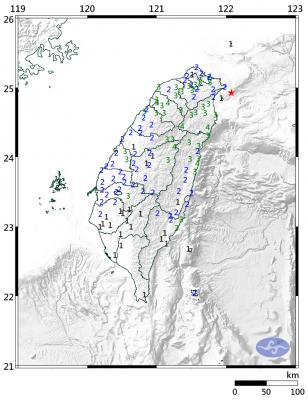
A magnitude 6.1 earthquake struck off the coast of Yilan County at 8:39pm tonight, the Central Weather Administration (CWA) said, with no immediate reports of damage or injuries. The epicenter was 38.7km east-northeast of Yilan County Hall at a focal depth of 98.3km, the CWA’s Seismological Center said. The quake’s maximum intensity, which gauges the actual physical effect of a seismic event, was a level 4 on Taiwan’s 7-tier intensity scale, the center said. That intensity level was recorded in Yilan County’s Nanao Township (南澳), Hsinchu County’s Guansi Township (關西), Nantou County’s Hehuanshan (合歡山) and Hualien County’s Yanliao (鹽寮). An intensity of 3 was
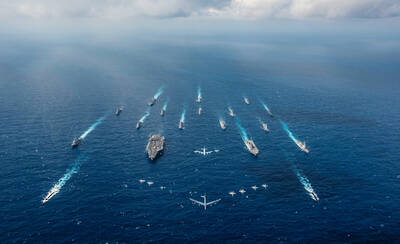
Japanese Prime Minister Sanae Takaichi’s comment last year on Tokyo’s potential reaction to a Taiwan-China conflict has forced Beijing to rewrite its invasion plans, a retired Japanese general said. Takaichi told the Diet on Nov. 7 last year that a Chinese naval blockade or military attack on Taiwan could constitute a “survival-threatening situation” for Japan, potentially allowing Tokyo to exercise its right to collective self-defense. Former Japan Ground Self-Defense Force general Kiyofumi Ogawa said in a recent speech that the remark has been interpreted as meaning Japan could intervene in the early stages of a Taiwan Strait conflict, undermining China’s previous assumptions
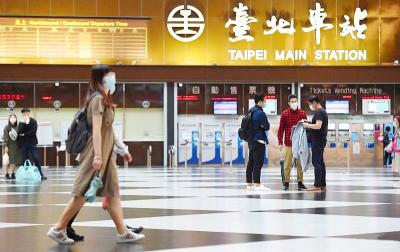
Taiwan Railways Corp (TRC) today announced that Shin Kong Mitsukoshi has been selected as the preferred bidder to operate the Taipei Railway Station shopping mall, replacing the current operator, Breeze Development Co Ltd. Among eight qualified firms that delivered presentations and were evaluated by a review committee, Shin Kong Mitsukoshi was ranked first, while Breeze was named the runner-up, the rail company said in a statement. Contract negotiations are to proceed in accordance with regulations, it said, adding that if negotiations with the top bidder fail, it could invite the second-ranked applicant to enter talks. Breeze in a statement today expressed doubts over


 RSS
RSS