


Defense experts have urged the government to be on high alert following the arrest of a Chinese national in New Taipei City’s Tamsui District (淡水) who claimed to have driven a motorboat from China to “defect” to Taiwan.
The Coast Guard Administration (CGA) on Sunday arrested the man, who allegedly arrived at a harbor at the mouth of the Tamsui River (淡水河) that leads into Taipei.
The suspicious vessel was monitored after being spotted at about 11am, 6 nautical miles (11.11km) off Tamsui, the CGA said.
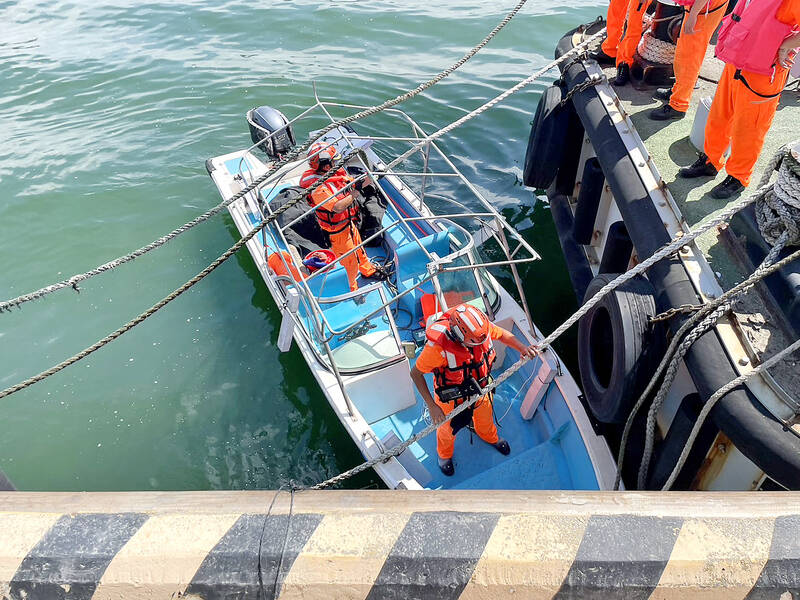
Photo courtesy of the Coast Guard Administration via CNA
After entering the river, the boat collided with other vessels at a ferry terminal, prompting ferry operators to contact the coast guard and file a report.
The intruder, identified as a 60-year-old man surnamed Ruan (阮), was being questioned by Taipei prosecutors on suspicion of contravening the Act Governing Relations Between the People of the Taiwan Area and the Mainland Area (臺灣地區與大陸地區人民關係條例) and the Immigration Act (入出國及移民法).
An unnamed source familiar with the incident told local media that Ruan claimed he wanted to defect to Taiwan after making anti-Chinese government comments on online messaging apps.
The incident drew attention from the media and military experts because the Tamsui River is considered a critical strategic location and serves as the gateway to the capital, where the Presidential Office and other important government institutions are located.
The military regularly holds the drills in the Tamsui River estuary, the Port of Taipei and Bali Beach — the so-called “defense triangle of Taipei” — to test its ability to guard the critical strategic area.
Defense experts yesterday said that it is still unclear whether Ruan really wanted to defect, or if the incident was part of a Chinese government test of Taiwan’s coastal and harbor management and defenses.
Su Tzu-yun (蘇紫雲), a research fellow at the government-funded Institute for National Defense and Security Research, said it is unlikely Ruan could have gone more than 200km from the coast of China to Taiwan aboard a motorboat.
It is more likely that the boat was released from a larger vessel midway, Su said.
Lin Ying-yu (林穎佑), an assistant professor at Tamkang University’s Institute of Strategic Studies, said that Taiwan has the technological capability to monitor its shores at all times, but that the incident on Sunday revealed certain weaknesses in harbor management and control.
It was possible that the Chinese Communist Party was behind the incident to test Taiwan’s defense capabilities, Lin said.
He called on the government to remain on high alert.
Shu Hsiao-huang (舒孝煌), another researcher from the Institute for National Defense and Security Research, said the incident shows that the coast guard, police and military must have clearer jurisdictions to help them respond timely to such events.
“Or in the future, the Chinese People’s Liberation Army could continue testing Taiwan’s defenses near the Tamsui River estuary by sending more and more civilian ships, speedboats or even unnamed ships,” he said.

LOUD AND PROUD Taiwan might have taken a drubbing against Australia and Japan, but you might not know it from the enthusiasm and numbers of the fans Taiwan might not be expected to win the World Baseball Classic (WBC) but their fans are making their presence felt in Tokyo, with tens of thousands decked out in the team’s blue, blowing horns and singing songs. Taiwanese fans have packed out the Tokyo Dome for all three of their games so far and even threatened to drown out home team supporters when their team played Japan on Friday. They blew trumpets, chanted for their favorite players and had their own cheerleading squad who dance on a stage during the game. The team struggled to match that exuberance on the field, with
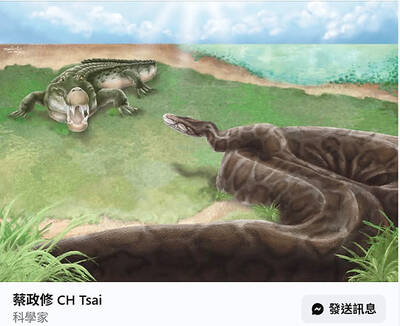
Taiwanese paleontologists have discovered fossil evidence that pythons up to 4m long inhabited Taiwan during the Pleistocene epoch, reporting their findings in the international scientific journal Historical Biology. National Taiwan University (NTU) Institute of Ecology and Evolutionary Biology associate professor Tsai Cheng-hsiu (蔡政修) led the team that discovered the largest snake fossil ever found in Taiwan. The single trunk vertebra was discovered in Tainan at the Chiting Formation, dated to between 400,000 and 800,000 years ago in the Middle Pleistocene, the paper said. The area also produced Taiwan’s first avian fossil, as well as crocodile, mammoth, saber-toothed cat and rhinoceros fossils, it said. Discoveries

Taiwanese paleontologists have discovered fossil evidence that pythons up to 4m long inhabited Taiwan during the Pleistocene epoch, reporting their findings in the international scientific journal Historical Biology. National Taiwan University (NTU) Institute of Ecology and Evolutionary Biology associate professor Tsai Cheng-hsiu (蔡政修) led the team that discovered the largest snake fossil ever found in Taiwan. A single trunk vertebra was discovered in Tainan at the Chiting Formation, dated to between 800,000 to 400,000 years ago in the Middle Pleistocene, the paper said. The area also produced Taiwan’s first avian fossil, as well as crocodile, mammoth, sabre-toothed cat and rhinoceros fossils, it said. Discoveries

Whether Japan would help defend Taiwan in case of a cross-strait conflict would depend on the US and the extent to which Japan would be allowed to act under the US-Japan Security Treaty, former Japanese minister of defense Satoshi Morimoto said. As China has not given up on the idea of invading Taiwan by force, to what extent Japan could support US military action would hinge on Washington’s intention and its negotiation with Tokyo, Morimoto said in an interview with the Liberty Times (sister paper of the Taipei Times) yesterday. There has to be sufficient mutual recognition of how Japan could provide


 RSS
RSS