


The governing Democratic Progressive Party (DPP) and the opposition Chinese Nationalist Party (KMT) are slated to organize town hall meetings across Taiwan “to engage people directly” and explain their stance regarding the legislative reform bills that passed on May 28.
The Executive Yuan on Thursday said it is preparing to have the legislature reconsider the passage of the bills on the grounds they are “unconstitutional” and “difficult to implement.”
The DPP is to hold its “Defend Democracy, Oppose Expansion of Power” series of talks in Hualien County starting Friday, then in New Taipei City on Saturday and Taipei on Sunday, the party’s secretary-general Lin Yu-chang (林右昌) said.
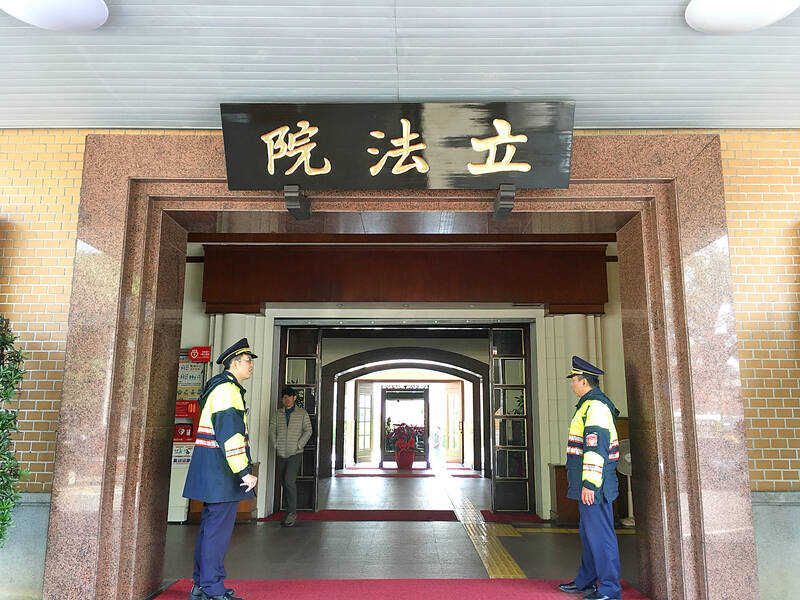
Photo: Lin Liang-sheng, Taipei Times
“Hualien County is the starting place, because the bills were proposed and spearheaded by [KMT Hualien Legislator] Fu Kun-chi (傅?萁),” and Fu has his power base there, as he was elected as legislator and previously as county commissioner there, Lin said on Friday.
Many Hualien County residents would also like to better understand the bills and related issues, he said.
Taipei and New Taipei are the center of gravity for Taiwan’s economy and politic domain, he added.
The DPP chose to get started at those three locations as time is short, Lin said.
“Taiwan’s democracy needs to reach all citizens for them to better understand and participate in the democratic process. This way, they can better evaluate events in politics and what is happening in the legislature. People should get to know how their personal rights might be affected and how our nation’s political framework can function more effectively,” he said.
DPP caucus secretary-general Rosalia Wu (吳思瑤) yesterday said that as the Executive Yuan is poised to ask the legislature to reconsider the bill, “we hope to consolidate all DPP supporters and the potential legislative seats representing them, to express the will of the people, so that the blue and white political camps will concede to the public sentiment, and maybe some of them will reject the bills.”
Meanwhile, the KMT said it plans to start its town hall meeting on Friday in Tainan.
KMT lawmakers are to speak at the event to explain to the public why they think the amendments are necessary.
The party said it plans to hold one such meeting in each city and county across Taiwan.
KMT Legislator Hsieh Lung-chieh (謝龍介) said the DPP is trying to vilify the bills passage.
“They are in control of the government agencies, but they are still quarreling and trash-talking,” Hsieh said
In response to media queries on whether the Taiwan People’s Party (TPP) would hold similar events, TPP caucus spokeswoman Vicky Chen (陳智菡) yesterday said that her party plans to do something different to get people more engaged.
The party might organize question-and-answer sessions, to explain its stance to the public directly, “so they would not have to listen to the rumors put forth by the ruling party,” Chen said.
The party has been engaging with the public on the matter, TPP caucus whip Huang Kuo-chang (黃國昌) said.
“That was why in the legislative process during second reading phase, I livestreamed for three days, explaining to people what is happening inside the legislature. I also accepted an interview request from a YouTuber who held an opposing view on the matter, and I did not try to evade on these issues,” he said.
Additional reporting by Hsieh Chun-lin, Huang Ching-hsuan, and Jason Pan

Considering that most countries issue more than five denominations of banknotes, the central bank has decided to redesign all five denominations, the bank said as it prepares for the first major overhaul of the banknotes in more than 24 years. Central bank Governor Yang Chin-lung (楊金龍) is expected to report to the Legislative Yuan today on the bank’s operations and the redesign’s progress. The bank in a report sent to the legislature ahead of today’s meeting said it had commissioned a survey on the public’s preferences. Survey results showed that NT$100 and NT$1,000 banknotes are the most commonly used, while NT$200 and NT$2,000

The Centers for Disease Control (CDC) yesterday reported the first case of a new COVID-19 subvariant — BA.3.2 — in a 10-year-old Singaporean girl who had a fever upon arrival in Taiwan and tested positive for the disease. The girl left Taiwan on March 20 and the case did not have a direct impact on the local community, it said. The WHO added the BA.3.2 strain to its list of Variants Under Monitoring in December last year, but this was the first imported case of the COVID-19 variant in Taiwan, CDC Deputy Director-General Lin Ming-cheng (林明誠) said. The girl arrived in Taiwan on

South Korea is planning to revise its controversial electronic arrival card, a step Taiwanese officials said prompted them to hold off on planned retaliatory measures, a South Korean media report said yesterday. A Yonhap News Agency report said that the South Korean Ministry of Foreign Affairs is planning to remove the “previous departure place” and “next destination” fields from its e-arrival card system. The plan, reached after interagency consultations, is under review and aims to simplify entry procedures and align the electronic form with the paper version, a South Korean ministry official said. The fields — which appeared only on the electronic form

The Ministry of Foreign Affairs (MOFA) is suspending retaliation measures against South Korea that were set to take effect tomorrow, after Seoul said it is updating its e-arrival system, MOFA said today. The measures were to be a new round of retaliation after Taiwan on March 1 changed South Korea's designation on government-issued alien resident certificates held by South Korean nationals to "South Korea” from the "Republic of Korea," the country’s official name. The move came after months of protests to Seoul over its listing of Taiwan as "China (Taiwan)" in dropdown menus on its new online immigration entry system. MOFA last week


 RSS
RSS