


Taiwanese and Indian think tanks last month held a tabletop exercise in India simulating the potential effect of tensions in the Taiwan Strait on the Sino-Indian border, the Institute for National Defense and Security Research said on Friday.
The institute and the New Delhi-based United Service Institution of India, with the assistance of US academics, conducted a war game called the Taiwan, US and India Trilateral Joint Military Simulation Workshop, it said.
Designed mainly by the Indian institute, the exercise focused on India’s geopolitical posture in 2035, the link between the Taiwan Strait and the contested Sino-Indian border and likely responses to potential developments in the US, West Asia, Southeast Asia, Central Asia and Europe, it said.
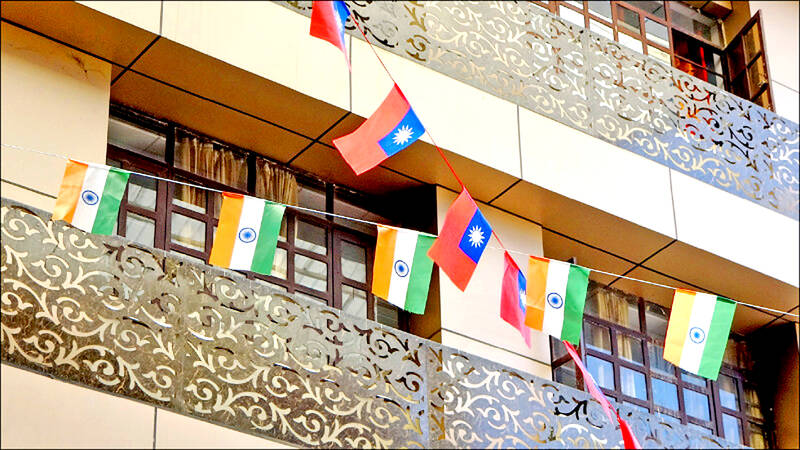
Photo: CNA
Russia, ASEAN and central and western Asian nations’ roles in the simulation were played by retired Indian diplomats, guided by the policy and objectives that their governments are believed would pursue, the Taipei-based institute said.
Retired officers of the Indian armed forces also took part in the exercise, it added.
United Service Institution director B.K. Sharma, a retired Indian Army major general, headed the final discussion of the war game and urged participants to be aware of the perspective, policy and interests of the government they were simulating, it said.
The tabletop exercises took place during a visit by a delegation from Taiwan consisting of Institute for National Defense and Security Research acting deputy chief executive officer Shen Ming-shih (沈明室), and researchers Lee Che-chuan (李哲全), Shih Chien-yu (侍建宇) and Tseng Yi-shuo (曾怡碩).
The exercise differed from US-held war games, as it focused more on actors other than the major powers and the diplomatic reaction from third parties, Shen said yesterday.
The joint war games have the potential to be a template for more exercises, he said.
Asked about Beijing’s protest to New Delhi after Indian Prime Minister Narendra Modi responded to a congratulatory message on his election victory by President William Lai (賴清德), Shen said that China’s “canned responses” are to be expected.
What was more interesting was Modi’s remark that he “looks forward to closer ties” between Taiwan and India in a “mutually beneficial economic and technological partnership,” as it hinted at greater bilateral cooperation, Shen said.
Although Modi’s ruling Bharatiya Janata Party did not win a majority of parliament seats and had to form a coalition government, signs were good that Indian Minister of External Affairs Subrahmanyam Jaishankar and Indian Minister of Defence Rajnath Singh would keep their positions, he said.
That would mean that India’s defense and foreign affairs stance on Taiwan would carry over in the new Cabinet, providing continuity in the two nation’s relationship, he added.
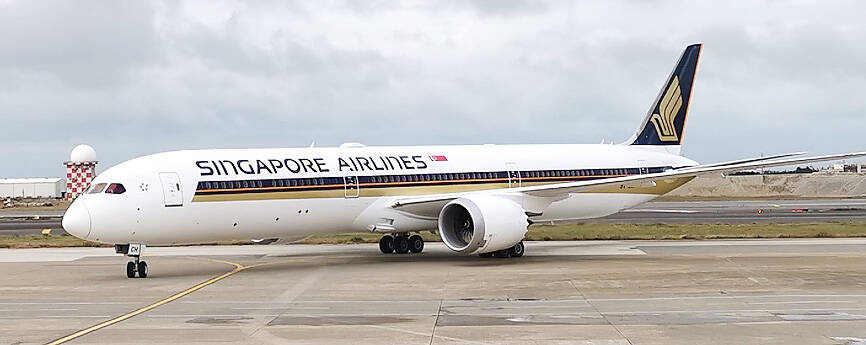
INCREASED CAPACITY: The flights on Mondays, Wednesdays, Fridays and Sundays would leave Singapore in the morning and Taipei in the afternoon Singapore Airlines is adding four supplementary flights to Taipei per week until May to meet increased tourist and business travel demand, the carrier said on Friday. The addition would raise the number of weekly flights it operates to Taipei to 18, Singapore Airlines Taiwan general manager Timothy Ouyang (歐陽漢源) said. The airline has recorded a steady rise in tourist and business travel to and from Taipei, and aims to provide more flexible travel arrangements for passengers, said Ouyang, who assumed the post in July last year. From now until Saturday next week, four additional flights would depart from Singapore on Monday, Wednesday, Friday
Taiwan’s three major international carriers are increasing booking fees, with EVA Airways having already increased the charge to US$28 per flight segment from US$25, while China Airlines (CAL) and Starlux Airlines are set to follow suit. Booking fees are charged by airlines through a global distribution system (GDS) and passed on to passengers. Carriers that apply the fees include CAL, EVA, Starlux and Tigerair Taiwan. A GDS is a computerized network operated by a company that connects airlines with travel agents and ticketing platforms, allowing reservations to be made and processed in real time. Major players include Amadeus, Sabre and Travelport. EVA Air began
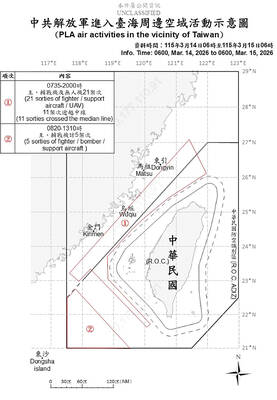
The Ministry of National Defense yesterday reported the return of large-scale Chinese air force activities after their unexplained absence for more than two weeks, which had prompted speculation regarding Beijing’s motives. China usually sends fighter jets, drones and other military aircraft around the nation on a daily basis. Interruptions to such routine are generally caused by bad weather. The Ministry of National Defense said it had detected 26 Chinese military aircraft in the Taiwan Strait over the previous 24 hours. It last reported that many aircraft on Feb. 25, when it spotted 30 aircraft, saying Beijing was carrying out another “joint combat
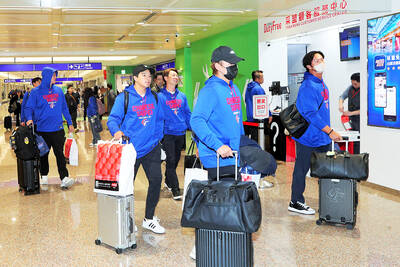
WATCH FOR HITCHHIKERS: The CDC warned those returning home from Japan to be alert for any contagious diseases that might have come back with them People who have returned from Japan following the World Baseball Classic (WBC) games during the weekend are recommended to watch for symptoms of infectious gastroenteritis, flu and measles for two weeks, the Centers for Disease Control (CDC) said. Flu viruses remain the most common respiratory pathogen in Taiwan in the past four weeks and the influenza B virus accounted for 55.7 percent of the tested cases, exceeding the percentage of influenza A (H3N2) infections and becoming the local dominant strain, CDC Epidemic Intelligence Center Deputy Director Lee Chia-lin (李佳琳) said at a news conference on Tuesday. There were 82,187 hospital visits for


 RSS
RSS