


Retired miners, joined by academics and labor rights groups, yesterday called for financial compensation and the release of full investigative reports into three major mining disasters in 1984 that took hundreds of lives.
Workers’ advocates from the Taiwan Labour Front and Taiwan Association for Human Rights told a news conference in Taipei that a commemoration event, including a concert and special exhibition, is to be held on June 20 to mark the 40th anniversary of the 1984 disasters.
They have invited President William Lai (賴清德) — whom they described as Taiwan’s most famous “coal miner’s son,” whose father died in a mining accident in 1960.
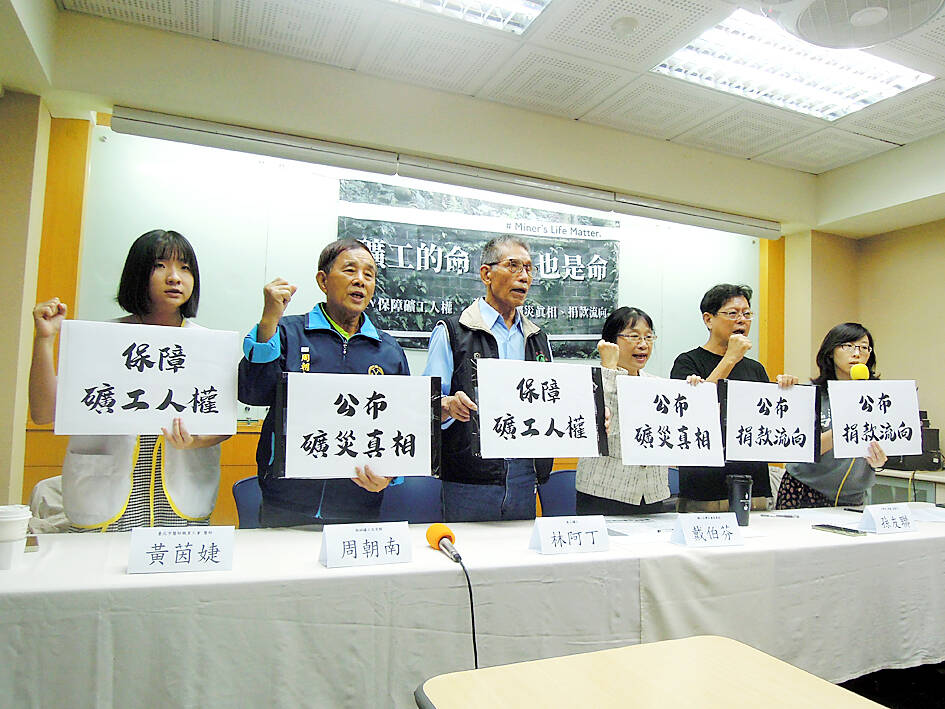
Photo: CNA
The event is being held to mourn the victims and remind government officials about “the most tragic year for Taiwanese coal miners,” with 270 workers killed at the Meishan (煤山) mine in New Taipei City’s Rueifang District (瑞芳), and the Haishan (海山) mine and Haiyi (海一) mine in the city’s Tucheng District (土城).
Retired miners Lin A-ting (林阿丁) and Chou Chao-nan (周朝南) demanded that the government compensate the victims and their families and said there was a lack of transparency about the NT$513 million (US$15.89 million at the current exchange rate) in donations collected in the aftermath of the 1984 disasters.
Lin said he suffers from pneumoconiosis, known as “black lung disease,” due to inhaling dust while working inside mine shafts, but he and fellow miners were unable to apply for occupational hazard compensation.
“They imposed very strict conditions, and no one we know has succeeded in obtaining compensation for this disease,” he said. “We ask for better safeguarding of the rights of miners and retirees. The government should also provide more help regarding health insurance for miners and retirees, and provide more social benefits to assist their livelihood.”
Chao said that back then, coal mining was an important industry, providing the fuel that powered Taiwanese industries and drove the nation’s economic growth.
However, the government failed to look after miners, who suffered many health problems and are mostly from poor families, he said.
“Many coal miners have passed away, but there are still about 10,000 of us who are still alive,” he said. “We protested in 2020 to fight for our rights and demand fair compensation from mining companies and government. That was our first protest and also the last, because retired miners are getting very old and can no longer walk. Many more have passed away in recent years.”
The coal dust explosion at Haishan mine on June 20, 1984, killed 74 miners. A few weeks later, a fire broke out at the Meishan mine on July 10, resulting in 103 deaths, mainly from suffocation and carbon monoxide poisoning. Another coal dust explosion on Dec. 5 that year at the Haiyi mine killed 93 miners, resulting in a total of 270 workers killed, as well as hundreds more injured in the three disasters.
Despite the tragedies and the 270 fatalities, the then-Chinese Nationalist Party (KMT) government spent little effort on ensuring safe conditions in mine shafts, had little regard for the lives of miners and did not enforce safety standards, Fu Jen Catholic University sociology professor Tai Po-fen (戴伯芬) said.
“Government agencies conducted investigations after each of the three disasters, but people still have no idea how the accidents happened, and what safety measures could have been taken to prevent them. The circumstances are still not known, because these investigation reports were kept in closed files... We demand that these reports be publicly released so victims and their families can learn the truth,” Tai said.
The public made generous donations after the accidents totaling NT$513 million, “but there was no transparency and no accounting in managing the funds, and people had no idea how it was spent and where it went,” she said. “Later on, the Control Yuan conducted a probe and found that the fund management committee was filled with officials and organizations from the ruling KMT.”
The Control Yuan should conduct a new probe, as the money should have gone to the victims and their families, the surviving miners who were injuured and the retirees who suffer from poor health due to pneumoconiosis or other work-related health issues, she said.
Coal miners’ retiree groups, representatives from the Houtong Miner’s Culture and History Museum in Rueifang, and the Taipei Doctors’ Union, who requested improved health insurance and better compensation for retirees, also participated in yesterday’s news conference.

NATIONAL SECURITY: Authorities are working to confirm the identities of the military personnel involved and investigating possible illegal conduct and regulatory violations Authorities are probing possible national security implications after Kinmen police and immigration officers on Sunday found a Chinese woman allegedly posing as a tourist while engaging in prostitution involving more than 10 military personnel. The woman, surnamed Chen (陳), has since been deported, authorities said, adding that investigators are still working to confirm the identities of those implicated, as the records only listed code names and aliases. The case stemmed from a report received by the Kinmen District Prosecutors’ Office on Friday last week from the Jinhu Precinct of the Kinmen County Police Bureau. On Sunday, police, along with the National Immigration
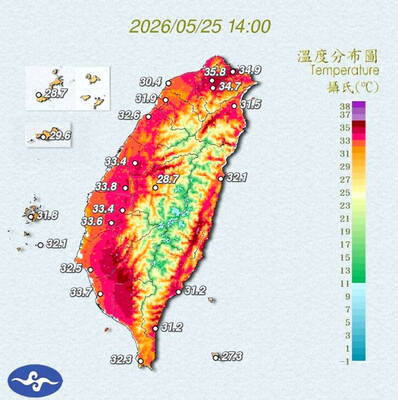
STAY COOL: The HPA recommended that people stay hydrated, use air-conditioning or fans while indoors, wear loose-fitting clothes and walk in the shade while outdoors Employers must implement measures such as installing cooling equipment, and providing drinking water and rest breaks for outdoor workers starting from Monday next week, the Taipei Department of Labor said on Sunday. Employers who fail to comply could face fines of NT$30,000 to NT$300,000 under the Occupational Safety and Health Act (職業安全衛生法), the department said. Businesses in Taipei employing fewer than 100 workers, as well as registered self-employed workers with labor insurance coverage, could receive on-site assessments and guidance from occupational safety consultants to help them apply for central government subsidies to implement or improve heat-protection measures, it said. Under the Ministry of

GLOBALGIVING: ‘ Caving to external pressure is not acceptable for an organization that has cultivated justice reform and human rights for 30 years,’ one NGO said A slew of non-government organizations (NGOs) have withdrawn from the GlobalGiving fundraising platform after it announced it would use “Chinese Taipei” instead of “Taiwan” from next month. The Taiwan Good Rice Association wrote on Facebook on Friday that it was informed on April 28 via a teleconference call of the change, which was made because the platform wanted to operate in China. Taiwan Good Rice is to terminate all cooperative relationships with GlobalGiving in response to the platform’s “unilateral and non-negotiable” decision to remove references to Taiwan, the NGO said. “Taiwan is in the official name of Taiwan Good Rice Association and the

Chinese Nationalist Party (KMT) Chairwoman Cheng Li-wun (鄭麗文) yesterday briefed her party’s Central Standing Committee regarding her scheduled visit to the US between Monday next week and June 16, saying that her purpose would be to persuade the US that the Republic of China (ROC) Constitution was a “one China” constitution that would foster stable and peaceful cross-strait relations. The ROC Constitution is the most important defense for all Taiwanese citizens, as it upholds our democracy and has contributed to our robust economy, which aligns with international and US interests, she said. “We would not be troublemakers and drag the US under,”


 RSS
RSS