


Diagnoses of nearsightedness in Taiwan have been increasing at a far slower rate than in its neighbors, thanks to a public health initiative to get children to spend more time outside, a feature carried by the international journal Nature said on Wednesday.
The article cited Taiwan’s 2010 policy of “120 Every Day” as the reason for the nation’s relatively low increase in myopia during the COVID-19 pandemic.
The necessity of staying indoors during the pandemic resulted in children in East Asia growing exponentially nearsighted, especially in Shandong, Shanghai and Hong Kong, it said.

Photo: Ou Su-mei, Taipei Times
There were fewer new cases of myopia among Taiwanese children, it added.
Chang Gung Hospital Kaohsiung branch ophthalmologist Wu Pei-chang (吳佩昌), who was also cited in the article, said that the “120 Every Day” policy encouraged children to exercise outdoors for at least two hours every day.
The government has continued to promote the view that myopia is an illness, and like other illnesses, it should be cured, Wu said.
The efforts have gradually corrected parents’ opinion that worsening myopia was a normal physiological phenomenon, making them more willing to take children for treatment, Wu said.
Wu said the Ministry of Education’s encouragement for students to step outside the classroom during recesses has also helped reduce myopia.
However, Wu also voiced concern that the ministry’s other policies of every student having a tablet computer and installing air-conditioners in every classroom would decrease students’ willingness to go outside.
“The government will have to expend greater efforts to encourage students to step outside the classroom during recesses,” he said.
Wu said such measures would help control myopia among children, ensure that children generate vitamin D from regular sun exposure and introduce opportunities for social interaction among students.
Turning off air-conditioners and lights would also help save energy, he added.
Taiwan’s achievements in controlling myopia have accomplished what no WHO member nation has done, Wu said, adding that he hoped to share Taiwan’s success with others and that the government would continue to introduce effective public health policies.
However, the Nature report also cited Australian National University myopia researcher Ian Morgan, who said that when it comes to promoting more outdoor time, “wide-scale implementation now seems feasible and likely to succeed” only if more governments were willing to recalibrate their education agendas.
Until then, however, Taiwan has been an exception, the article said.
The article also said researchers do not fully know why outdoor exposure helps prevent myopia and that a firmer understanding would help scientists develop better treatments.
The article cited Christine Wildsoet, an optometrist at the University of California, Berkeley, as saying: “Because once we know the key features, then we can bring some of them indoors.”

FUKUOKA SITUATION: Japanese media reported that the pathogen is expected to be identified by the summer, while the CDC downplayed the idea that it was hMPV A “mysterious cold-like illness” reported in Japan’s Fukuoka Prefecture does not seem to be a new disease, but Japanese authorities have been asked about the situation, the Centers for Disease Control (CDC) said yesterday. The Fukuoka Prefectural Medical Association on Wednesday told a news conference that a “mystery cold” that has become a hot topic on social media is “highly likely to be caused by some kind of viral infection,” Japan’s KBC News reported. “Many people are experiencing symptoms starting with a sore throat, followed by a runny nose, phlegm and a severe cough,” KBC News reported, citing association officials. Health authorities are

Nvidia Corp CEO Jensen Huang (黃仁勳) arrived in Taiwan yesterday ahead of upcoming AI and technology events, saying he plans to meet with clients and Taiwan Semiconductor Manufacturing Co Chairman C.C. Wei (魏哲家) during his visit. After landing at Taipei Songshan Airport, Huang posed for photos with fans and handed out Yakult drinks to reporters and supporters waiting at the scene, saying he has “a lot to do” during the trip. Asked about reports that Nvidia’s planned headquarters site in Taipei’s Beitou Shilin Technology Park could break ground on May 27, Huang said that if the company holds an event, he would

Carrefour Taiwan is to begin using a new name from the start of July, but it cannot divulge the name until then, the chairman of the supermarket chain's parent company said today. President Chain Store Co chairman Lo Chih-hsien (羅智先) was asked by reporters after a shareholders' meeting to confirm whether the company has settled on a new name for the supermarket brand. In March, the government-registered name of two Carrefour Taiwan branches was quietly changed to "Le Chia Kang" (樂家康) in Chinese, raising speculation that has been selected as the name. Lo said that because of local regulations and contractual obligations, the
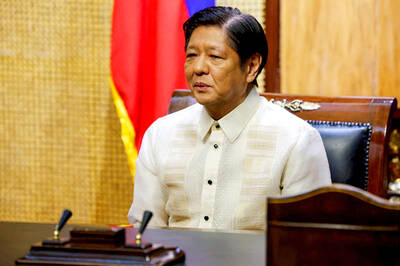
The Philippines would likely be involved in any conflict over Taiwan due to its proximity to the democracy claimed by China, President Ferdinand Marcos Jr said, reiterating a stance that risks angering Beijing. “In the Philippines, we do not have a choice because Taiwan is so close to the Philippines and we have almost 200,000 Filipino nationals living and working in Taiwan,” Marcos said in an interview with Japanese media in Manila on Monday. The Philippine leader’s comments come ahead of a state visit to Japan next week, where he is to meet with Japanese Prime Minister Sanae Takaichi to discuss security


 RSS
RSS