


Minister of Education Cheng Ying-yao (鄭英耀) is to hit the brakes on the Bilingual 2030 policy, but would keep it on the nation’s agenda, he said during an interview published yesterday.
“These things take time,” he said. “We need to slow down.”
Taiwanese enterprises are active globally and need people with professional-level proficiency in the English language, Cheng told the Liberty Times (sister paper of the Taipei Times) in an exclusive interview.
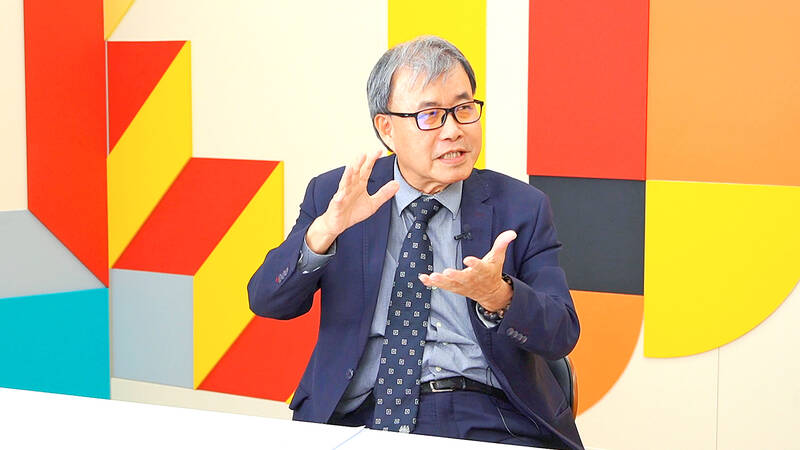
Photo: Huang Chun-hsuan, Taipei Times
English-only universities are attractive to high-performing foreign students who can become part of the nation’s skilled workforce, he said.
Cheng said that while president of National Sun Yat-sen University, he contributed to the design and implementation of a 10-year plan to achieve English-only instruction at its graduate school.
The program emphasized recruiting qualified faculty members and course design before launching classes in English, which would only be mandatory at the university’s graduate school in 2030, he said.
The undergraduate section would offer optional courses taught in English, Cheng said.
About 80 percent of Taiwanese enterprises have branches in 20 to 30 foreign nations, most of which use English, he said, adding that bilingual education needs to start now to prepare the workforce two or three decades from today.
The implementation of the Bilingual 2030 policy leaves something to be desired, as local governments are in a rush to hire English teachers regardless of qualifications to meet targets, he said.
Under Cheng’s leadership, the Ministry of Education would show more care in its coordination with local education authorities to ensure the core competencies of educators are not neglected, he said.
Children should be encouraged to learn English in their daily lives, Cheng said, adding that he launched as the then-director-general of the Kaohsiung Education Bureau collaborations with McDonald’s and doctors to promote the use of English by students.
Children making orders in English were rewarded with a free side of fries and those using the language to speak with doctors got a NT$50 discount on their appointment fees, he said.
The ministry is to make a greater effort to give students from poor rural regions or culturally disadvantaged backgrounds the English-language education they need, he added.
Citing a study by students’ rights group EdYouth, Cheng said metropolitan areas have a near glut of bilingual education resources.
The ministry is mulling plans to use university social responsibility programs to send more university students to teach English to children disadvantaged by geography or culture, he said.
Meanwhile, the vocational school system must become skill-centric instead of focusing on conferring diplomas, and the culture of rewarding employees for educational attainment instead of practical skills must be changed, he said.
Vocational high-school graduates on average make NT$25,000 to NT$28,000 a month, much less than university graduates who make NT$32,000 to NT$35,000 a month, he said.
The disparity in income spurs 90 percent of vocational school graduates to try enrolling in a university instead of learning a trade, with negative implications for the economy, he said.
Regarding the aging population, Chen said that employee education could be an answer to the economy’s need for a trained workforce.
There are 8 million working Taiwanese between the ages of 30 and 50 who should be able to study at universities, he added.

Considering that most countries issue more than five denominations of banknotes, the central bank has decided to redesign all five denominations, the bank said as it prepares for the first major overhaul of the banknotes in more than 24 years. Central bank Governor Yang Chin-lung (楊金龍) is expected to report to the Legislative Yuan today on the bank’s operations and the redesign’s progress. The bank in a report sent to the legislature ahead of today’s meeting said it had commissioned a survey on the public’s preferences. Survey results showed that NT$100 and NT$1,000 banknotes are the most commonly used, while NT$200 and NT$2,000

The Centers for Disease Control (CDC) yesterday reported the first case of a new COVID-19 subvariant — BA.3.2 — in a 10-year-old Singaporean girl who had a fever upon arrival in Taiwan and tested positive for the disease. The girl left Taiwan on March 20 and the case did not have a direct impact on the local community, it said. The WHO added the BA.3.2 strain to its list of Variants Under Monitoring in December last year, but this was the first imported case of the COVID-19 variant in Taiwan, CDC Deputy Director-General Lin Ming-cheng (林明誠) said. The girl arrived in Taiwan on

South Korea is planning to revise its controversial electronic arrival card, a step Taiwanese officials said prompted them to hold off on planned retaliatory measures, a South Korean media report said yesterday. A Yonhap News Agency report said that the South Korean Ministry of Foreign Affairs is planning to remove the “previous departure place” and “next destination” fields from its e-arrival card system. The plan, reached after interagency consultations, is under review and aims to simplify entry procedures and align the electronic form with the paper version, a South Korean ministry official said. The fields — which appeared only on the electronic form

The Ministry of Foreign Affairs (MOFA) is suspending retaliation measures against South Korea that were set to take effect tomorrow, after Seoul said it is updating its e-arrival system, MOFA said today. The measures were to be a new round of retaliation after Taiwan on March 1 changed South Korea's designation on government-issued alien resident certificates held by South Korean nationals to "South Korea” from the "Republic of Korea," the country’s official name. The move came after months of protests to Seoul over its listing of Taiwan as "China (Taiwan)" in dropdown menus on its new online immigration entry system. MOFA last week


 RSS
RSS