


To give farmers more autonomy in product pricing, the Ministry of Agriculture is instituting a system to promote contract farming and bring produce directly to hypermarkets, Minister of Agriculture Chen Junne-jih (陳駿季) said yesterday.
Currently, agricultural prices are mainly set by intermediaries who sell at wholesale markets, the ministry said.
Dealers purchasing produce is the main reason for wildly fluctuating prices and excess production of crops as growers race to plant the previous season’s cash crops, it said.
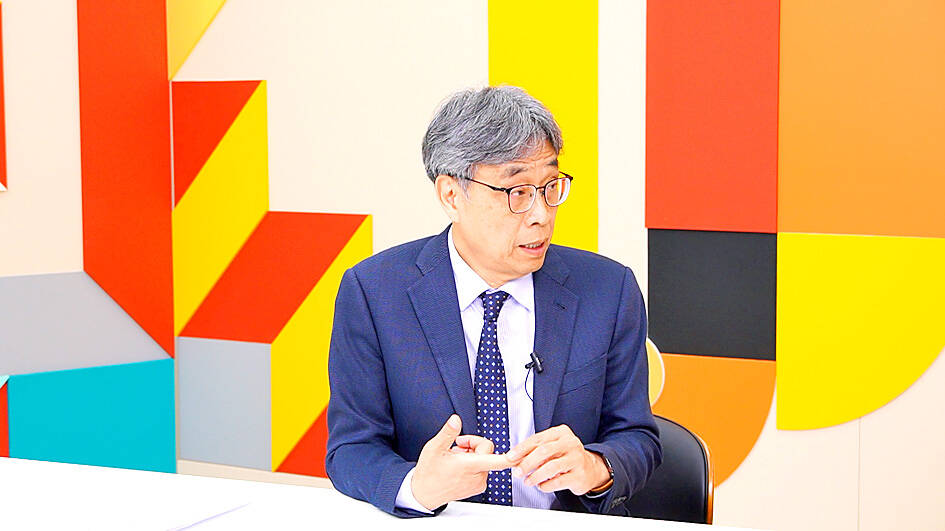
Photo: Chang Chia-juei, Taipei Times
In an interview with the Liberty Times (sister paper of the Taipei Times), Chen said that production should determine price.
There must be a way for growers to assess the live price of agricultural goods and the amount already planted to decide whether to continue a crop, he said.
The ministry has relied on local township officials to report farming information, but that data might be inaccurate, he said.
The ministry is to hire investigators to analyze statistics and other information to better understand what is planted on arable land nationwide, he said.
The work would be assisted by satellite imagery and aerial drone photography so the ministry would have the most accurate information, which growers could use to help them make decisions, he said.
Most growers in Taiwan are single entities and do not consider sales when planting, Chen said, adding that the ministry is attempting to change that by encouraging group cultivation, with groups selecting the most beneficial crop according to the ministry’s real-time information.
Other benefits of group cultivation include more people shouldering the costs, a general decrease in operational overhead and more thorough pest prevention, he said.
Produce from group farms would be sold directly to supermarkets or convenience stores, removing intermediaries so growers would get a bigger cut, Chen said.
As supermarkets and convenience stores pay via check, the ministry is offering assistance for growers’ associations or cooperatives to forward payments to growers immediately and receive payment from stores later, the ministry said.
The Agricultural Bank would ensure that all such platforms have good credit and ample cash flow, the ministry said.
Group cultivation and contract farming would bring many benefits, including the revitalization of farming communities with an influx of sales and accounting talent and other workers, Chen said.
This gives young people a role in farming even if they are not working the land themselves, he said.
The ministry would also keep data on unused land and consider establishing elderly care centers on it so young people would not have to worry about their elderly family members at home, he added.

The US plans to deploy thousands of drones in the Taiwan Strait in an operation called “Hellscape” to ensure that any attempt by China to invade Taiwan does not succeed, US Indo-Pacific Commander Admiral Samuel Paparo told the Washington Post. In an article published on Monday, columnist Josh Rogin quoted Paparo as saying from the sidelines of the recent Shangri-La Dialogue defense forum in Singapore that the “Hellscape” strategy would involve deploying thousands of uncrewed submarines, surface vessels and aerial vehicles around Taiwan to buy the nation, Washington and its partners time to assemble a response. The plan was devised to deter

CHINESE THREAT: Twenty-two military aircraft and vessels were detected around Taiwan over 24 hours, including a drone that flew as close as 80km to Oluanpi China’s Taiwan Affairs Office (TAO) yesterday said that the Chinese man who drove a motorboat into a strategic river mouth in Taiwan on Sunday was acting on his own and would be punished upon his return to China. However, the National Security Bureau said it would not exclude any possibilities regarding the man’s motivations, including the Chinese government’s involvement. The man has been identified as a 60-year-old former Chinese navy captain surnamed Ruan (阮). Coast guard personnel on Sunday arrested Ruan in New Taipei City’s Tamsui District (淡水) after his boat entered Tamsui River (淡水河). The boat was detected off the coast of

SHIN KONG SHENANIGANS: Eugene Wu is the father of Cynthia Wu, who was the TPP’s vice presidential candidate alongside Chairman Ko-Wen-je in January’s election Former Shin Kong Life Insurance Co chairman Eugene Wu (吳東進) and several other company executives are being investigated for alleged embezzlement and fraud resulting in corporate financial losses of about NT$150 million (US$4.63 million), New Taipei City prosecutors said yesterday. After being summoned to the New Taipei District Prosecutors’ Office for questioning, Wu was listed as among 17 suspects facing charges of aggravated breach of trust, embezzlement and breaches of the Insurance Act (保險法). Wu was released on bail of NT$100 million yesterday. The case has received much attention with Eugene Wu being the eldest son of Wu Ho-su (吳火獅), who founded Shin

REPORT: In a number of cases, Taiwanese have been detained or interrogated, the MAC said, while warning that Chinese authorities can from next month confiscate cellphones Taiwanese who are traveling to China for religious, business or other non-political purposes can all be interrogated by Chinese national security officers due to new national security laws, the Mainland Affairs Council (MAC) said in a recent report. Starting next month, Taiwanese could also be asked to hand over their mobile phones and electronic devices for national security inspections when visiting China, the council said. Beijing has introduced a series of laws that were designed to impose heavier sanctions on people who are considered enemies of the state. An amendment to China’s Anti-Espionage Law, which took effect in July last year, expanded


 RSS
RSS