


Lawmakers have been at loggerheads for several weeks over legislative reforms bills, which the Democratic Progressive Party (DPP) describes as “an unconstitutional abuse of power,” while opposition parties say reforms would enable better oversight of the Executive Yuan.
The proposals include amendments to the Act Governing the Legislative Yuan’s Power (立法院職權行使法) to normalize presidential state of the nation addresses to the legislature, boost legislative powers of oversight and investigation, create criminal penalties for holding the legislature in contempt, and empower the legislature to approve the appointment of officials and conduct legislative speaker elections with open ballots.
DPP caucus whip Ker Chien-ming (柯建銘) said that requiring the president to attend a question-and-answer session would be “unconstitutional,” as it should be up to the president to decide whether they want to respond to questions.
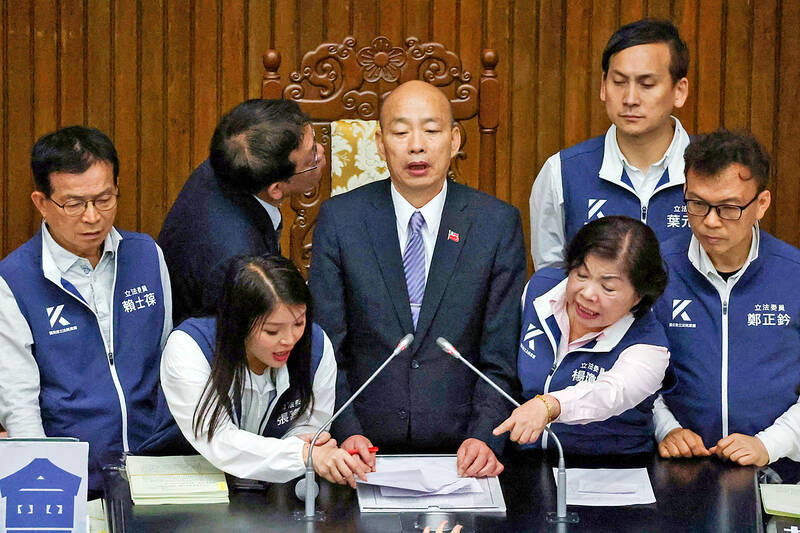
Photo: Reuters
Regarding investigative rights, the Chinese Nationalist Party (KMT) has proposed granting the legislature “investigative rights” beyond its current right to access official documents, including convening investigative committees and hearings that can summon people to testify.
The scope of the summons would include private entities , the KMT said.
Those who refuse a demand by the legislature or delay responding, conceal information or provide false statements to the legislature during an investigation, inquiry or hearing or when it reviews documents can be fined or, if the offense is serious, be held in contempt of the legislature, a KMT-proposed bill says.
DPP bills say that investigating committees should only be convened if the matter is related to rights conferred by the Constitution to the Legislative Yuan and should not violate the authority of other independent agencies.
To support the right of the legislature to launch investigations, amendments have been proposed to the Criminal Code to criminalize “contempt of the legislature” during an investigation.
Several lawyers last month voiced concerns during public hearings over the proposal and who would define contempt, citing potential effects on basic rights and freedom.
DPP Legislator Puma Shen (沈伯洋) has said that before expanding the power of lawmakers, regulations defining limits should be established to avoid having the legislature become a place for “self-serving retribution” that bypasses institutions.
The KMT said that the reform bills are necessary to enhance the legislature’s oversight role, bring about greater government transparency and accountability, and force the ruling party and government officials to face and respond to public opinion — which it said the DPP had not had to do over the past eight years due to its legislative majority.
Granting the legislature broader “investigative rights” would help prevent and expose scandals, such as stock manipulation, improper government procurement and profiteering, the KMT said.
Allowing the legislature to fine or hold in contempt people or entities who do not comply with an investigative inquiry would prevent government officials from lying in the legislature, it added.

Considering that most countries issue more than five denominations of banknotes, the central bank has decided to redesign all five denominations, the bank said as it prepares for the first major overhaul of the banknotes in more than 24 years. Central bank Governor Yang Chin-lung (楊金龍) is expected to report to the Legislative Yuan today on the bank’s operations and the redesign’s progress. The bank in a report sent to the legislature ahead of today’s meeting said it had commissioned a survey on the public’s preferences. Survey results showed that NT$100 and NT$1,000 banknotes are the most commonly used, while NT$200 and NT$2,000

The Centers for Disease Control (CDC) yesterday reported the first case of a new COVID-19 subvariant — BA.3.2 — in a 10-year-old Singaporean girl who had a fever upon arrival in Taiwan and tested positive for the disease. The girl left Taiwan on March 20 and the case did not have a direct impact on the local community, it said. The WHO added the BA.3.2 strain to its list of Variants Under Monitoring in December last year, but this was the first imported case of the COVID-19 variant in Taiwan, CDC Deputy Director-General Lin Ming-cheng (林明誠) said. The girl arrived in Taiwan on

South Korea is planning to revise its controversial electronic arrival card, a step Taiwanese officials said prompted them to hold off on planned retaliatory measures, a South Korean media report said yesterday. A Yonhap News Agency report said that the South Korean Ministry of Foreign Affairs is planning to remove the “previous departure place” and “next destination” fields from its e-arrival card system. The plan, reached after interagency consultations, is under review and aims to simplify entry procedures and align the electronic form with the paper version, a South Korean ministry official said. The fields — which appeared only on the electronic form

The Ministry of Foreign Affairs (MOFA) is suspending retaliation measures against South Korea that were set to take effect tomorrow, after Seoul said it is updating its e-arrival system, MOFA said today. The measures were to be a new round of retaliation after Taiwan on March 1 changed South Korea's designation on government-issued alien resident certificates held by South Korean nationals to "South Korea” from the "Republic of Korea," the country’s official name. The move came after months of protests to Seoul over its listing of Taiwan as "China (Taiwan)" in dropdown menus on its new online immigration entry system. MOFA last week


 RSS
RSS