


President William Lai (賴清德) missed his “historic moment” by not showing his vision for governance for the next four years in his inaugural speech, the Chinese Nationalist Party (KMT) said yesterday, adding that he would not have a long honeymoon after taking office as the country faces several challenges.
“The inaugural speech is an important political ritual that presidents deliver during their term to show the people and the world what direction they are leading the country in. It is also the best opportunity to show they are looking at the bigger picture and approaching issues from a higher standpoint,” KMT Culture and Communications head Lee Yen-hsiu (李彥秀) wrote on Facebook.
“President Lai missed his ‘historic moment’ to do so,” she said.
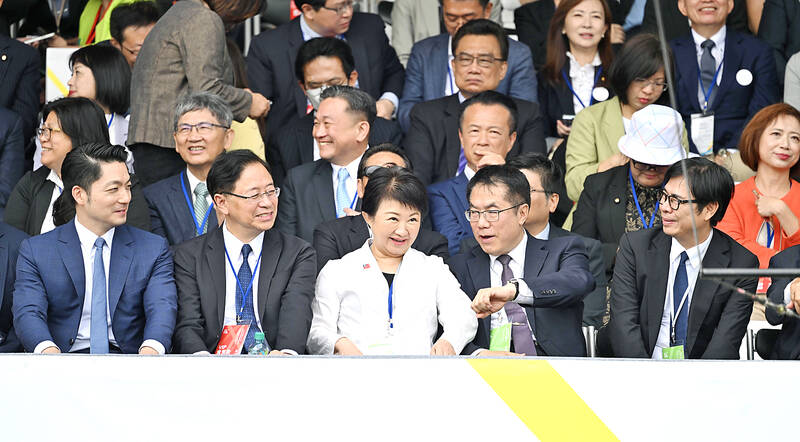
Photo: Tu Chien-jung, Taipei Times
One cannot see in the inaugural speech how Lai plans to lead the country and the innovative solutions he would deliver, Lee said.
Instead, Lai made vapid statements, reiterating that he would build on existing foundations, she said, adding that he also failed to use the speech to show confidence and unite the nation, she said.
The nation’s largest opposition party also compared Lai’s inaugural speech with that made by former president Tsai Ing-wen (蔡英文) in 2016.
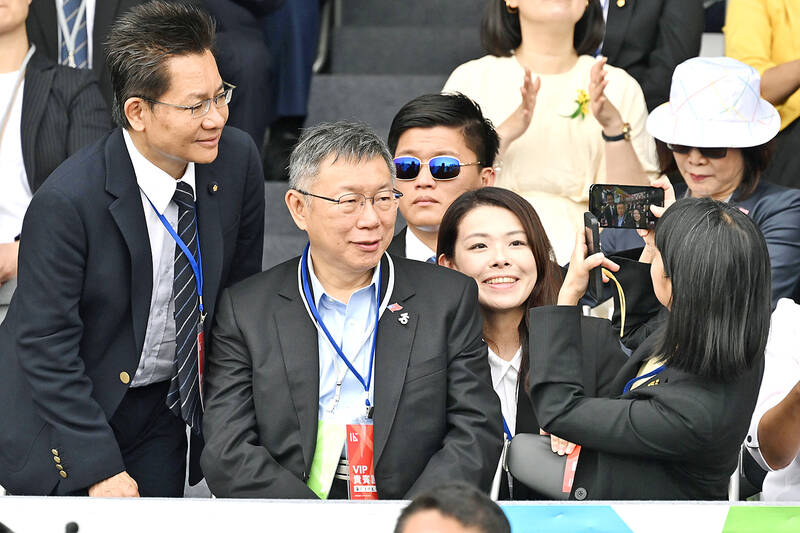
Photo: Tu Chien-jung, Taipei Times
While Tsai said she recognized the historical fact of the cross-strait meeting in 1992 and spoke about being an active communicator for peace, Lai simply spoke about maintaining peace and prosperity across the Taiwan Strait without highlighting the importance of having cross-strait dialogue and exchange, Lee said.
Tsai in her inaugural speech vowed to build a closely-knit economic community with other regional members and spent a larger part of her speech identifying the challenges facing Taiwan, from economic development to generational justice, she said.
By contrast, Lai appeared to speak with only domestic audiences in mind, declaring slogans such as “protecting democracy against autocratic regimes” or “making Taiwan a most valuable player within democratic countries,” she said.
The government’s shortcomings in the past eight years were only mentioned in passing in Lai’s speech, and his repeated emphasis on the importance of semiconductors also showed his complete unawareness of Taiwan’s shrinking competitive edge with other countries and society’s economic inequality, Lee said.
“Lai reiterated the keynote of ‘two nations’ in his speech, showing his belief in Taiwanese independence and obliterating any ambiguity in cross-strait relations,” she said, adding that cross-strait relations would become more precarious in the next four years without dialogue or mutual trust.
While Lai called for a rational discussion of politics in the legislature and the minority respecting the majority, he allowed lawmakers from his own side to speak and act violently in the Legislative Yuan and boycott legislative reform bills, she said.
KMT Chairman Eric Chu (朱立倫), who did not attend the inauguration, said that people want cross-strait peace and exchanges, and the Lai administration must deliver solutions.
“Lai in his speech seemed to only stress that the majority needs to respect the minority. He forgot that only about 40 percent of the country voted for him and that the Democratic Progressive Party (DPP) is now the minority in the legislature,” Chu said. “The minority demanded respect from the majority, but it forgot that it needed to submit to the majority.”
“I hope that the DPP lawmakers will obey the majority in the legislature and allow major bills to pass,” Chu said.
The KMT holds 52 seats in the 113-seat legislature, while the Taiwan’s People Party (TPP) has eight and the DPP has 51. There are also two independent lawmakers who are ideologically aligned with the KMT.
Fu Kun-chi
On the legislative reform bills that the KMT proposed being put to a vote in a plenary session today, KMT caucus whip Fu Kun-chi said: “We will see in what ways the DPP respond to the speech made by President Lai.”
Ko Wen-je
TPP Chairman Ko Wen-je (柯文哲), who attended the inauguration, said that the most important thing is what Lai does do in the first three months.
“Lai said that there should be more exchanges across the Taiwan Strait, which could increase mutual goodwill and avoid misunderstandings and unintended conflicts,” Ko said. “We do not want the world to think of Taiwan as a war zone either.”

Considering that most countries issue more than five denominations of banknotes, the central bank has decided to redesign all five denominations, the bank said as it prepares for the first major overhaul of the banknotes in more than 24 years. Central bank Governor Yang Chin-lung (楊金龍) is expected to report to the Legislative Yuan today on the bank’s operations and the redesign’s progress. The bank in a report sent to the legislature ahead of today’s meeting said it had commissioned a survey on the public’s preferences. Survey results showed that NT$100 and NT$1,000 banknotes are the most commonly used, while NT$200 and NT$2,000

The Centers for Disease Control (CDC) yesterday reported the first case of a new COVID-19 subvariant — BA.3.2 — in a 10-year-old Singaporean girl who had a fever upon arrival in Taiwan and tested positive for the disease. The girl left Taiwan on March 20 and the case did not have a direct impact on the local community, it said. The WHO added the BA.3.2 strain to its list of Variants Under Monitoring in December last year, but this was the first imported case of the COVID-19 variant in Taiwan, CDC Deputy Director-General Lin Ming-cheng (林明誠) said. The girl arrived in Taiwan on

South Korea is planning to revise its controversial electronic arrival card, a step Taiwanese officials said prompted them to hold off on planned retaliatory measures, a South Korean media report said yesterday. A Yonhap News Agency report said that the South Korean Ministry of Foreign Affairs is planning to remove the “previous departure place” and “next destination” fields from its e-arrival card system. The plan, reached after interagency consultations, is under review and aims to simplify entry procedures and align the electronic form with the paper version, a South Korean ministry official said. The fields — which appeared only on the electronic form

The Ministry of Foreign Affairs (MOFA) is suspending retaliation measures against South Korea that were set to take effect tomorrow, after Seoul said it is updating its e-arrival system, MOFA said today. The measures were to be a new round of retaliation after Taiwan on March 1 changed South Korea's designation on government-issued alien resident certificates held by South Korean nationals to "South Korea” from the "Republic of Korea," the country’s official name. The move came after months of protests to Seoul over its listing of Taiwan as "China (Taiwan)" in dropdown menus on its new online immigration entry system. MOFA last week


 RSS
RSS