


Preparing for a state banquet reflecting Taiwan’s unique history, chef Wes Kuo (郭庭瑋) places delicate vegetable fronds around sauces inspired by the cuisines of its five major ethnic groups.
The dish is to be part of an eight-course feast full of symbolism to be served after William Lai (賴清德) is sworn in as president on Monday against a backdrop of increasing pressure from China.
Kuo said the banquet created by Taiwanese chefs and food critics mirrors the nation’s identity.
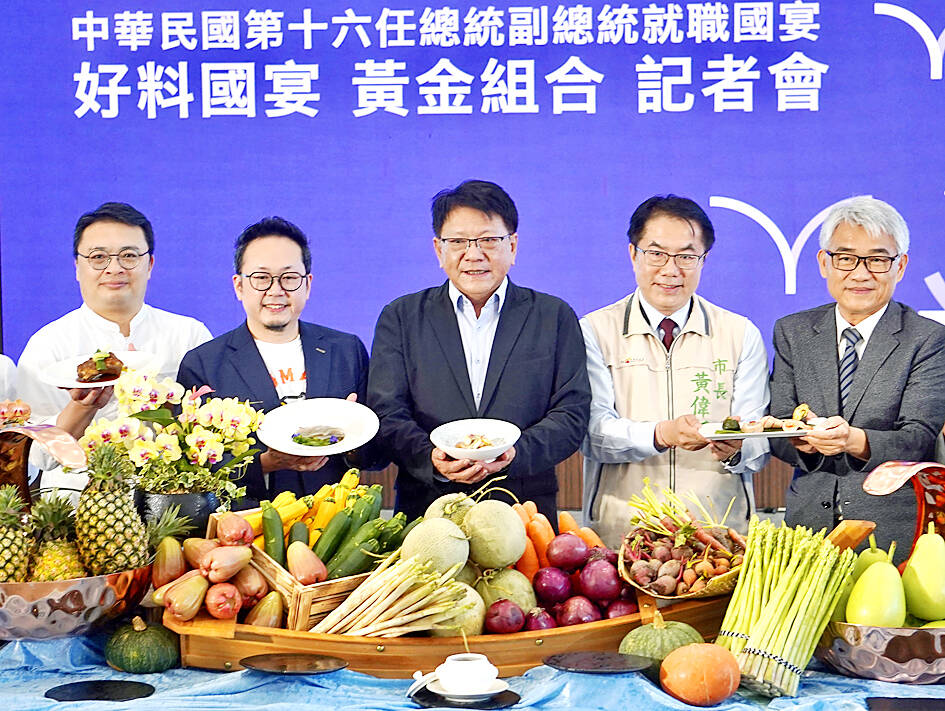
Photo: CNA
“We put together Taiwan’s seasonal produce on one plate, paired with five different sauces, to represent the flavor of each ethnic group,” Kuo said as he practiced the dish in his Taipei restaurant, Embers.
The sauces paint a vivid picture.
Fermented tofu paste — often found in Taiwanese dishes — sits alongside a kumquat concoction popular with Taiwan’s Hakka community.
There is also a satay sauce similar to Southeast Asian cuisines, with a spot of chilli for a kick. A finishing touch are crystal-clear drops of Te’nas — made with sea salt, chilli and water — which comes from the Amis people.
The sauces “blend very well when eaten together,” Kuo said.
Food critic Jewel Tsai (蔡珠兒) said the banquet tells the story of Taiwan and its most important elements of “freedom, democracy and diversity.”
The dinner is to be held in Tainan, where Lai previously served as mayor.
Dignitaries expected to attend include former officials from the US, as well as leaders from its diplomatic allies.
Long before the Chinese Nationalist Party (KMT) fled to Taiwan after the Chinese Communist Party gained control of China in 1949, Taiwan’s cultural identity had been shaped over centuries by indigenous people, as well as Chinese, European and Japanese rulers.
As Taiwan moved from autocracy to democracy by the 1990s, the population — which had been educated under a Chinese curriculum — began to develop a distinct identity.
“Many ordinary people felt that they were suppressed or repressed in the past, so if they can show the food of common people, this will be connected with the local identity,” said Chen Yu-jen (陳玉箴), a Taiwan food historian. “Taiwanese people are very confident in their own food and culture ... it has developed into a political symbol.”
Lai’s inauguration menu also features a chicken soup common in small eateries, as well as bubble milk tea — a drink usually loaded with milk, sugar and tapioca pearls.
A fish dish of yellowfin bream is to be served with an aromatic tana herb and pepper sauce, drawn from traditional indigenous cooking.
Lai himself has requested a sweet potato and kumquat roll from a favorite rural restaurant in his northern birthplace of New Taipei City’s Wanli District (萬里).
“He likes sweet food and it just suits his taste,” said Tung Shih-min, owner of Jiu Zhuang Mei Shi restaurant, as his staff prepared 1,000 rolls.
Kuo said that including everyday street snacks like the sweet roll in the fine dining banquet represented Taiwan’s acceptance of different cultures and ways of life.
“I think this is the most important value of democracy — no exclusivity,” he said.

UPGRADE: The Kang Ding-class frigate is replacing its Chaparall missiles with Tien Chien II and Hua Yang VLS, which would provide it with long-range, 360° air defense Taiwan plans to produce 1,200 to 1,376 Hai Chien II missiles (海劍二, Sea Sword II) — also known as TC-2N — to serve as the standard air defense system of the navy’s surface combatant fleet, a source said yesterday. Last week, the Hai Chien II, the naval version of the Tien Kung II missile (天劍二, Sky Sword II), completed a live-fire test in waters off the National Chungshan Institute of Science and Technology’s Jiupeng facility (九鵬) in Pingtung County’s Manjhou Township (滿州). The MIM72 Chaparral and other dated air defense missiles that currently arm Taiwanese ships have inadequate range to combat Chinese

REASONS FOR TRAVEL: An assistant professor said that proposed amendments to penalize drivers if they used drugs overseas would not deter people from traveling People who operate a motor vehicle under the influence of marijuana would have their driver’s license revoked, even if they used the substance while overseas, the Ministry of Transportation and Communications said yesterday, citing proposed amendments to the Road Traffic Management and Penalty Act (道路交通管理處罰條例). The amendments would also authorize the government to revoke the licenses of people determined to have used Category 1 or Category 2 narcotics, even if they were not operating a vehicle while under the influence of drugs, as well as ban them from taking the license test for three years, the ministry said. People aged 18 or

HEAVY WEATHER: Typhoon Jangmi is due to crash straight into the Ryukyus as airlines look to shift flights to larger aircraft or cancel flights to Okinawa entirely Taiwan’s international air carriers announced flight adjustments over the weekend as Typhoon Jangmi is forecast to hit the Ryukyu Islands today and tomorrow. The Central Weather Administration (CWA) upgraded Jangmi from a tropical storm to a typhoon at 8am yesterday, with the eye located 580km south of Naha city. It was moving north at 19kph. Today, China Airlines’ CI-120, CI-121, CI-122 and CI-123 flights between Taoyuan and Naha, Okinawa, have been canceled as well as CI-132 and CI-133 between Kaohsiung and Naha. EVA Air’s BR-112, BR-113, BR-186 and BR-185 flights between Taoyuan and Naha are also canceled. Low-cost carrier Tigerair Taiwan canceled IT-230,
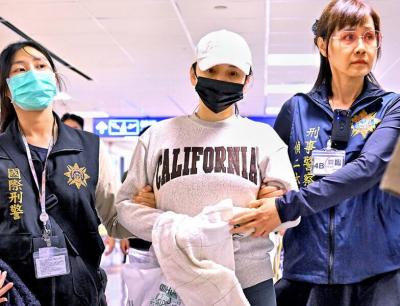
Johanne Liou (劉喬安), a Taiwanese woman who shot to unwanted fame during the Sunflower movement protests in 2014, returned to Taiwan last night after being deported from the US. She is to stand trial in Taiwan for charges involving embezzlement, fraud and drug crimes. The Criminal Investigation Bureau (CIB) said it took her into custody at Taiwan Taoyuan International Airport and would first question her before transferring her to the New Taipei District Prosecutors’ Office. She was arrested upon disembarking a flight from San Francisco that landed shortly before 7pm. Liou absconded to the US in 2019 after jumping bail


 RSS
RSS