


Chinese Nationalist Party (KMT) legislators are bypassing established procedures to push through a package of bills that would expand lawmakers’ powers, Democratic Progressive Party (DPP) caucus members said yesterday.
The group of bills — which would make “contempt of the legislature” a punishable offense and require the president to deliver a “state of the nation address” to the body — on Tuesday cleared the Legislative Yuan’s Procedure Committee with support from Taiwan People’s Party (TPP) legislators.
DPP caucus secretary-general Rosalia Wu (吳思瑤) said the bills did not undergo established procedures for deliberation and review in legislative committees, as well as cross-party negotiations.
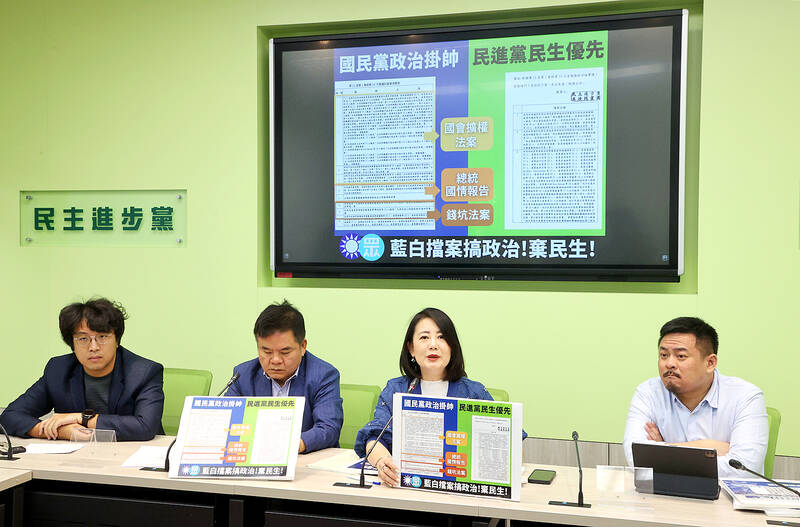
Photo: CNA
Wu said that TPP legislators were working with the KMT to fast-track the legislation to pass a third reading tomorrow.
“If, as expected, the KMT and TPP work together to use their majority in the legislature to get the bills past the third reading vote, it would go down in history as the most reprehensible action by legislators,” she said.
The KMT is also pushing through “money pit projects,” spearheaded by KMT caucus whip Fu Kun-chi (傅?萁), she said.
The bills include more than NT$2 trillion (US$61.9 billion) for major transportation projects on the east coast, which did not undergo a clause-by-clause review at the legislative committee level, as has been standard in the past, she said.
In addition, Legislative Speaker Han Kuo-yu (韓國瑜) has not presided over the process in accordance with tradition, Wu said.
She said Han was allowing the bills to skip established procedures to reach a party vote on the floor of the legislature.
“Under Han’s leadership, the legislature has stopped functioning properly, undermining our democratic system,” she said.
In the past, when the KMT held a larger majority under former legislative speaker Wang Jin-pyng (王金平), Wang would insist that legislation undergo several rounds of deliberation, review and cross-party negotiation to respect the rights of opposition parties.
“Han has taken away other parties’ rights to these procedures, and the legislature is on track to become a rubber-stamp body for the KMT,” she said.
Meanwhile, KMT caucus secretary-general Hung Mong-kai (洪孟楷) yesterday said that his party had set up a schedule for rotating groups of KMT legislators to watch the entrance to the main legislative chamber for the 24 hours leading up to tomorrow’s vote to prevent DPP lawmakers from interfering.
He said it was necessary to prevent DPP members from entering the chamber beforehand to use delay tactics, such as introducing a series of motions or taking the floor for long speeches to block the bills’ passage.
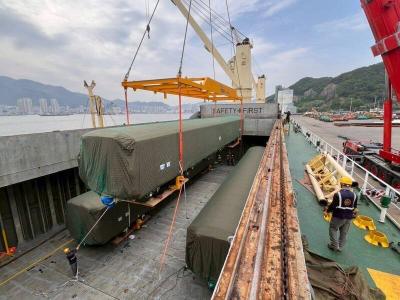
The first of 10 new high-capacity trains purchased from South Korea’s Hyundai Rotem arrived at the Port of Taipei yesterday to meet the demands of an expanding metro network, Taipei Rapid Transit Corp (TRTC) said yesterday. The train completed a three-day, 1,200km voyage from the Port of Masan in South Korea, the company said. Costing NT$590 million (US$18.79 million) each, the new six-carriage trains feature a redesigned interior based on "human-centric" transportation concepts, TRTC said. The design utilizes continuous longitudinal seating to widen the aisles and optimize passenger flow, while also upgrading passenger information displays and driving control systems for a more comfortable
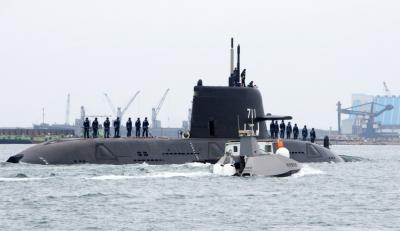
Taiwan's first indigenous defense submarine, the SS-711 Hai Kun (海鯤, or Narwhal), departed for its 13th sea trial at 7am today, marking its seventh submerged test, with delivery to the navy scheduled for July. The outing also marked its first sea deployment since President William Lai (賴清德) boarded the submarine for an inspection on March 19, drawing a crowd of military enthusiasts who gathered to show support. The submarine this morning departed port accompanied by CSBC Corp’s Endeavor Manta (奮進魔鬼魚號) uncrewed surface vessel and a navy M109 assault boat. Amid public interest in key milestones such as torpedo-launching operations and overnight submerged trials,
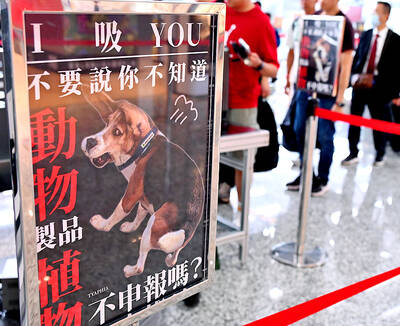
Quarantine awareness posters at Taiwan Taoyuan International Airport have gone viral for their use of wordplay. Issued by the airport branch of the Animal and Plant Health Inspection Agency, the posters feature sniffer dogs making a range of facial expressions, paired with advisory messages built around homophones. “We update the messages for holidays and campaign needs, periodically refreshing materials to attract people’s attention,” quarantine officials said. “The aim is to use the dogs’ appeal to draw focus to quarantine regulations.” A Japanese traveler visiting Taiwan has posted a photo on X of a poster showing a quarantine dog with a

Taiwan’s coffee community has launched a “one-person-one-e-mail” campaign, calling for people to send a protest-e-mail to the World Coffee Championships (WCC) urging it to redesignate Taiwanese competitors as from “Taiwan,” rather than “Chinese Taipei.” The call followed sudden action last week after the WCC changed all references to Taiwanese competitors from “Taiwan” to “Chinese Taipei,” including recent World Latte Art champion Bala (林紹興), who won the World Latte Art Championship in San Diego earlier this month. When Bala received the trophy, he was referred to as representing Taiwan, as well as in the announcement on the WCC’s Web site, until it


 RSS
RSS