


About 20,000 people with cancer per year would benefit from more advanced next generation sequencing (NGS) covered by the National Health Insurance (NHI) system, the National Health Research Institutes said on Tuesday.
Testing for cancer, which has long been the leading cause of death in the nation, now sees a significant advancement with the inclusion in the NHI system since May 1 of NGS for 19 types of cancer, the institute said at a news conference.
The NHI-covered NGS assesses cancers including lung, colorectal, pancreatic cancers and leukemia, and aids in the selection of appropriate treatment or the assessment for bone marrow transplant suitability, the National Health Insurance Administration (NHIA) said.

Photo: CNA
NGS breaks down DNA samples, and then links them back together at the computer-end to conduct analysis, National Taiwan University Cancer Center superintendent James Yang (楊志新) said.
“After approximately 400 to 1,000 sequencing cycles, we compare it with normal DNA to determine which parts of the tumor DNA have variations,” Yang said.
“With these variations, we can identify which type of cancer it [the tumor] belongs to,” Yang said.
As NGS is included in NHI coverage, physicians can make more comprehensive clinical decisions, which would significantly improve treatment outcomes and reduce ineffective medication use, Yang added.
NHIA Director-General Shih Chung-liang (石崇良) said two types of data would be collected from the sequencing, one is data directly applicable for clinical purposes by physicians, and the other is raw data stored in National Biobank Consortium of Taiwan for research on drug development and testing methods.
Each individual covered by NHI is entitled to undergo NGS once per cancer type, according to the NHIA’s regulations.

The brilliant blue waters, thick foliage and bucolic atmosphere on this seemingly idyllic archipelago deep in the Pacific Ocean belie the key role it now plays in a titanic geopolitical struggle. Palau is again on the front line as China, and the US and its allies prepare their forces in an intensifying contest for control over the Asia-Pacific region. The democratic nation of just 17,000 people hosts US-controlled airstrips and soon-to-be-completed radar installations that the US military describes as “critical” to monitoring vast swathes of water and airspace. It is also a key piece of the second island chain, a string of
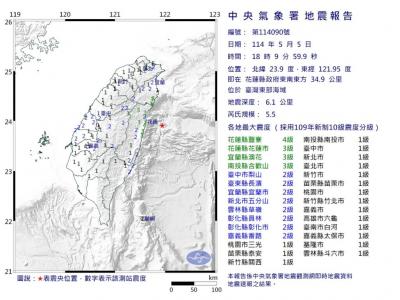
A magnitude 5.9 earthquake that struck about 33km off the coast of Hualien City was the "main shock" in a series of quakes in the area, with aftershocks expected over the next three days, the Central Weather Administration (CWA) said yesterday. Prior to the magnitude 5.9 quake shaking most of Taiwan at 6:53pm yesterday, six other earthquakes stronger than a magnitude of 4, starting with a magnitude 5.5 quake at 6:09pm, occurred in the area. CWA Seismological Center Director Wu Chien-fu (吳健富) confirmed that the quakes were all part of the same series and that the magnitude 5.5 temblor was
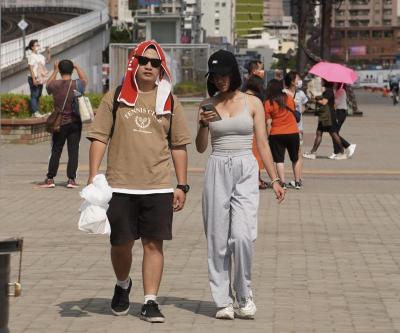
The Central Weather Administration has issued a heat alert for southeastern Taiwan, warning of temperatures as high as 36°C today, while alerting some coastal areas of strong winds later in the day. Kaohsiung’s Neimen District (內門) and Pingtung County’s Neipu Township (內埔) are under an orange heat alert, which warns of temperatures as high as 36°C for three consecutive days, the CWA said, citing southwest winds. The heat would also extend to Tainan’s Nansi (楠西) and Yujing (玉井) districts, as well as Pingtung’s Gaoshu (高樹), Yanpu (鹽埔) and Majia (瑪家) townships, it said, forecasting highs of up to 36°C in those areas

IN FULL SWING: Recall drives against lawmakers in Hualien, Taoyuan and Hsinchu have reached the second-stage threshold, the campaigners said Campaigners in a recall petition against Chinese Nationalist Party (KMT) Legislator Yen Kuan-heng (顏寬恒) in Taichung yesterday said their signature target is within sight, and that they need a big push to collect about 500 more signatures from locals to reach the second-stage threshold. Recall campaigns against KMT lawmakers Johnny Chiang (江啟臣), Yang Chiung-ying (楊瓊瓔) and Lo Ting-wei (羅廷瑋) are also close to the 10 percent threshold, and campaigners are mounting a final push this week. They need about 800 signatures against Chiang and about 2,000 against Yang. Campaigners seeking to recall Lo said they had reached the threshold figure over the


 RSS
RSS