


Taipei Economic and Cultural Office in Toronto Director-General Chen Jin-ling (陳錦玲) called on Canada to support Taiwan’s inclusion in the WHO, as it would be in line with the country’s interests.
By advocating for Taiwan’s integration into global health governance, “Canada can enhance global health security and advance its strategic interests in the Indo-Pacific region,” Chen said in an op-ed article published on May 4 on the Canadian digital media platform True North.
“Such actions resonate with Canada’s commitment to inclusivity, fairness, and international cooperation, contributing to a more robust global health framework,” she added.
Photo: Screen shot from Trending Taiwan YouTube
The WHO is to hold the 77th World Health Assembly (WHA) in Geneva from May 27 to June 1, during which its members are scheduled to consider the proposed text of the world’s first pandemic agreement for adoption, the organization said.
After negotiations aimed at finalizing the agreement resumed from April 29 to Friday, the member states agreed to continue refining the draft and submit its outcome for consideration at the WHA, it said.
“Alarmingly, Taiwan faces potential exclusion from these critical discussions despite its proven track record in global health security,” Chen said.
Taiwan’s exclusion would carry “tangible implications for global health,” citing the example of the WHO refusing to include the nation in direct communication channels for pandemic-related information exchange, adding that Taiwan’s continued exclusion might potentially undermine global pandemic prevention efforts.
While some fear that the next pandemic might be looming, Taiwan is still excluded from the WHO and its affiliated organizations, a letter to the editor written by Chen said in the Globe and Mail newspaper on May 3.
“Could treating Taiwan differently be a starting point to avert this?” she asked.
In the event of a new global pandemic, the burden on healthcare systems of other countries might be exacerbated because Taiwan is not able to participate in the WHO’s Global Digital Health Certification Network, wrote in the True North op-ed, titled “Taiwan needs a seat at the table in the post-pandemic world order.”
It is “crucial” for Canada and other countries to support Taipei’s inclusion in WHO mechanisms as “ignoring Taiwan’s capability and expertise in global health matters is not just a diplomatic misstep — it is a serious global vulnerability.”
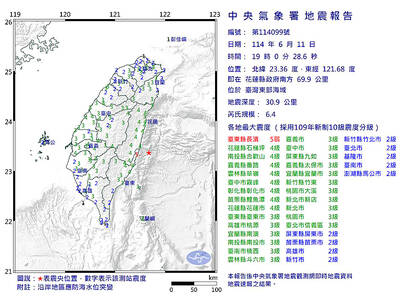
A magnitude 6.4 earthquake struck off the coast of Hualien County in eastern Taiwan at 7pm yesterday, the Central Weather Administration (CWA) said. The epicenter of the temblor was at sea, about 69.9km south of Hualien County Hall, at a depth of 30.9km, it said. There were no immediate reports of damage resulting from the quake. The earthquake’s intensity, which gauges the actual effect of a temblor, was highest in Taitung County’s Changbin Township (長濱), where it measured 5 on Taiwan’s seven-tier intensity scale. The quake also measured an intensity of 4 in Hualien, Nantou, Chiayi, Yunlin, Changhua and Miaoli counties, as well as

Credit departments of farmers’ and fishers’ associations blocked a total of more than NT$180 million (US$6.01 million) from being lost to scams last year, National Police Agency (NPA) data showed. The Agricultural Finance Agency (AFA) said last week that staff of farmers’ and fishers’ associations’ credit departments are required to implement fraud prevention measures when they serve clients at the counter. They would ask clients about personal financial management activities whenever they suspect there might be a fraud situation, and would immediately report the incident to local authorities, which would send police officers to the site to help, it said. NPA data showed

ENERGY RESILIENCE: Although Alaska is open for investments, Taiwan is sourcing its gas from the Middle East, and the sea routes carry risks, Ho Cheng-hui said US government officials’ high-profile reception of a Taiwanese representative at the Alaska Sustainable Energy Conference indicated the emergence of an Indo-Pacific energy resilience alliance, an academic said. Presidential Office Secretary-General Pan Men-an (潘孟安) attended the conference in Alaska on Thursday last week at the invitation of the US government. Pan visited oil and gas facilities with senior US officials, including US Secretary of the Interior Doug Burgum, US Secretary of Energy Chris Wright, Alaska Governor Mike Dunleavy and US Senator Daniel Sullivan. Pan attending the conference on behalf of President William Lai (賴清德) shows a significant elevation in diplomatic representation,
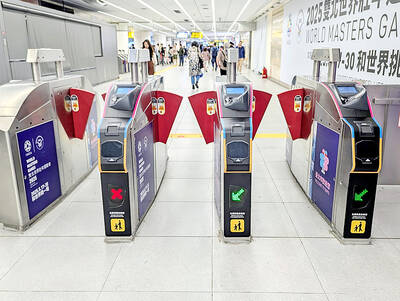
The Taipei MRT is to begin accepting mobile payment services in the fall, Taipei Rapid Transit Corp said on Saturday. When the company finishes the installation of new payment units at ticketing gates in October, MRT passengers can use credit cards, Apple Pay, Google Pay and Samsung Pay, the operator said. In addition, the MRT would also provide QR payment codes — which would be compatible with Line Pay, Jkopay, iPass Money, PXPay Plus, EasyWallet, iCash Pay, Taiwan Pay and Taishin Pay — to access the railway system. Currently, passengers can access the Taipei MRT by buying a single-journey token or using EasyCard,


 RSS
RSS