


Marriage laws need to be amended to improve gender equality, the Awakening Foundation said yesterday, citing the 80,000 calls it has received over 30 years, the majority of which were questions about divorce.
The foundation held a news conference to mark the anniversary of its hotline for legal advice about marriage, with officials saying that important work remains to be done despite significant progress in women’s rights.
Calls to the hotline made in the past decade were predominantly inquiries about divorce, which accounted for 11,943 of the total of 30,990 calls, the officials said.
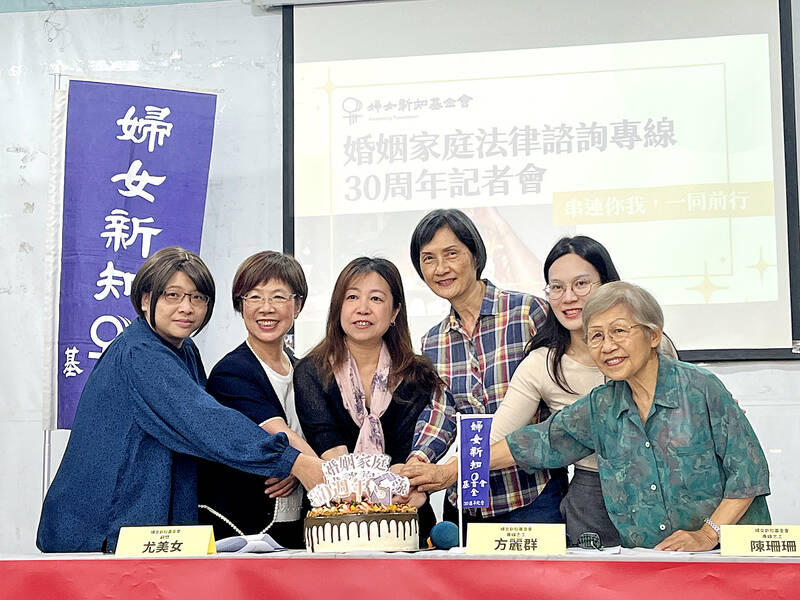
Photo: Chen Chia-yi, Taipei Times
Questions about children came in next, with 6,577 calls, while property ownership was third at 5,351, they said.
Divorce by mutual consent accounted for 15.5 percent of calls about divorce, 12 percent were about court-ordered divorces, 19.1 percent were about custody arrangements and 10.1 percent were about division of property, they said.
Women made up 86.5 percent of the callers, while men accounted for 12.2 percent — a marked change from a decade earlier when men comprised less than 10 percent of callers, they said.
The foundation’s priority now is to advocate changes in the Civil Code to make it easier for estranged couples to divorce, chairperson Chen Lin-yi (陳令宜) said.
People who for years have not slept under the same roof as their spouse should be released from a functionally dead marriage instead of being stuck in legal limbo without rules governing their rights and responsibilities, she said.
The calls informed many of the foundation’s landmark initiatives following the hotline’s creation in 1994, foundation adviser and former legislator Yu Mei-nu (尤美女) said.
The foundation’s achievements include the right of women to live in a place not of their husband’s choosing, keep their maiden name, matrilineally name their children, possess property they had owned before marriage and share or claim child custody, she said.
Amendments to marriage laws under the Civil Code advocated by the foundation included putting an end to the dissolution of marriage if the husband had an extramarital affair, a provision that caused many women to lose their homes through no fault of their own, Yu said.
The Domestic Violence Prevention Act (家庭暴力防治法), which became law in 1998, was made possible in part due to the foundation’s efforts to deal with familial violence reported by callers, she said.
People aged 31 to 40 accounted for the largest number of callers at 33.9 percent, while those aged 41 to 54 accounted for 26.9 percent and those aged 51 to 60 made up 14.8 percent, the foundation said in a news release.
A total of 75 women have volunteered to staff the call center since the hotline’s founding after studying law on their own or receiving on-the-job training, it said, adding that volunteers serve 14 years on average.
The legal advice hotline receives 60 to 70 calls on average per month, it said.

Considering that most countries issue more than five denominations of banknotes, the central bank has decided to redesign all five denominations, the bank said as it prepares for the first major overhaul of the banknotes in more than 24 years. Central bank Governor Yang Chin-lung (楊金龍) is expected to report to the Legislative Yuan today on the bank’s operations and the redesign’s progress. The bank in a report sent to the legislature ahead of today’s meeting said it had commissioned a survey on the public’s preferences. Survey results showed that NT$100 and NT$1,000 banknotes are the most commonly used, while NT$200 and NT$2,000

The Centers for Disease Control (CDC) yesterday reported the first case of a new COVID-19 subvariant — BA.3.2 — in a 10-year-old Singaporean girl who had a fever upon arrival in Taiwan and tested positive for the disease. The girl left Taiwan on March 20 and the case did not have a direct impact on the local community, it said. The WHO added the BA.3.2 strain to its list of Variants Under Monitoring in December last year, but this was the first imported case of the COVID-19 variant in Taiwan, CDC Deputy Director-General Lin Ming-cheng (林明誠) said. The girl arrived in Taiwan on

South Korea is planning to revise its controversial electronic arrival card, a step Taiwanese officials said prompted them to hold off on planned retaliatory measures, a South Korean media report said yesterday. A Yonhap News Agency report said that the South Korean Ministry of Foreign Affairs is planning to remove the “previous departure place” and “next destination” fields from its e-arrival card system. The plan, reached after interagency consultations, is under review and aims to simplify entry procedures and align the electronic form with the paper version, a South Korean ministry official said. The fields — which appeared only on the electronic form

The Ministry of Foreign Affairs (MOFA) is suspending retaliation measures against South Korea that were set to take effect tomorrow, after Seoul said it is updating its e-arrival system, MOFA said today. The measures were to be a new round of retaliation after Taiwan on March 1 changed South Korea's designation on government-issued alien resident certificates held by South Korean nationals to "South Korea” from the "Republic of Korea," the country’s official name. The move came after months of protests to Seoul over its listing of Taiwan as "China (Taiwan)" in dropdown menus on its new online immigration entry system. MOFA last week


 RSS
RSS