


Taiwan’s average excess mortality in the past four years during the COVID-19 pandemic was 3.3 percent, much lower than many of the Organization for Economic Co-operation and Development (OECD) member countries, a Taipei Medical University (TMU) research team said yesterday.
The research team’s survey report was released at the International Public Health Summit – Partnership for a Healthy & Sustainable Future cohosted by TMU and Thailand’s Mahidol University on TMU’s campus in Taipei yesterday.
The report showed that the average excess mortality of Taiwan between 2020 and last year during the COVID-19 pandemic was 3.3 percent, which was better than the OECD average, similar to Japan, South Korea and Singapore, and significantly lower than Germany, the UK and the US.
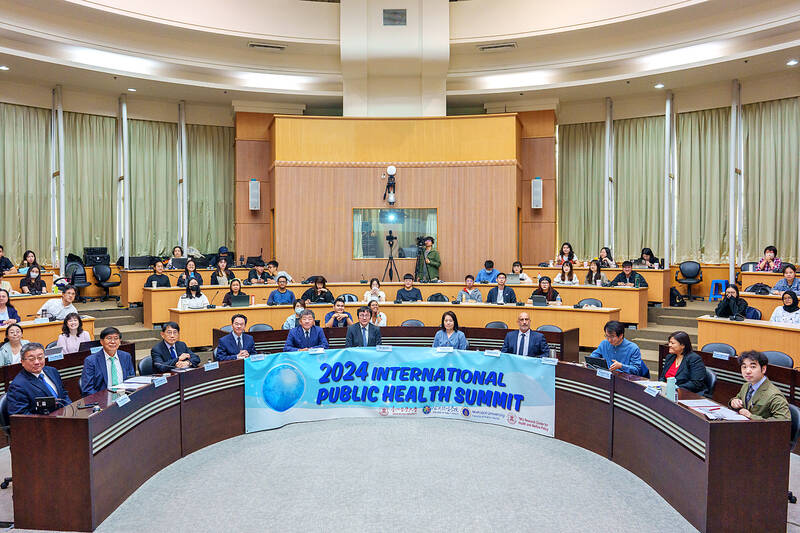
Photo courtesy of Taipei Medical University via CNA
No significant increase in excess mortality from stroke, heart disease and cancer was observed during the four years either, the report said.
According to the WHO, excess mortality is measured as the difference between the reported number of deaths (from all causes) in a given period between 2020 and 2024 and an estimate of the expected deaths for that period had the COVID-19 pandemic not occurred. It is used to quantify the direct and indirect impacts of the pandemic.
The report also said that the pre-hospital triage system played an important role during the pandemic, as the emergency room service volume of regional hospitals and district hospitals increased to about 120 to 160 percent of the pre-pandemic volume.
The survey was conducted by a research team led by TMU College of Public Health dean Chen Yi-hua (陳怡樺), to analyze the changes in excess mortality from 2010 to last year, and compare the healthcare demands between 2020 and 2022 during the COVID-19 pandemic and between 2015 and 2019 before COVID-19 to determine whether there were delayed or missed care, the university said.
TMU College of Public Health vice dean Bai Chyi-huey (白其卉) yesterday said the survey showed that during the pandemic, the work burden on healthcare providers was increased, but the health system was not paralyzed by a surge of COVID-19 patients.
TMU College of Public Health associate professor Wayne Gao (高志文) said that as Taiwan’s population is aging rapidly, the annual total deaths have been increasing, from about 144,000 in 2010 to about 175,000 in 2019, but with strict border control, a mask mandate and other preventive measures, the COVID-19 virus was contained in Taiwan during the first year of the pandemic, and the total deaths instead dropped to 173,067 in 2020.
Gao said that the total deaths in Taiwan between 2020 and 2021 were 4.85 percent lower than the average expected rate in the decade before, and no excess mortality was observed in the first two years.
Attending the summit, former minister of health and welfare Chen Shih-chung (陳時中), who headed the Central Epidemic Command Center during the COVID-19 pandemic, said Taiwan did very well overall in fighting COVID-19, but there were many political influences in the process.
Public health is also part of social science, which concerns negotiating with society and reaching a consensus that is both the most beneficial and least harmful, because too many political conflicts lead to chaos, so from a public health and disease management perspective, people should be united and respect professional decisions, he said.
Additional reporting by CNA

Considering that most countries issue more than five denominations of banknotes, the central bank has decided to redesign all five denominations, the bank said as it prepares for the first major overhaul of the banknotes in more than 24 years. Central bank Governor Yang Chin-lung (楊金龍) is expected to report to the Legislative Yuan today on the bank’s operations and the redesign’s progress. The bank in a report sent to the legislature ahead of today’s meeting said it had commissioned a survey on the public’s preferences. Survey results showed that NT$100 and NT$1,000 banknotes are the most commonly used, while NT$200 and NT$2,000

The Centers for Disease Control (CDC) yesterday reported the first case of a new COVID-19 subvariant — BA.3.2 — in a 10-year-old Singaporean girl who had a fever upon arrival in Taiwan and tested positive for the disease. The girl left Taiwan on March 20 and the case did not have a direct impact on the local community, it said. The WHO added the BA.3.2 strain to its list of Variants Under Monitoring in December last year, but this was the first imported case of the COVID-19 variant in Taiwan, CDC Deputy Director-General Lin Ming-cheng (林明誠) said. The girl arrived in Taiwan on

ANNUAL EVENT: Two massive Pokemon balloons are to be set up in Daan Park, with an event zone operating from 10am to 6pm This year’s Taipei Floral Picnic is to be held at Daan Park today and tomorrow, featuring an exclusive Pokemon Go event, a themed food market, a coffee rave picnic area and stage performances, the Taipei Department of Information and Tourism said yesterday. Two massive Pokemon balloons are to be set up in the park as attractions, with an exclusive event zone operating from 10am to 6pm, it said. Participants who complete designated tasks on-site would have a chance to receive limited-edition souvenirs, it added. People could also try the newly launched game Pokemon Pokopia in the trial area, the department said. Three PokeStops are

South Korea is planning to revise its controversial electronic arrival card, a step Taiwanese officials said prompted them to hold off on planned retaliatory measures, a South Korean media report said yesterday. A Yonhap News Agency report said that the South Korean Ministry of Foreign Affairs is planning to remove the “previous departure place” and “next destination” fields from its e-arrival card system. The plan, reached after interagency consultations, is under review and aims to simplify entry procedures and align the electronic form with the paper version, a South Korean ministry official said. The fields — which appeared only on the electronic form


 RSS
RSS