


Prosecutors have listed former Taipei mayor and Taiwan People’s Party (TPP) Chairman Ko Wen-je (柯文哲) as a suspect in a corruption probe relating to the Core Pacific City (京華城) shopping mall redevelopment and the Beitou Shilin Science Park (北投士林科技園區) project.
The Taipei District Prosecutors’ Office yesterday confirmed the investigation after receiving complaints from third parties alleging misconduct, illegal profiteering, and questionable negotiation and approval procedures on the two projects in contravention of the Anti-Corruption Act (貪污治罪條例).
The development came after more documents, meeting records and other evidence surfaced, and Chinese Nationalist Party (KMT) and Democratic Progressive Party (DPP) city councilors set up two investigation committees with the authority to call upon Ko and city government officials to question their involvement.
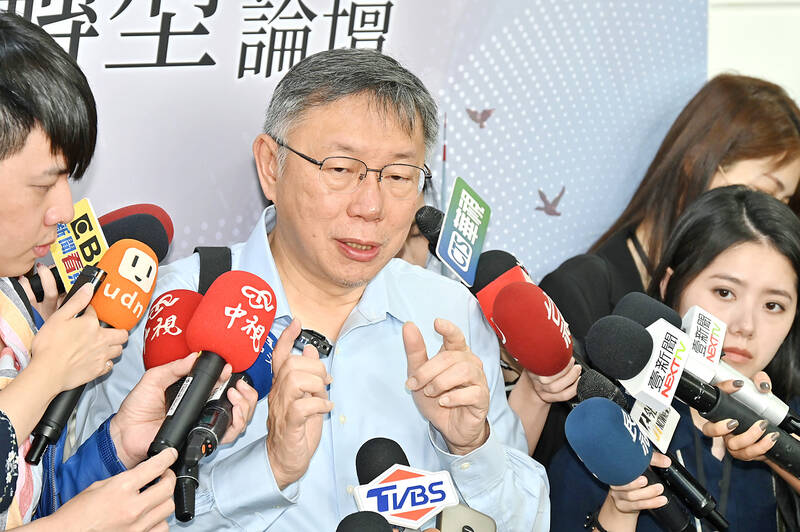
Photo: George Tsorng, Taipei Times
In the Core Pacific City shopping mall redevelopment project in Taipei’s Songshan District (松山), Ko allegedly had overseen the negotiations and signed an agreement to increase the floor area ratio (FAR) from 392 percent to 840 percent, which would allow the mall’s owner, Core Pacific Group (威京集團), to derive extra financial gains of more than NT$40 billion (US$1.23 billion), DPP Taipei city councilors Hsu Shu-hua (許淑華) and Chien Shu-pei (簡舒培) said.
“This is the key evidence showing that Ko abused his authority to allow a large corporation to illegally benefit,” Hsu said.
Core Pacific Group applied to dismantle the mall, which had been losing money, to build combined commercial and luxury residential buildings, and requested the city government to grant a much higher than normal FAR of 840 percent, she said.
Increased FAR is usually granted as an incentive in urban renewal projects to permit more floor area, but usually at 130 to 150 percent.
“The 840 percent is the highest ever in city history; no other landowner or business has come close to getting so much,” Hsu said, adding that it amounted to Ko giving Core Pacific Group more than 1,000 ping (3,306m2) for free.
“We have many city residents who have applied for an urban renewal project and they cannot even get 1 ping at old building for 1 ping at the new building, and only a few get a slightly higher FAR, but Ko’s approval of 840 percent means Core Pacific Group was able to trade in 1 ping and get 4 ping for the new redevelopment project,” she said.
In the other case, Ko is suspected of using illicit means to favor Shin Kong Life Insurance Co (新光人壽) winning 50-year surface rights to plots T17 and T18 at the Beitou Shilin Science Park without needing an investment plan.
Chien said after construction work began at the science park, the city government posted public tenders for plots T16, T17 and T18 in 2019.
Shin Kong Life Insurance secured the latter two plots, despite not having an investment plan to attract science and technology companies, while other bidders allegedly had submitted higher bids, she said.
Chien alleged that Ko was looking for financial support from large corporations for TPP candidates’ election campaigns, while the science park deal led to Ko naming Cynthia Wu (吳欣盈), a granddaughter of Shin Kong Group’s founder, on the party’s legislators-at-large list.
She later served as a TPP legislator from 2020 to January, then ran alongside Ko as the vice presidential candidate in January’s presidential election.
Taipei prosecutors said they are coordinating with Ministry of Justice Agency Against Corruption to investigate.
KMT city councilors submitted materials to the the Control Yuan and demanded an investigation into Ko.

FUKUOKA SITUATION: Japanese media reported that the pathogen is expected to be identified by the summer, while the CDC downplayed the idea that it was hMPV A “mysterious cold-like illness” reported in Japan’s Fukuoka Prefecture does not seem to be a new disease, but Japanese authorities have been asked about the situation, the Centers for Disease Control (CDC) said yesterday. The Fukuoka Prefectural Medical Association on Wednesday told a news conference that a “mystery cold” that has become a hot topic on social media is “highly likely to be caused by some kind of viral infection,” Japan’s KBC News reported. “Many people are experiencing symptoms starting with a sore throat, followed by a runny nose, phlegm and a severe cough,” KBC News reported, citing association officials. Health authorities are

Nvidia Corp CEO Jensen Huang (黃仁勳) arrived in Taiwan yesterday ahead of upcoming AI and technology events, saying he plans to meet with clients and Taiwan Semiconductor Manufacturing Co Chairman C.C. Wei (魏哲家) during his visit. After landing at Taipei Songshan Airport, Huang posed for photos with fans and handed out Yakult drinks to reporters and supporters waiting at the scene, saying he has “a lot to do” during the trip. Asked about reports that Nvidia’s planned headquarters site in Taipei’s Beitou Shilin Technology Park could break ground on May 27, Huang said that if the company holds an event, he would

The Ministry of Finance this afternoon announced the winning numbers for the March-April uniform invoice lottery. The winning number for the NT$10 million (US$318,060) special prize is 19531471, and the winning number for the NT$2 million grand prize is 85941329. Three numbers were drawn for the NT$200,000 first prize: 07225810, 20231230 and 83518781. Those with receipts matching the last seven digits of any of the first-prize numbers will win the NT$40,000 second prize, while those matching the last six digits will win the NT$10,000 third prize. Those whose receipts match the last five digits of the first-prize numbers can claim the NT$4,000 fourth prize,
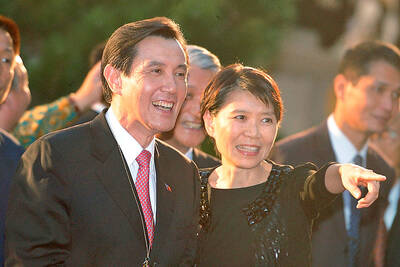
Former president Ma Ying-jeou (馬英九) yesterday expressed “shock and regret” over a statement issued by his wife without his consent, and rejected her assertion that his eldest sister, Ma Yi-nan (馬以南), would manage his medical care or act as his spokesperson amid an ongoing embezzlement probe into his foundation. Ma Ying-jeou in a statement said he was shocked by a statement by his wife, Chou Mei-ching (周美青), regarding his affairs. Ma Yi-nan “must not” be in charge of his healthcare and other personal affairs, nor can she be allowed to represent the Ma family, the former president said. He said he was also


 RSS
RSS