

Treatment-resistant depression (TRD) could be genetically passed on, a study by Taipei Veterans General Hospital showed.
The study showed that first-degree relatives of patients with TRD are two or three times more likely to have other mental illnesses, such as anxiety disorders, obsessive-compulsive disorders, depression, bipolar disorders and schizophrenia, the hospital’s Precision Depression Intervention Center director Li Cheng-ta (李正達) said.
First-degree relatives of TRD patients are 9.16 times more likely to be diagnosed with the disease, the study showed.
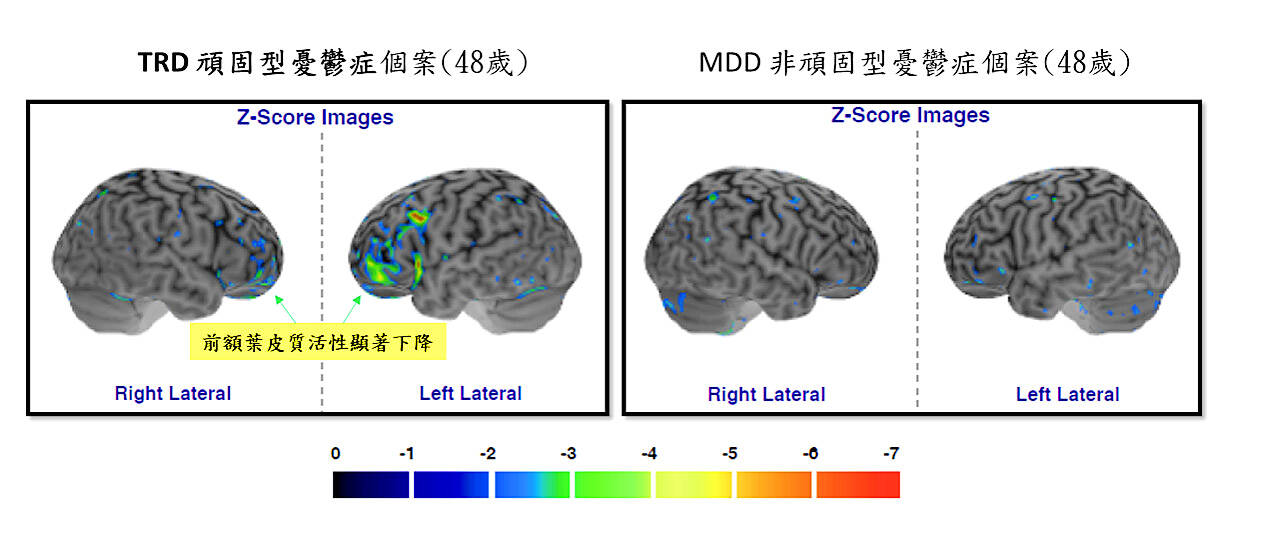
Photo courtesy of the Taipei Veterans General Hospital
Through the analysis of medical data in Taiwan, the study confirmed that TRD can be passed on through genes and the condition is a physical illness, not mental, Li said.
CNN also reported on the hospital’s study, saying that it “analyzed national health insurance data for the entire population of Taiwan for a 15-year period ... more than 21,0000 people went on to be diagnosed with treatment-resistant depression.”
“This is the most convincing evidence so far that treatment-resistant depression tends to run in families,” Andrew McIntosh, a professor of psychiatry at the Centre for Clinical Brain Sciences at the University of Edinburgh in Scotland, told CNN.
He was not involved in the study.
“While the findings imply a genetic basis, family members might also share life events, socioeconomic disadvantages or other unidentified risk factors,” McIntosh was quoted as saying.
Family members of a patient need not be overly concerned, as the study only indicated higher risk and did not state that family members would definitively be diagnosed with TRD, Li said.
Although they might be more susceptible to pressure, they should be alright if they are aware and take measures to release it, Li said.
Hospitals have many methods to help treat TRD patients, including phototherapy and radiotherapy, as well as medicinal methods that seek to help patients’ brain regain activity by simulating the frontal lobe, Li added.
The article was published in the international journal JAMA Psychiatry on April 3. The first author was Cheng Chih-ming (鄭智銘) and Li was a contributing author.

Two executives of drone supplier Jiin Ming Industry Co (錦明實業) have been detained and held incommunicado over the company's alleged use of prohibited China-made chips and camera lenses in drones supplied under recent military contracts, the Taoyuan District Prosecutors' Office said today. In a statement, prosecutors said they raided the offices of Jiin Ming — headquartered in Taoyuan — as well as those of its subsidiaries and its suppliers on Thursday last week. The raids followed a report that the company had breached its procurement contracts by putting the prohibited components into drones delivered to the military. During the raids, prosecutors summoned
The government would continue monitoring online rumors that a pneumonic plague outbreak has spread from Russia into China and could enhance existing quarantine measures, Premier Cho Jung-tai (卓榮泰) said today. During a legislative meeting, Democratic Progressive Party Legislator Wang Ting-yu (王定宇) said rumors were circulating that the disease had spread across several Chinese provinces. He asked Cho whether the government was prepared to prevent the disease from spreading to Taiwan, given the frequent exchanges between Taiwan and China, and how concerned the government was about the alleged outbreak. The Ministry of Health and Welfare implemented border quarantine measures after briefing the Executive Yuan

South Korean boy band BigBang drew 120,000 fans to three concerts at Taipei Dome from Friday through yesterday, as the band thanked them for their support over their 20-year career. The Taipei Dome concerts were part of BigBang's "2026-2027 World Tour XX: Cosmos." Friday's concert was BigBang's first performance in Taiwan in 11 years. During the encore, group leader G-Dragon (GD) shouted "I love you" in Chinese and said he was especially happy to perform in Taiwan with bandmates Taeyang and Daesung. "Taipei, I'm very grateful to you all," GD said in Chinese, asking fans to wait for the band's return. Daesung thanked

Pulled aside onto the balcony of an empty hotel room by Chinese state security officers, a Taiwanese tourist on a trip to Tibet described facing an unnerving barrage of questions about his military background and political loyalties. The man surnamed Lin (林) reported his experience in a viral post on Threads before accepting an interview with the Central News Agency (CNA) yesterday. Lin, who works as a nurse, told CNA that he knew some Taiwanese had run afoul of Chinese law enforcement, but he thought he would be safe, as he did not post much about his personal political views online. It came


 RSS
RSS