


A lawmaker has proposed a legal amendment to transfer authority to demarcate prohibited and restricted waters off Taiwan proper and Taiwan-controlled outlying islands from the defense ministry to the Ocean Affairs Council (OAC), saying that it would augment law enforcement in those areas.
Chinese Nationalist Party (KMT) Legislator Chen Yeong-kang (陳永康) crafted the draft legislation and held a public hearing on Friday.
In a written explanation accompanying the bill, Chen said that after the fatal capsizing of an unlicensed and unregistered Chinese speedboat in prohibited waters off the Kinmen Islands in February, China’s Taiwan Affairs Office publicly rejected the legality of the Taiwan-controlled prohibited and restricted waters off the Kinmen Islands.
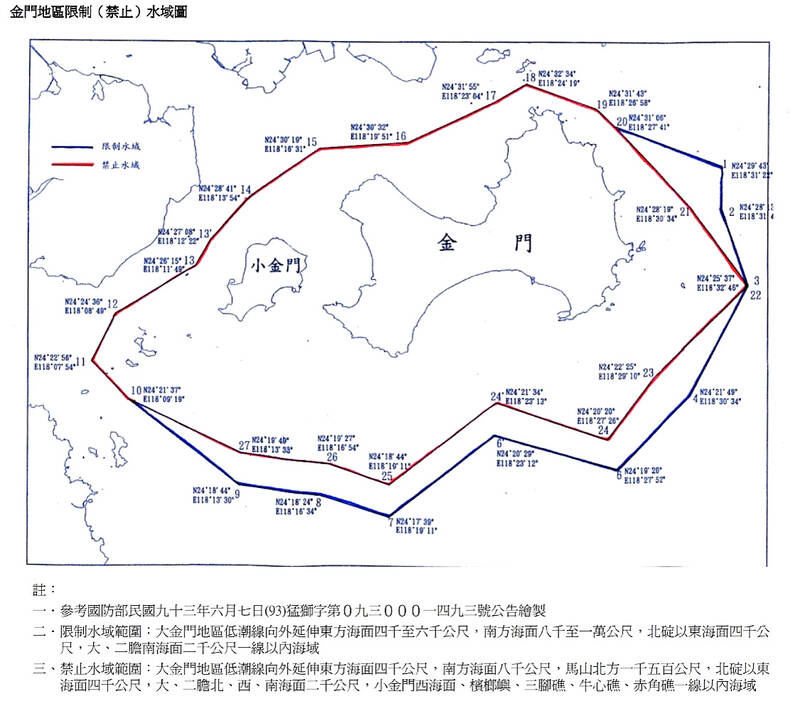
Photo courtesy of the Mainland Affairs Council
Kinmen and the city of Xiamen in China’s Fujian Province are separated by less than 10km.
Chen said that under the Act Governing Relations Between the People of the Taiwan Area and the Mainland Area (臺灣地區與大陸地區人民關係條例), the Ministry of National Defense is mandated to declare the scope of the prohibited and restricted waters.
However, the Coast Guard Administration (CGA), an OAC agency, is designated as the competent authority and tasked with patrolling and law enforcement in those areas, he added.
Since the purpose of delineating prohibited and restricted waters is to maintain order on the sea, not national defense, that task should be undertaken by the CGA, Chen said.
Tamkang University Graduate Institute of International Affairs and Strategic Studies associate professor Alexander Huang (黃介正) said that transferring the task from a military agency to a law enforcement agency would not only signal that Taiwan has sovereignty over the overlapping waters, but would also de-escalate tensions.
However, Mainland Affairs Council Deputy Minister Liang Wen-chieh (梁文傑) said the proposed amendment “would not make much difference.”
Liang added that the prohibited and restricted waters have been enforced for more than three decades based on a tacit understanding between Taiwan and China, and that it is inappropriate to seek the other side’s validation through negotiations over the scope of the Taiwan-controlled water due to unforeseen incidents.
The capsizing of the Chinese boat on Feb. 14 occurred after a high-speed chase by a Taiwanese coast guard vessel which resulted in the death of two Chinese crew members.
Beijing criticized the Democratic Progressive Party’s “brutal” handling of the incident and on Feb. 19 China Coast Guard personnel boarded a Taiwanese cruise ship.
In the month following the incident, China Coast Guard vessels frequently entered Kinmen’s prohibited waters, saying it was conducting “legal” patrols, but were expelled by vessels dispatched by its Taiwanese counterpart.

FUKUOKA SITUATION: Japanese media reported that the pathogen is expected to be identified by the summer, while the CDC downplayed the idea that it was hMPV A “mysterious cold-like illness” reported in Japan’s Fukuoka Prefecture does not seem to be a new disease, but Japanese authorities have been asked about the situation, the Centers for Disease Control (CDC) said yesterday. The Fukuoka Prefectural Medical Association on Wednesday told a news conference that a “mystery cold” that has become a hot topic on social media is “highly likely to be caused by some kind of viral infection,” Japan’s KBC News reported. “Many people are experiencing symptoms starting with a sore throat, followed by a runny nose, phlegm and a severe cough,” KBC News reported, citing association officials. Health authorities are

Nvidia Corp CEO Jensen Huang (黃仁勳) arrived in Taiwan yesterday ahead of upcoming AI and technology events, saying he plans to meet with clients and Taiwan Semiconductor Manufacturing Co Chairman C.C. Wei (魏哲家) during his visit. After landing at Taipei Songshan Airport, Huang posed for photos with fans and handed out Yakult drinks to reporters and supporters waiting at the scene, saying he has “a lot to do” during the trip. Asked about reports that Nvidia’s planned headquarters site in Taipei’s Beitou Shilin Technology Park could break ground on May 27, Huang said that if the company holds an event, he would

The Ministry of Finance this afternoon announced the winning numbers for the March-April uniform invoice lottery. The winning number for the NT$10 million (US$318,060) special prize is 19531471, and the winning number for the NT$2 million grand prize is 85941329. Three numbers were drawn for the NT$200,000 first prize: 07225810, 20231230 and 83518781. Those with receipts matching the last seven digits of any of the first-prize numbers will win the NT$40,000 second prize, while those matching the last six digits will win the NT$10,000 third prize. Those whose receipts match the last five digits of the first-prize numbers can claim the NT$4,000 fourth prize,
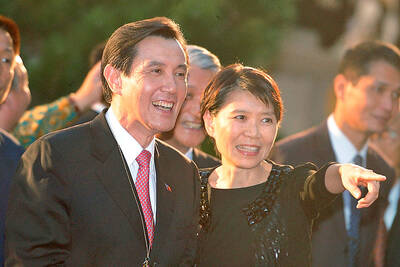
Former president Ma Ying-jeou (馬英九) yesterday expressed “shock and regret” over a statement issued by his wife without his consent, and rejected her assertion that his eldest sister, Ma Yi-nan (馬以南), would manage his medical care or act as his spokesperson amid an ongoing embezzlement probe into his foundation. Ma Ying-jeou in a statement said he was shocked by a statement by his wife, Chou Mei-ching (周美青), regarding his affairs. Ma Yi-nan “must not” be in charge of his healthcare and other personal affairs, nor can she be allowed to represent the Ma family, the former president said. He said he was also


 RSS
RSS