


Organizers yesterday unveiled the design for the presidential inauguration ceremony, which features a four-color theme symbolizing Taiwanese values.
The organizers, the General Association of Chinese Culture, said that the neat and simple design for the May 20 ceremony is centered on ribbons of four colors — red, yellow, green and blue — to symbolize freedom, democracy, confidence and friendship respectively.
The design represents people in Taiwan from various backgrounds and with different values interacting with and supporting each other, said Yen Design founder and director Yen Po-chun (顏伯駿), who is in charge of the design.
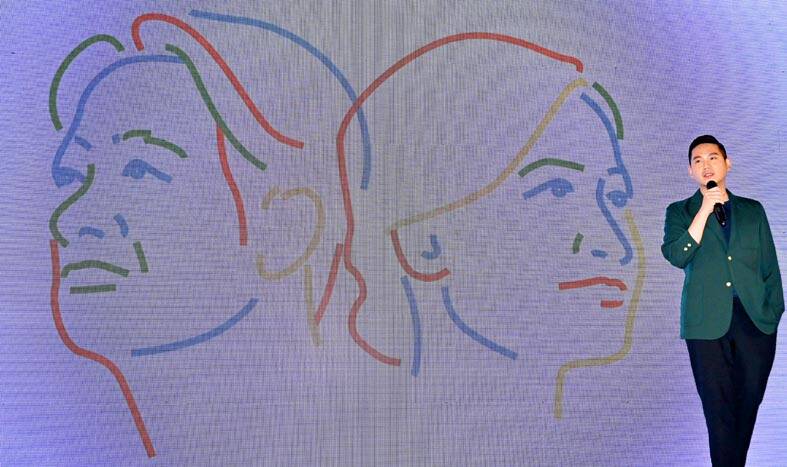
Photo: George Tsorng, Taipei Times
Stylized portraits of president-elect William Lai (賴清德) and vice president-elect Hsiao Bi-khim (蕭美琴) using the four colors symbolize hope that the two would lead Taiwanese to a better future, Yen told a news conference in Taipei.
The organizers have prepared five items each for people who attend the ceremony — a sun hat, a towel, an amulet, a set of two badges and a bottle of water — all with the four-color design, he said.
One of the badges bears the portraits of Lai and Hsiao, and the other images of a dog and a cat — as Lai is a dog person and Hsiao a cat person — symbolizing that people with different stances can share a better future, he said.

Photo: CNA
For the first time, the ceremony is to include performances by a cappella choirs, and Hakka and Hoklo-language (also known as Taiwanese) rappers on a stage that can be raised and lowered, Lai’s campaign office spokeswoman Kuo Ya-hui (郭雅慧) said.
There are also to be performances by groups from the National Taiwan College of Performing Arts, the Taiwan Acrobatic Troupe, the Chio Tian Folk Drums and Arts Troupe, the Taipei Municipal Chien Kuo High School Marching Band, National Taiwan University of Sport, Best Crew Dance Studio, Paper Windmill Theatre, Vuize (王鐘惟), KE (柯蕭), the Taipei Male Choir, Ilid Kaolo, the Dashing Theater, Since Chou (周自從), Juang Jing Vocational High School, Fire Ex and LaBa LaVa, Kuo said.
On the night of the ceremony, a state banquet is to be held in Tainan to mark the 400th anniversary of the city’s founding, she said, adding that singer Hsieh Ming-yu (謝銘佑), the Yowuwei Children’s Choir, cellist Kenneth Kuo (郭虔哲) and Siri Lee (李竺芯) are to perform at the banquet.
The ceremony is to be hosted by SET News anchor Jasmine Liu (劉宸希) and Taiwan Plus journalist Ethan Liu (劉傑中), while the banquet is to be hosted by herself and model Kevin Tai (戴凱文), Kuo added.
The inauguration ceremony and the state banquet are invitation-only, but the events are to be broadcast live, she added.
An area would be set up at the intersection of Ketagalan Boulevard and Gongyuan Road in Taipei for public viewing, she said.
There would be surprises and more details revealed in the next few days, she said.
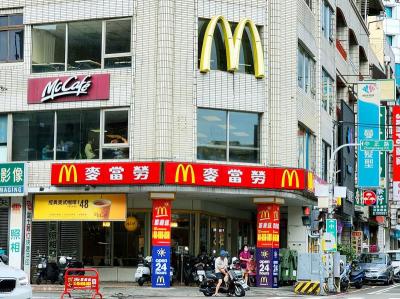
Fast food chain McDonald's is to raise prices by up to NT$5 on some products at its restaurants across Taiwan, starting on Wednesday next week, the company announced today. The prices of all extra value meals and sharing boxes are to increase by NT$5, while breakfast combos and creamy corn soup would go up by NT$3, the company said in a statement. The price of the main items of those meals, if ordered individually, would remain the same. Meanwhile, the price of a medium-sized lemon iced tea and hot cappuccino would rise by NT$3, extra dipping sauces for chicken nuggets would go up
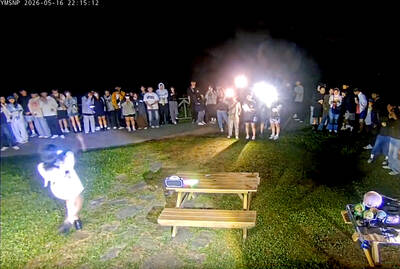
Yangmingshan National Park’s Qingtiangang (擎天崗) nature area has gone viral after a park livestream camera observed a couple in the throes of intimate congress, which was broadcast live on YouTube, drawing large late-night crowds and sparking a backlash over noise, bright lights and disruption to wildlife habitat. The area’s livestream footage appeared to show a couple engaging in sexual activity on a picnic table in the park on Friday last week, with the uncensored footage streamed publicly online. The footage quickly spread across social media, prompting a tide of visitors to travel to the site to “check in” and recreate the

Minister of Digital Affairs Lin Yi-ching (林宜敬) yesterday cited regulatory issues and national security concerns as an expert said that Taiwan is among the few Asian regions without Starlink. Lin made the remarks on Facebook after funP Innovation Group chief executive officer Nathan Chiu (邱繼弘) on Friday said Taiwan and four other countries in Asia — China, North Korea, Afghanistan and Syria — have no access to Starlink. Starlink has become available in 166 countries worldwide, including Ukraine, Malaysia, the Philippines and Vietnam, in the six years since it became commercial, he said. While China and North Korea block Starlink, Syria is not
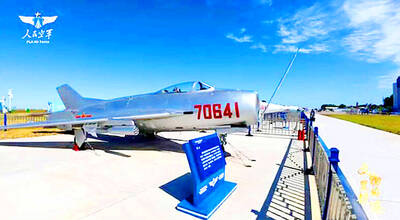
GROUNDED: A KMT lawmaker proposed eliminating drone development programs and freezing funding for counterdrone systems, despite China’s adoption of the technology China has deployed attack drones at air bases near the Taiwan Strait in a strategy aimed at overwhelming Taiwan’s air defense systems through saturation attacks, the Mainland Affairs Council (MAC) said. The council’s latest quarterly report on China said that satellite imagery and open-source intelligence indicate that the Chinese People’s Liberation Army (PLA) had converted retired J-6 fighter jets into J-6W drones, which the PLA has stationed at six air bases near Taiwan, five in China’s Fujian Province and one in Guangdong Province. The report cited J. Michael Dahm, a senior fellow at the US-based Mitchell Institute, as saying that China has


 RSS
RSS