


The first Fast IDentity Online (FIDO) Device Onboard (FDO) seminar, hosted by Academia Sinica, was held yesterday in Taipei, highlighting Taiwan’s status as a hub for the global tech supply chain.
Taiwan’s promotion of “information security equates to national security” aligns with the prevalence of the “zero trust” concept among other foreign governments, as all governments and companies seek to develop more secure networks and systems.
Zero Trust is a security framework that requires all users to be authenticated, authorized and continuously validated for security configuration and posture.
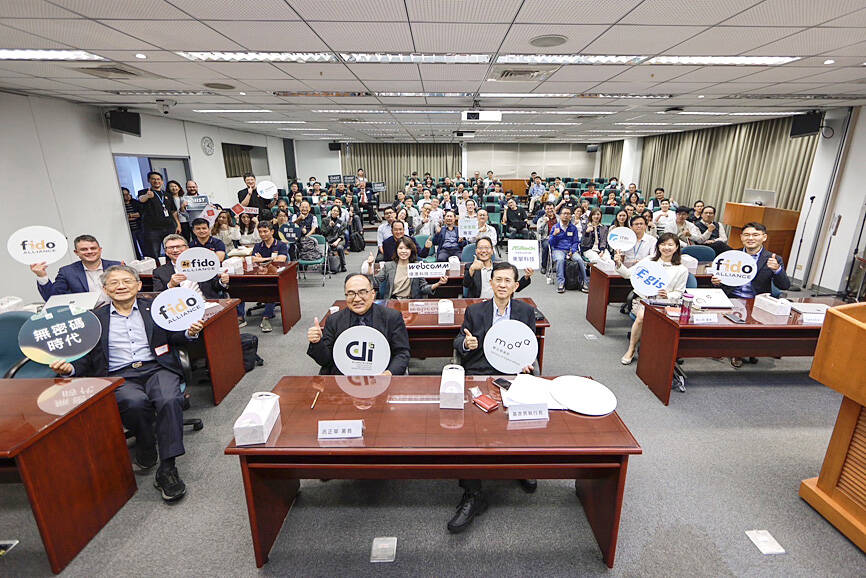
Photo: courtesy of the FIDO Alliance Taiwan Engagement Forum
FIDO Alliance members Intel, Dell, Qualcomm, ARM, Amazon, Google and Microsoft have recently jointly completed a proof of concept of a new technology that would help the FIDO Alliance promote a certification program that would encourage all supply chain owners around the globe to begin focusing on Internet of Things (IoT) security.
FIDO Alliance FDO project manager Richard Kerslake yesterday said that as IoT solutions become commonplace, including in factories, hospitals, vehicle platforms and even stores, the urgency of developing a safe, effective and standardized procedure to connect them to central management platforms is growing.
FDO technology meets these demands and provides a nearly universally adaptable, automated, safe and “plug and use” method for connecting devices with the managing platform, he said.
With FDO, the information security risks generated by the need for preset passwords to activate devices or passwords for engineers in the event of malfunctioning units are largely removed, he said.
Taiwan’s information security sector has always been at the world’s forefront, FIDO Taiwan Engagement Forum Chair and Egis Technology vice president Karen Chang (張心玲) said, adding that she hoped the FIDO branch would bring together all FIDO groups in Taiwan to form a healthier ecosystem and bring in more domestic industry owners to jointly safeguard information security for the global supply chain.
Academia Sinica’s Research Center for Information Technology Innovation research fellow Huang Yen-nun (黃彥男) said that, as a FIDO Alliance member, Academia Sinica would work closely with the Ministry of Digital Affairs to realize a safer digital environment.
The ministry is committed to implementing the “zero trust’ concept when promoting FIDO identification technology, Administration for Digital Industries Director-General Leu Jang-hwa (呂正華) said.
Applauding FIDO’s goal of implementing its FDO technology in the IoT sector, Leu said that he expected it to see great applications in the manufacturing, retail and medical industries.
Safeguarding the IoT sector would ensure greater digital resilience and prove to be a big boost to the development of the information security industry, he said.
Intel, Dell, Infineone, Red Hat, VinCSS from Vietnam and other significant players in the tech industry participated in yesterday’s event.
The Ministry of Digital Affairs joined the FIDO alliance last year, making it the seventh government unit to join the organization and the second in the country.
Minister of Digital Affairs Audrey Tang (唐鳳) last year said that since its inauguration in August 2022, the ministry has been focusing on tightening security for online identification and electronic signatures.
Tang said that Taiwan joining the FIDO Alliance would allow it to implement FIDO standards across government agencies and the financial sector, and broaden the application of such standards to other industries.
The ministry would participate in FIDO forums on tech standards and evaluate how the technologies discussed can be applied in government, the corporate sector and among base-level consumers, Tang said.
FIDO Alliance members include financial institutions, credit card companies, information and network service providers, semiconductors and software and hardware manufacturers.
Its 39 board members include Google, Microsoft, Apple, Meta, Amazon, PayPal, Mastercard, Visa, Intel, NTT Docomo, Line, Samsung and Egis.
FIDO aims to allow users to sign into systems and platforms using phishing-resistant credentials, or passkeys, that can be synced across multiple devices or bound to a singular platform or security key.

FUKUOKA SITUATION: Japanese media reported that the pathogen is expected to be identified by the summer, while the CDC downplayed the idea that it was hMPV A “mysterious cold-like illness” reported in Japan’s Fukuoka Prefecture does not seem to be a new disease, but Japanese authorities have been asked about the situation, the Centers for Disease Control (CDC) said yesterday. The Fukuoka Prefectural Medical Association on Wednesday told a news conference that a “mystery cold” that has become a hot topic on social media is “highly likely to be caused by some kind of viral infection,” Japan’s KBC News reported. “Many people are experiencing symptoms starting with a sore throat, followed by a runny nose, phlegm and a severe cough,” KBC News reported, citing association officials. Health authorities are

Nvidia Corp CEO Jensen Huang (黃仁勳) arrived in Taiwan yesterday ahead of upcoming AI and technology events, saying he plans to meet with clients and Taiwan Semiconductor Manufacturing Co Chairman C.C. Wei (魏哲家) during his visit. After landing at Taipei Songshan Airport, Huang posed for photos with fans and handed out Yakult drinks to reporters and supporters waiting at the scene, saying he has “a lot to do” during the trip. Asked about reports that Nvidia’s planned headquarters site in Taipei’s Beitou Shilin Technology Park could break ground on May 27, Huang said that if the company holds an event, he would

Carrefour Taiwan is to begin using a new name from the start of July, but it cannot divulge the name until then, the chairman of the supermarket chain's parent company said today. President Chain Store Co chairman Lo Chih-hsien (羅智先) was asked by reporters after a shareholders' meeting to confirm whether the company has settled on a new name for the supermarket brand. In March, the government-registered name of two Carrefour Taiwan branches was quietly changed to "Le Chia Kang" (樂家康) in Chinese, raising speculation that has been selected as the name. Lo said that because of local regulations and contractual obligations, the

The Philippines would likely be involved in any conflict over Taiwan due to its proximity to the democracy claimed by China, President Ferdinand Marcos Jr said, reiterating a stance that risks angering Beijing. “In the Philippines, we do not have a choice because Taiwan is so close to the Philippines and we have almost 200,000 Filipino nationals living and working in Taiwan,” Marcos said in an interview with Japanese media in Manila on Monday. The Philippine leader’s comments come ahead of a state visit to Japan next week, where he is to meet with Japanese Prime Minister Sanae Takaichi to discuss security


 RSS
RSS