


Four defendants in an espionage case were sentenced yesterday by the High Court’s Tainan branch to six to eight years in jail.
The four were found guilty of contravening the National Security Act (國家安全法) and the Anti-corruption Act (貪污治罪條例).
The verdict can be appealed.
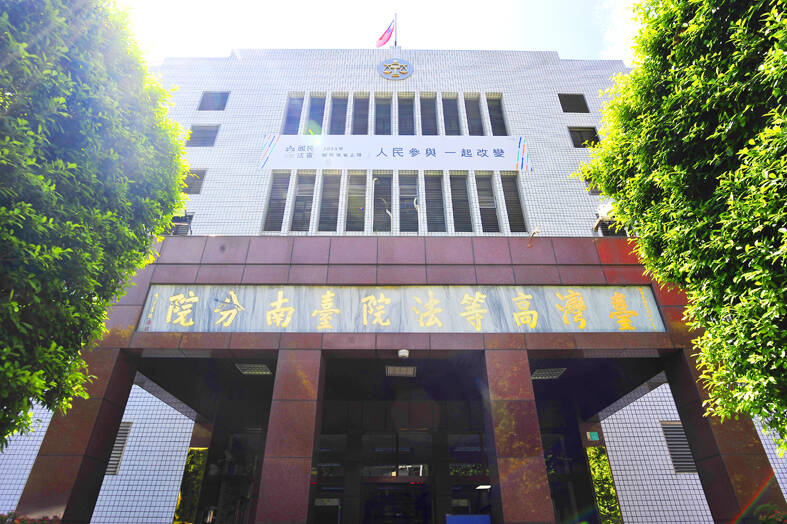
Photo: Wang Chieh, Taipei Times
Huang Lung-lung (黃龍瀧) and his son Huang Sheng-yu (黃聖峪) started doing business in Xiamen, China, in April 2015, where they met China’s Taiwan Affairs Office (TAO) Fujian branch office member Zhong Dongsheng (鍾東生) and TAO Guangzhou office member Zhang Xiaofeng (張曉楓) in 2019, the court said in its verdict.
Zhong and Zhang persuaded the Huangs to recruit Taiwanese military members willing to provide government or military secrets, promising cash in return, it said.
Between March 2017 and August 2021, the Huangs approached Huang Sheng-yu’s former sports team members and classmates, obtaining agreements from Yeh Hsin-liang (葉鑫亮) and Su Kuan-ying (蘇冠穎), both of whom were air force personnel, the ruling said.
Two others surnamed Chin (金) and Hsieh (謝) declined the offers, it said.
Yeh was paid NT$100,000 for delivering military and government secrets to Huang Lung-lung in 2019 and 2020, while Su received NT$210,000 for selling military and state secrets from September to October 2021, it said.
The Huangs were sentenced to eight years in prison, while Su was given seven years and disenfranchisement for five years, and Yeh is to serve six years and be disenfranchised for five years, it said.
Separately yesterday, Zhou Manzhi (周滿芝), head of the Taiwan New Immigrants’ Association, was indicted on charges of accepting Chinese funding to develop espionage cells in Taiwan.
The case, formerly under the jurisdiction of the Ciaotou District Court, had been remanded to the High Court’s Kaohsiung branch, as it was a second-appellate court case involving an alleged violation of the National Security Act (國家安全法).
The Ciaotou District Prosecutors’ Office had suggested that Zhou should remain in detention, but the Kaohsiung District Court set bail at NT$150,000 and ordered her not to leave the country.
Zhou is alleged to have contravened the Presidential and Vice Presidential Election and Recall Act (總統副總統選舉罷免法) and the Anti-infiltration Act (反滲透法), the Ciaotou District Prosecutors’ Office said.
Prosecutors said that an investigation found that the association and other pro-Chinese organizations had taken groups on tours to China’s Hunan Province, and the Chinese government had allegedly paid their expenses.
During the trip, Zhou spoke about the importance of “peaceful unification” and asked tour group members to support specific candidates in Taiwan, the prosecutors said.

Actor Darren Wang (王大陸) was sentenced to six months in prison, commutable to a fine, by the New Taipei District Court today for contravening the Personal Data Protection Act (個人資料保護法) in a case linked to an alleged draft-dodging scheme. Wang allegedly paid NT$3.6 million (US$114,380) to an illegal group to help him evade mandatory military service through falsified medical documents, prosecutors said. He transferred the funds to Chen Chih-ming (陳志明), the alleged mastermind of a draft-evasion ring, although he lost contact with him as he was already in detention on fraud charges, they said. Chen is accused of helping a

SECURITY: Starlink owner Elon Musk has taken pro-Beijing positions, and allowing pro-China companies to control Taiwan’s critical infrastructure is risky, a legislator said Starlink was reluctant to offer services in Taiwan because of the nation’s extremely high penetration rates in 4G and 5G services, the Ministry of Digital Affairs said yesterday. The ministry made the comments at a meeting of the legislature’s Transportation Committee, which reviewed amendments to Article 36 of the Telecommunications Management Act (電信管理法). Article 36 bans foreigners from holding more than 49 percent of shares in public telecommunications networks, while shares foreigners directly and indirectly hold are also capped at 60 percent of the total, unless specified otherwise by law. The amendments, sponsored by Chinese Nationalist Party (KMT) Legislator Ko
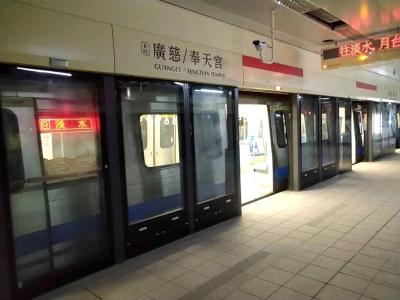
The eastern extension of the Taipei MRT Red Line could begin operations as early as late June, the Taipei Department of Rapid Transit Systems said yesterday. Taipei Rapid Transit Corp said it is considering offering one month of free rides on the new section to mark its opening. Construction progress on the 1.4km extension, which is to run from the current terminal Xiangshan Station to a new eastern terminal, Guangci/Fengtian Temple Station, was 90.6 percent complete by the end of last month, the department said in a report to the Taipei City Council's Transportation Committee. While construction began in October 2016 with an
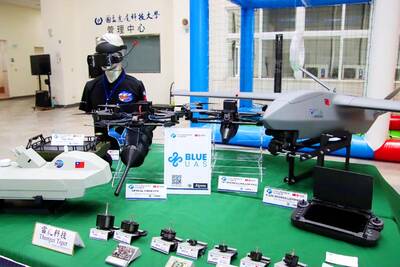
NON-RED SUPPLY: Boosting the nation’s drone industry is becoming increasingly urgent as China’s UAV dominance could become an issue in a crisis, an analyst said Taiwan’s drone exports to Europe grew 41.7-fold from 2024 to last year, with demand from Ukraine’s fight against Russian aggression the most likely driver of growth, a study showed. The Institute for Democracy, Society and Emerging Technology (DSET) in a statement on Wednesday said it found that many of Taiwan’s uncrewed aerial vehicle (UAV) sales were from Poland and the Czech Republic. These countries likely transferred the drones to Ukraine to aid it in its fight against the Russian invasion that started in 2022, it said. Despite the gains, Taiwan is not the dominant drone exporter to these markets, ranking second and fourth


 RSS
RSS