


University students yesterday proposed six ways to update the Gender Equity Education Act (性別平等教育法), two decades after its enactment, to better address today’s issues.
The legislature passed amendments to the act in July last year.
Former National Taiwan University (NTU) Student Association Gender Workshop head Chen Su-chien (陳思捷) said that the government should further amend the act to include the definition of “hostile environment sexual harassment” as stated in the Sexual Harassment Prevention Act (性騷擾防治法).
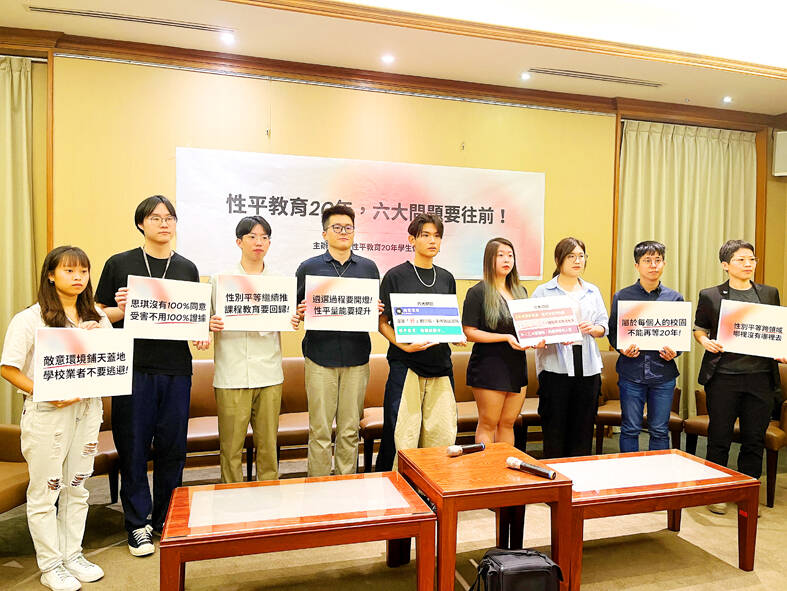
Photo: Lee Wen-hsin, Taipei Times
National Chengchi University Gender Equality Association student member Ho Chieh-en (何傑恩) said the definition of sexual violence should be changed to require alleged harassers to provide proof of “affirmative consent.”
School gender equality associations should regularly inspect whether course content at universities is in line with the standards of gender-equal education, National Tsing Hua University Gender Equality Association student representative Wu Ching-hsuan (吳清軒) said.
Campus gender equality associations lack resources and personnel, and should have one full-time member, former NTU Gender Equality Association member Yu Tung-hsu (余東栩) said, adding that all association members should publicly express their views on gender equality.
Ministry of Education Gender Equality Association member Yang Yun-chen (楊昀臻), also a student at the National Taipei University, said the ministry should make guidelines on how gender equality education can be reflected on different institutions of the military, arts and humanities, and medical education.
Chiaotung Campus of National Yangming Chiaotung University Gender Equality Association head Ma Hsiao-chi (麻筱祺) said the education system should be adjusted to better understand the experiences and needs of those who identify as non-binary and should establish proper channels through which their voices can be heard.
Many things in everyday campus life, such as dorm choices, restrooms and the collection and use of basic gender data present hardships and challenges for non-binary students, Ma said.

Kenting National Park service technician Yang Jien-fon (楊政峰) won a silver award in World Grand Prix Photography Awards Spring Season for his photograph of two male rat snakes intertwined in combat. Yang’s colleagues at Kenting National Park said he is a master of nature photography who has been held back by his job in civil service. The awards accept entries in all four seasons across six categories: architectural and urban photography, black-and-white and fine art photography, commercial and fashion photography, documentary and people photography, nature and experimental photography, and mobile photography. Awards are ranked according to scores and divided into platinum, gold and

The Chinese Nationalist Party (KMT) caucus yesterday said it opposes the introduction of migrant workers from India until a mechanism is in place to prevent workers from absconding. Minister of Labor Hung Sun-han (洪申翰) on Thursday told the Legislative Yuan that the first group of migrant workers from India could be introduced as early as this year, as part of a government program. The caucus’ opposition to the policy is based on the assessment that “the risk is too high,” KMT caucus secretary-general Lin Pei-hsiang (林沛祥) said. Taiwan has a serious and long-standing problem of migrant workers absconding from their contracts, indicating that

SPACE VETERAN: Kjell N. Lindgren, who helps lead NASA’s human spaceflight missions, has been on two expeditions on the ISS and has spent 311 days in space Taiwan-born US astronaut Kjell N. Lindgren is to visit Taiwan to promote technological partnerships through one of the programs organized by the US for its 250th national anniversary. Lindgren would be in Taiwan from Tuesday to Saturday next week as part of the US Bureau of Educational and Cultural Affairs’ US Speaker Program, organized to celebrate the 250th anniversary of the signing of the Declaration of Independence, the American Institute in Taiwan (AIT) said in a statement yesterday. Lindgren plans to engage with key leaders across the nation “to advance cutting-edge technological partnerships and inspire the next generation of scientists and engineers,”

TRADE-OFF: Beijing seeks to trade a bowl of tempura for a Chinese delicacy, an official said, while another said its promises were attempts to interfere in the polls The government must carefully consider the national security implications of building a bridge connecting Kinmen County and Xiamen, China, the Public Construction Commission (PCC) said yesterday. PCC Commissioner Derek Chen (陳金德), who is also a minister without portfolio, made the remarks in a meeting of the legislature’s Transportation Committee, after Democratic Progressive Party Legislator Hsu Fu-kuei (徐富癸) asked about China’s proposal of new infrastructure projects to further connect Kinmen and Lienchiang (Matsu) counties with Xiamen. China unveiled the bridge plan, along with nine other policies for Taiwan, on Sunday, the last day of Chinese Nationalist Party (KMT) Chairwoman Cheng Li-wun’s (鄭麗文) visit


 RSS
RSS