


Israel is an important global start-up hub, and hopefully, based on shared values of democracy and freedom, Taiwan and Israel can continue to deepen their partnership and leverage their respective strengths to build more resilient global supply chains together, President Tsai Ing-wen (蔡英文) said yesterday.
Tsai made the remarks in a meeting with a delegation from the Knesset, Israel’s parliament, at the Presidential Office in Taipei.
The cross-party delegation was led by Taiwan-Israel Parliamentary Friendship Group chair Boaz Toporovsky.
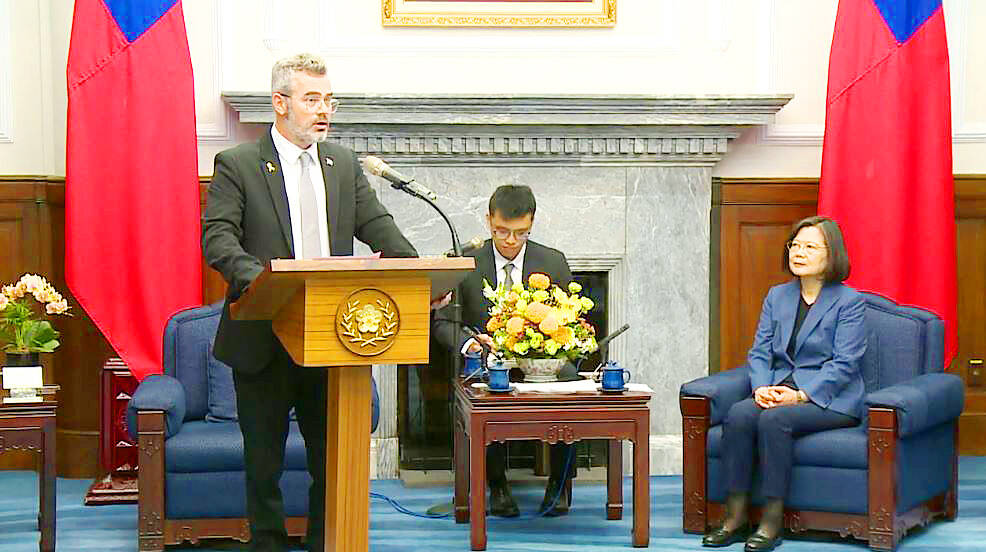
Photo: Screenshot from the Presidential Office’s Web site
It has been more than 30 years since Israel and Taiwan mutually established representative offices, and both countries have worked closely and held regular dialogues in the fields of energy, environment and economics, Tsai said.
Over the past three decades, Taiwan and Israel have also signed 33 agreements and enhanced exchanges in the fields of education and public health, she said, adding that a joint declaration of tourism collaboration was signed last month.
Taiwan’s Industrial Technology Research Institute, Asia Silicon Valley Development Agency and other companies hope to have more cooperation opportunities with Israel, Tsai said.
In reference to Iran launching an unprecedented large-scale drone and missile attack on Israel on Saturday evening, Tsai also expressed her sincere concern and condolences, and condemned the use of violence to destroy world peace.
Taiwan is a beacon of freedom and democracy, and Tsai is a role model of democracy and freedom leadership, Toporovsky said.
He expressed his condolences to the victims of the April 3 earthquake in Hualien, and added that the quake has once again shown Taiwan’s strength and resilience to the world.
Taiwan and Israel are good friends, and although people in both countries face difficult situations, both are small and strong democratic countries, and that friendship would become more stable, while cooperation would continue to expand, he said.
Later yesterday at a press conference, Toporovsky said the delegation appreciated the collaboration between Taiwan and Israel and the support shown by Tsai and Minister of Foreign Affairs Joseph Wu (吳釗燮) in the wake of the Iranian attacks.
Regarding what Israel needs at the moment, Boaz Bismuth, one of the four delegation members, said that with 120,000 people forced to evacuate from their homes, Israel needs humanitarian aid, and he said the international community should care about the situation there.
"I think Taiwan felt exactly the grief in which we were the first day [after the attack], and solidarity is the word," he said.
Separately, all Taiwanese nationals in Iran and Israel have been reported safe, Wu said yesterday.
Currently, there are a little more than 20 Taiwanese expatriates who are now naturalized Iranians living in the West Asian country, Wu said.
More than 200 Taiwanese nationals and their spouses and children are in Israel, data from the Ministry of Foreign Affairs showed.
The ministry also called on people to refrain from traveling to both countries due to heightened tensions in the Middle East.
It has also issued the second highest-level orange alert for both Israel and Iran.
The ministry uses a four-tiered travel advisory regarding safety and security risks. The lowest level, grey, signifies caution should be exercised; yellow suggests travel should be reconsidered; orange indicates unnecessary travel should be avoided; and red asks nationals not to travel to a destination.
People can call Taiwan’s representative offices in Israel at +972-544-275-204 and in Dubai at +971-50-6453018, as well as the Taiwan Trade Center in Tehran at +98-21-8879-4243.
Additional reporting by CNA

FUKUOKA SITUATION: Japanese media reported that the pathogen is expected to be identified by the summer, while the CDC downplayed the idea that it was hMPV A “mysterious cold-like illness” reported in Japan’s Fukuoka Prefecture does not seem to be a new disease, but Japanese authorities have been asked about the situation, the Centers for Disease Control (CDC) said yesterday. The Fukuoka Prefectural Medical Association on Wednesday told a news conference that a “mystery cold” that has become a hot topic on social media is “highly likely to be caused by some kind of viral infection,” Japan’s KBC News reported. “Many people are experiencing symptoms starting with a sore throat, followed by a runny nose, phlegm and a severe cough,” KBC News reported, citing association officials. Health authorities are

Nvidia Corp CEO Jensen Huang (黃仁勳) arrived in Taiwan yesterday ahead of upcoming AI and technology events, saying he plans to meet with clients and Taiwan Semiconductor Manufacturing Co Chairman C.C. Wei (魏哲家) during his visit. After landing at Taipei Songshan Airport, Huang posed for photos with fans and handed out Yakult drinks to reporters and supporters waiting at the scene, saying he has “a lot to do” during the trip. Asked about reports that Nvidia’s planned headquarters site in Taipei’s Beitou Shilin Technology Park could break ground on May 27, Huang said that if the company holds an event, he would

The Ministry of Finance this afternoon announced the winning numbers for the March-April uniform invoice lottery. The winning number for the NT$10 million (US$318,060) special prize is 19531471, and the winning number for the NT$2 million grand prize is 85941329. Three numbers were drawn for the NT$200,000 first prize: 07225810, 20231230 and 83518781. Those with receipts matching the last seven digits of any of the first-prize numbers will win the NT$40,000 second prize, while those matching the last six digits will win the NT$10,000 third prize. Those whose receipts match the last five digits of the first-prize numbers can claim the NT$4,000 fourth prize,
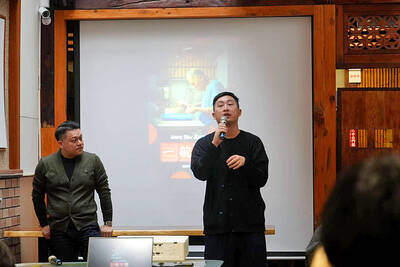
Taiwan Travelogue (臺灣漫遊錄), which earlier this week became the first Taiwanese novel to win the International Booker Prize, is to be adapted into a television series through a Taiwan-Japan coproduction, producer Chang Chen-yu (張辰漁) said yesterday. Chang, a producer at World Softest Production Film Co, wrote on Facebook that the company had been searching for projects with international appeal that retain a strong Taiwanese identity after colleagues and Japanese partners strongly recommended the novel. After reading the book, Chang said he immediately decided to pursue the screen rights. “A great story has the power to transcend time and borders, and connect countless people,”


 RSS
RSS