


President-elect William Lai’s (賴清德) partial list of picks for the incoming Cabinet drew praise from allies and criticism from opponents yesterday, with reactions largely falling along political lines.
Former Cabinet secretary-general Cho Jung-tai (卓榮泰), who Lai named as presumptive premier, is experienced in governance and negotiating political waters, Democratic Progressive Party (DPP) Legislator Rosalia Wu (吳思瑤) told a news conference in Taipei, adding that he commands confidence.
With a well-rounded resume and reputation for political skills, Cho would likely prove a good leader of the Cabinet and communicate effectively with the legislature, Wu said.
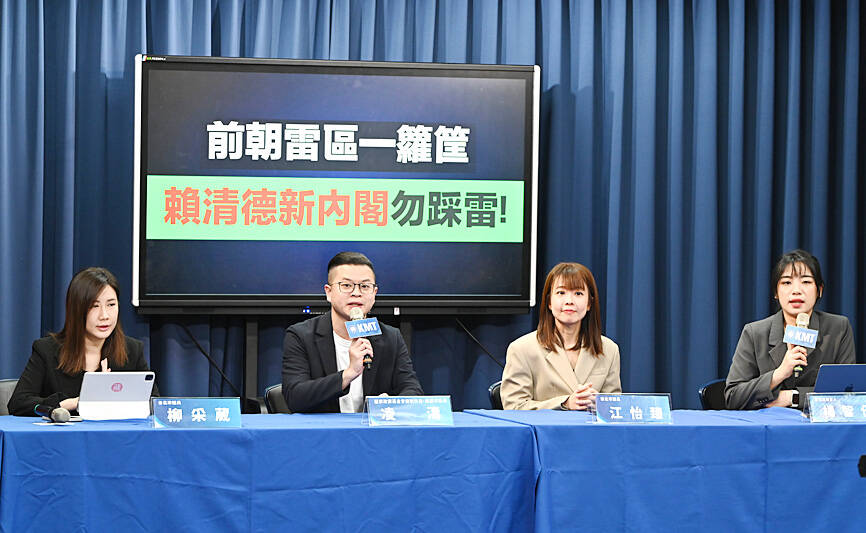
Photo: Tien Yu-hua, Taipei Times
Former minister of culture Cheng Li-chiun (鄭麗君), tapped for vice premier, was a convener at the National Hope Project, the Lai campaign’s task force that wrote his campaign platform, Wu said.
Cho enjoys Lai’s trust, has a good sense for trends in public opinion and is skilled at brokering deals, while Cheng’s involvement in crafting the president-elect’s policies ensured her place in the Cabinet, Wu said.
Regarding National Security Council Deputy Secretary-General Wellington Koo (顧立雄) — who is set to be the next defense minister, DPP Legislator Chuang Jui-hsiung (莊瑞雄) said criticism that Koo lacks military experience is misguided.
Following changes to the Ministry of National Defense’s organization, its administration and leadership have been unified, Chuang said, adding that Taiwan would not be the first nation to name a civilian to run its defense ministry.
Chinese Nationalist Party (KMT) spokeswoman Yang Chih-yu (楊智?) said that the DPP officials picked for Lai’s Cabinet are distinguished by checkered ethical records, while the list showed no innovation or initiative.
KMT Taoyuan Councilor Ling Tao (凌濤) said that Lai’s slogan to name an “active and innovative Cabinet,” or an “AI Cabinet,” belies a government with no new ideas.
The “AI” misleads the public into thinking something is being done with artificial intelligence, Ling said.
“The people tapped by Lai are the same politicians who sound like a broken record or a wolf warrior during questioning at the legislature,” he said, adding that “ChatGPT would probably have done better.”
Koo has no military experience and he is known only for making belligerent comments about China, Ling said, adding that Taiwanese should be scared by the prospect of the new administration.
Lai would do well not to give Deputy Minister of Digital Affairs Lee Huai-jen (李懷仁) a Cabinet post, as Lee has been caught napping during a legislative session, KMT New Taipei City Councilor Chiang I-chen (江怡臻) said.
Cho talked a lot about innovation at Lai’s news conference, but said nothing about what that would mean when it comes to policymaking, Taiwan People’s Party spokeswoman Wu Yi-hsuan (吳怡萱) said in a statement, adding that Taiwanese would have better luck asking Siri about the “AI” Cabinet.
Additional reporting by Shih Hsiao-huang

Actor Darren Wang (王大陸) was sentenced to six months in prison, commutable to a fine, by the New Taipei District Court today for contravening the Personal Data Protection Act (個人資料保護法) in a case linked to an alleged draft-dodging scheme. Wang allegedly paid NT$3.6 million (US$114,380) to an illegal group to help him evade mandatory military service through falsified medical documents, prosecutors said. He transferred the funds to Chen Chih-ming (陳志明), the alleged mastermind of a draft-evasion ring, although he lost contact with him as he was already in detention on fraud charges, they said. Chen is accused of helping a

SECURITY: Starlink owner Elon Musk has taken pro-Beijing positions, and allowing pro-China companies to control Taiwan’s critical infrastructure is risky, a legislator said Starlink was reluctant to offer services in Taiwan because of the nation’s extremely high penetration rates in 4G and 5G services, the Ministry of Digital Affairs said yesterday. The ministry made the comments at a meeting of the legislature’s Transportation Committee, which reviewed amendments to Article 36 of the Telecommunications Management Act (電信管理法). Article 36 bans foreigners from holding more than 49 percent of shares in public telecommunications networks, while shares foreigners directly and indirectly hold are also capped at 60 percent of the total, unless specified otherwise by law. The amendments, sponsored by Chinese Nationalist Party (KMT) Legislator Ko
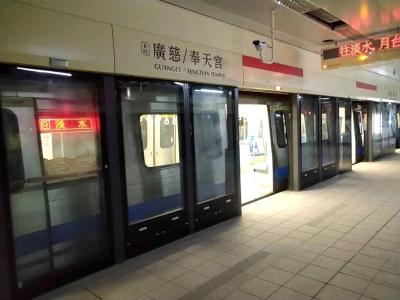
The eastern extension of the Taipei MRT Red Line could begin operations as early as late June, the Taipei Department of Rapid Transit Systems said yesterday. Taipei Rapid Transit Corp said it is considering offering one month of free rides on the new section to mark its opening. Construction progress on the 1.4km extension, which is to run from the current terminal Xiangshan Station to a new eastern terminal, Guangci/Fengtian Temple Station, was 90.6 percent complete by the end of last month, the department said in a report to the Taipei City Council's Transportation Committee. While construction began in October 2016 with an
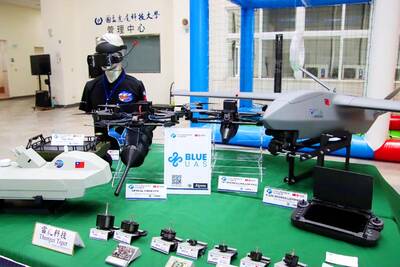
NON-RED SUPPLY: Boosting the nation’s drone industry is becoming increasingly urgent as China’s UAV dominance could become an issue in a crisis, an analyst said Taiwan’s drone exports to Europe grew 41.7-fold from 2024 to last year, with demand from Ukraine’s fight against Russian aggression the most likely driver of growth, a study showed. The Institute for Democracy, Society and Emerging Technology (DSET) in a statement on Wednesday said it found that many of Taiwan’s uncrewed aerial vehicle (UAV) sales were from Poland and the Czech Republic. These countries likely transferred the drones to Ukraine to aid it in its fight against the Russian invasion that started in 2022, it said. Despite the gains, Taiwan is not the dominant drone exporter to these markets, ranking second and fourth


 RSS
RSS