

Satellite imagery from Formosat-5 showed the extent of damage resulting from Wednesday’s earthquake, which measured 7.2 on the Richter scale and magnitude 7.4 on the moment magnitude scale, with experts saying that the contrast of images taken before and after the earthquake could help with the disaster relief effort.
Experts added that rain from an incoming front yesterday would affect the already loosened soil caused by landslides and warned rescue teams to be careful onsite.
Taiwan Space Agency Formosat-5 Project head Chang Li-hsueh (張莉雪) said yesterday the agency had considered using satellite imagery, adding that it was fortunate that the satellite orbited over Taiwan three hours after the earthquake struck.
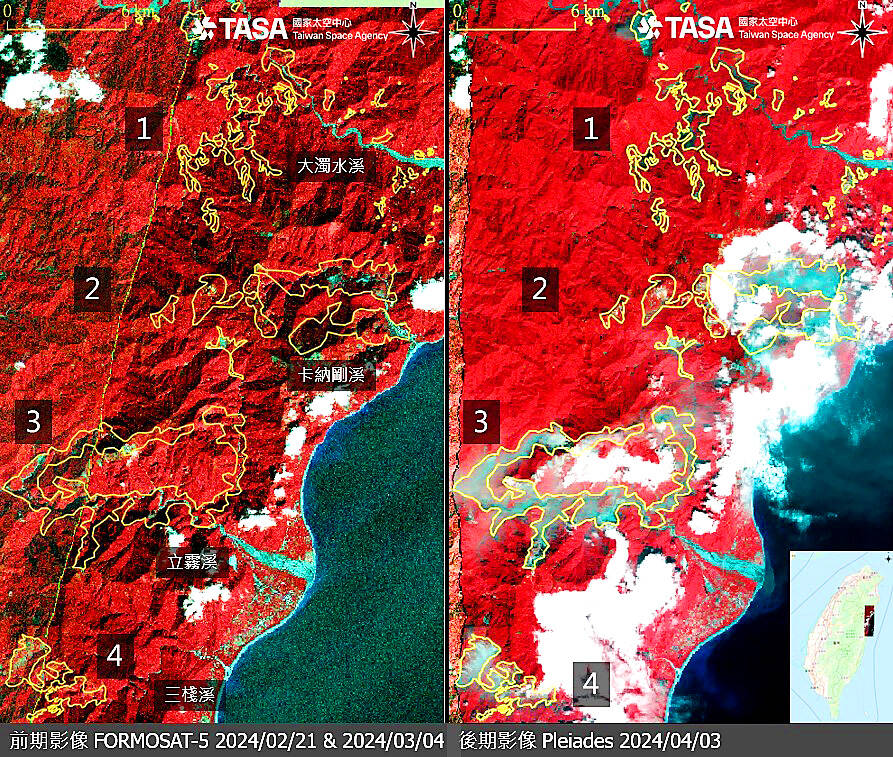
Photo courtesy of the Taiwan Space Agency
As the satellite could only take snapshots of areas up to 24km, the agency had reset the mission parameters for the satellite so that the satellite would prioritize taking imagery of eastern Taiwan, she said, adding that the parameter reset had been completed six minutes before the satellite passed over Taiwan.
The agency contrasted the photos taken on the day from Formosat-5 with those taken by the Pleiades satellite, also taken on the day, provided by the National Central University, and pre-earthquake imagery taken by Formosat-5 on Feb. 21 and March 4, with multiple sites of suspected landslides on the upstream areas in the mountainous regions of Hualien County, Chang said, adding that the head of Gueishan Island (龜山島) had also shown signs of a landslide.
Further statistical analyses conducted on Thursday, contrasted with imagery taken in February, showed distinctive geological changes in the mountain regions near Hualien County’s Sioulin Township (秀林), with about 20.6 square kilometers experiencing landslides.
Areas affected include the Nansi Dam (南溪壩), upstream of Jhuoshuei River (濁水溪), Chang said, adding that satellite imagery showed a vast dust cloud upstream of Qnragan Rikver (卡那岡溪), Liwu River (立霧溪) and Sanchan River (三棧溪), which large-scale landslides could cause, Chang said.
Further imagery taken by Formosat-5 on April 5 confirmed large landslide areas in the mountains’ upstream regions, she added.
Additional reporting by Rachel Lin
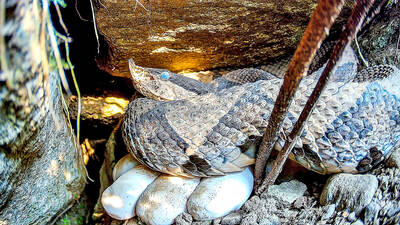
NATURE TAKES ITS COURSE: The agency’s head said he felt a sense of loss watching red-banded snakes eat the babies, as they had decided on non-intervention The Forestry and Nature Conservation Agency yesterday released a documentary on a hundred-pace viper that had incubated 16 eggs, all of which hatched, but only a baby viper escaped after they were attacked by red-banded snakes. The agency’s Taichung branch last year launched the viper reproduction monitoring project soon after forest rangers Lin Chun-yu (林俊佑) and Chou Chia-cheng (周家成) spotted a pregnant hundred-pace viper in a grass-covered burrow near a parking lot in Tbulan Village (松鶴部落). The Atayal village, in Taichung’s Heping District (和平), is headed by Ecyang Yapu, who was positive about the project and assisted in access control and power

The Coast Guard Administration (CGA) yesterday said that it had deployed vessels to “monitor” Chinese ships operating in waters off the east coast. The CGA said it dispatched vessels in response to a China Coast Guard announcement that it had carried out another “routine law-enforcement patrol” in waters off the east coast. “The CGA firmly rejects China’s cognitive warfare campaign of ‘law enforcement in name, jurisdictional expansion in practice,’” it said on X. As of 11am yesterday, two China Coast Guard ships were “loitering and drifting” about 105 nautical miles (195km) and 74 nautical miles east of Green Island (綠島) respectively, it said. It
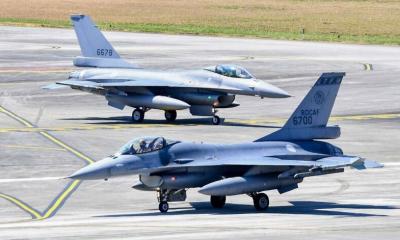
The first two F-16V Block 70 jets Taiwan purchased from the US were spotted unexpectedly turning back after departing from Hawaii yesterday, potentially further delaying delivery of the aircraft. Taiwan has purchased 66 of the F-16 C/D Block 70 jets to be deployed at Chihhang Air Base (志航基地) in Taitung County and operated by the air force's 7th Tactical Fighter Wing to defend Taiwan’s eastern region. Two single-seat jets, bearing serial No. 6727 and 6728, were spotted taking off from Hickam Field in Hawaii yesterday, observers said. Based on the precedent set during the delivery of Taiwan's older F-16 Block 20s, the new
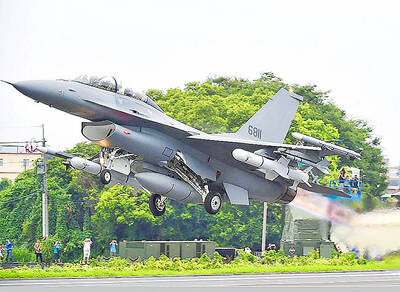
A sharp rise in compensation to be paid by air force officers who leave before completing their required service could indicate an increase in pilots leaving the military early, an analyst said on Friday, warning that the trend could worsen a shortage of experienced personnel. Chieh Chung (揭仲), a researcher at the Association for Strategic Foresight, issued the warning even though the number of volunteer military personnel is expected to increase next year. The planned headcount for volunteer military personnel, covering officers, noncommissioned officers (NCO) and enlisted soldiers, is 158,223 for next year, up 4,258 from 153,965 this year, Chieh said. The increase


 RSS
RSS